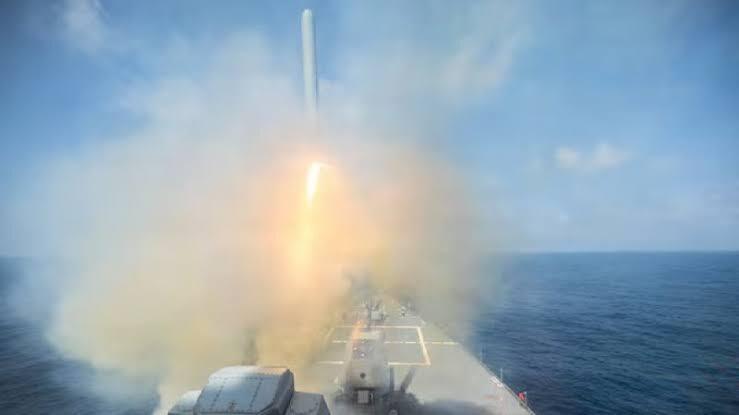
Acting Navy secretary says the service recoded and fired munitions he called expired during the Iran war
Hung Cao told senators the Navy recoded and fired munitions coded unserviceable—codes he called expired—during Operation Epic Fury. The codes mean repairable, not condemned, and he did not name the weapons or the quantities.
Documented: On November 17, 2026, acting Navy Secretary Hung Cao told the Senate Armed Services Committee, during a hearing on his nomination to become Navy secretary, that a lot of the munitions used in Operation Epic Fury had been recoded and fired after carrying condition codes he described as expired. His words, reported by Navy Times, Business Insider, and CNBC: “They were code echo, code foxtrot, which means they’re expired.” He then compared the practice to reviving stale bread—“You just rub some water on it, microwave it for 15 seconds and it’s good to go”—and said the service was “able to shoot off the expired munitions.” The exchange came in answer to Sen. Deb Fischer, who asked whether the Navy was balancing expensive precision weapons against cheaper mass-produced ones. Cao also said the war was stressing naval resources and that Tomahawk production had risen from about 125 a year when he was in uniform to more than 60 a month.
What the codes actually mean is narrower than the bread line suggests. Defense Logistics Agency supply-condition guidance defines code E as unserviceable but restorable with limited effort at the storage site, and code F as unserviceable but economically reparable through repair, overhaul, or reconditioning. Condemned shelf-life material that has passed an expiration date and cannot be extended is a different code, H. Navy Times and Business Insider both note that E and F mark materiel that is currently unserviceable but able to be fixed. Cao did not identify the weapons, say how many were recoded, describe the inspection, or say what code they received afterward. The Navy did not immediately say whether the practice was ongoing.
Claimed, not independently verified in the public record of the hearing: that these rounds were “expired” in the ordinary sense of past a hard shelf life, and that recoding restored them to reliable use. That is Cao’s characterization. Kelly Grieco of the Stimson Center, quoted by Navy Times, compared the idea to pharmaceuticals past a labeled date whose efficacy may still hold—if, hypothetically, inspectors check for cracks or defects, mechanical function, and whether the munition can still detonate. That review process was not described in the testimony.
The stockpile context is documented separately and is the reason the remark matters more than the metaphor. Navy Times cites a March Washington Post report that the U.S. had fired at least 850 Tomahawk missiles in the first month of Operation Epic Fury, and a Center for Strategic and International Studies estimate that about 3,000 remained at that point, with co-author Marc Cancian saying replacement of the 850 could take two to three years. In August the Pentagon awarded Raytheon a seven-year, $22.9 billion contract aimed at lifting Tomahawk output toward more than 1,000 a year; at the time of that reporting Raytheon was making about 60 a year. Cao did not say the recoded rounds were Tomahawks. Some secondary accounts have asserted they were; that identification is not in the quoted testimony.
Speculated, and not established by the hearing: that the Navy knowingly fired defective missiles, that the bread analogy describes the engineering standard, or that the episode by itself proves a collapse in readiness. What is on the record is an acting service secretary, under questioning about precision-munition expenditure, volunteering that previously unserviceable stock was recoded and used, while production is being scaled because the Iran campaign has drawn down inventories that were already tight for a larger war.
Sailors, planners, and taxpayers are affected because an acting Navy secretary told Congress that previously unserviceable munitions were put back into use while the Iran war was drawing down stocks that take years to replace. The hearing left open which weapons, how many, and what inspection standard was applied.
Sources (4)
- [1]US Navy used expired munitions during Iran war, Cao says(https://www.navytimes.com/news/2026/11/18/us-navy-used-expired-munitions-during-iran-war-cao-says/)
- [2]Navy Fired Expired Munitions During Iran War, Acting Secretary Says(https://www.businessinsider.com/navy-fired-expired-munitions-during-iran-war-acting-secretary-says-2026-11)
- [3]U.S. Navy used expired munitions as Iran war strains resources(https://www.cnbc.com/2026/11/18/us-iran-navy-hormuz-war-cao.html)
- [4]DLA Disposition Services condition codes(https://www.dla.mil/Disposition-Services/DDSR/Quick-Links/Condition-Codes/)