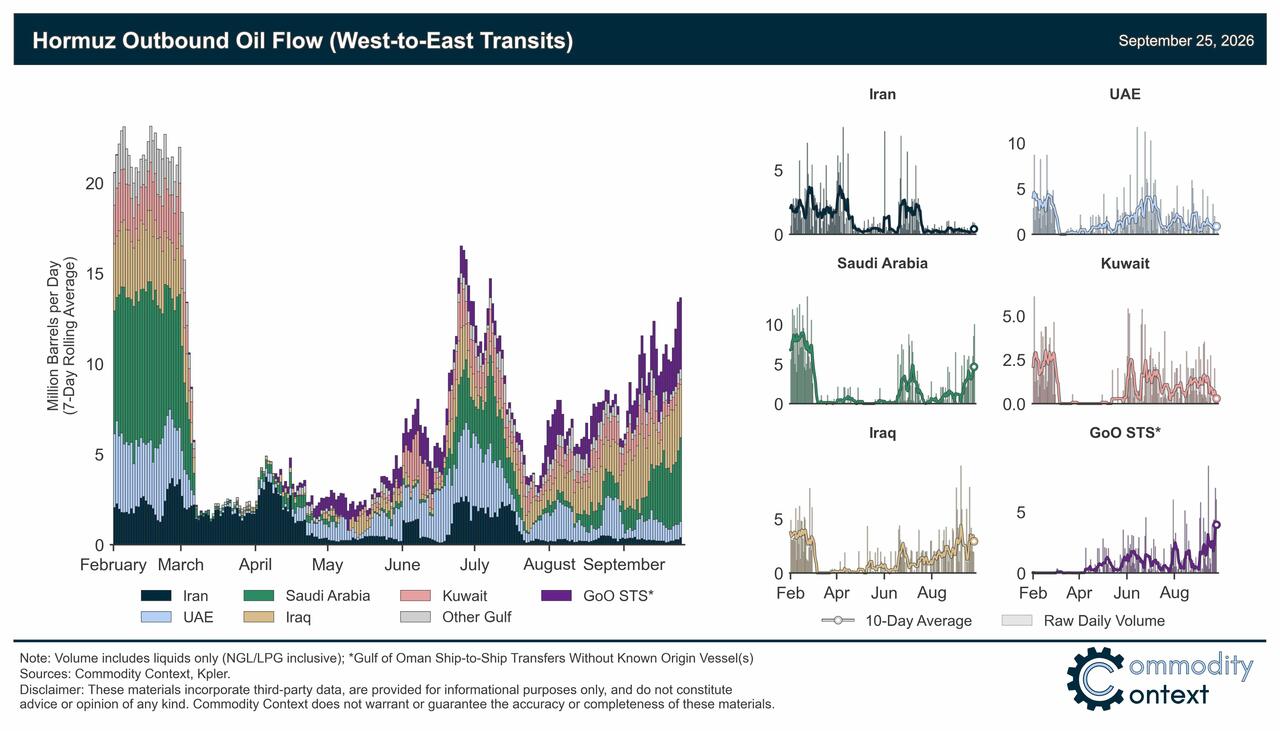
Hormuz Oil Flows Recover to Over Two-Thirds Pre-War Levels Amid Saudi Export Surge, Eroding Iranian Leverage
Partial recovery of Hormuz oil flows to ~13.5+ MMb/d (2/3 pre-war) via Saudi and Qatar activity erodes Iran's blockade leverage, even as attacks continue and diplomacy stalls; corroborated by Kpler, Bloomberg, and analyst reports.
Oil shipments through the Strait of Hormuz have rebounded significantly, reaching a seven-day average above 13.5 million barrels per day according to tanker-tracking data from Kpler analyzed by Commodity Context's Rory Johnston. This represents roughly two-thirds of pre-war levels of around 20 million barrels per day, driven primarily by a surge in Saudi Arabian crude loadings from Gulf ports. Saudi exports averaged 5.28 million barrels per day in the first 23 days of September—the strongest pace since the conflict began—per Bloomberg ship-tracking data, with Kpler estimates even higher at 6.27 million barrels per day through September 24.[1][2]
Energy analyst Art Berman noted that "Hormuz is no longer behaving like a chokepoint under effective Iranian control," emphasizing that while Iran can still attack ships and raise insurance costs, increased flows shift its leverage from outright blockage to mere cost imposition. Qatar has also increased LNG tanker traffic through the strait to the highest levels in more than two months, signaling greater comfort with the route amid global supply pressures.[3]
Despite these gains, hostilities persist. Iranian state-linked reports indicate attacks on shipping, though independent verification of specific claims like 19 vessels targeted over 48 hours remains limited to Iranian sources. Broader context from U.S. Central Command and shipping data shows ongoing risks, with flows occurring via escorted or "dark" routes. Saudi Arabia's shift back to Gulf loadings followed damage to its East-West pipeline earlier in the month.[4]
U.S. President Trump publicly rejected an Iranian-proposed seven-day ceasefire, stating openness to further actions post-midterms while mediators like Qatar and Pakistan continued diplomatic efforts. Oil prices have remained elevated near or above $100 per barrel, reflecting the partial recovery and persistent global refining strains. The recovery highlights how Gulf producers are adapting to risks, but full normalization depends on sustained de-escalation.
Energy analysts: Partial Hormuz recovery eases immediate supply panic but sustains price pressure near $100/bbl through winter due to pipeline outages and refining bottlenecks; post-midterm U.S. policy shifts could either accelerate flows or trigger new disruptions.
Sources (4)
- [1]Iran's grip on Hormuz slips as oil flows top 13.5mn b/d(https://www.intellinews.com/iran-s-grip-on-hormuz-slips-as-oil-flows-top-13-5mn-b-d-471293/)
- [2]Saudi Arabia oil exports hit highest level since Iran war began(https://www.cnbc.com/2026/09/25/saudi-arabia-oil-iran-war-pipeline-strait-hormuz-red-sea-houthis.html)
- [3]Qatar Boosts LNG Traffic Via Hormuz as Global Shortage Bites(https://www.bloomberg.com/news/articles/2026-09-24/qatar-boosts-lng-traffic-through-hormuz-as-global-shortage-bites)
- [4]كبلر: صادرات نفط السعودية تقترب من مستويات ما قبل الحرب في سبتمبر(https://asharqbusiness.com/power/149173/%D9%83%D8%A8%D9%84%D8%B1-%D8%B5%D8%A7%D8%AF%D8%B1%D8%A7%D8%AA-%D9%86%D9%81%D8%B7-%D8%A7%D9%84%D8%B3%D8%B9%D9%88%D8%AF%D9%8A%D8%A9-%D9%81%D9%8A-%D8%B3%D8%A8%D8%AA%D9%85%D8%A8%D8%B1-%D8%A7%D9%84%D8%A3%D8%B9%D9%84%D9%89-%D9%85%D9%86%D8%B0-%D8%A7%D9%86%D8%AF%D9%84%D8%A7%D8%B9-%D8%A7%D9%84%D8%AD%D8%B1%D8%A8/)