New York’s $310 billion pension is weighing a roughly $4 billion collateralized fund obligation backed by private credit stakes
Reports citing Bloomberg say New York’s roughly $310 billion Common Retirement Fund is considering a ~$4 billion CFO against private-credit fund stakes, including Blue Owl and Blackstone vehicles, while keeping the first-loss equity. The deal is unconfirmed by the pension. CFOs are a documented, fast-growing liquidity tool; private-credit redemption pressure at Blue Owl is also documented. Whether the structure threatens retiree benefits is an inference, not a recorded loss.
Documented: Secondary reports citing Bloomberg say the New York State Common Retirement Fund, which oversees about $310 billion, is considering a collateralized fund obligation of roughly $4 billion backed by stakes in about 20 private credit funds managed by firms including Blackstone, Blue Owl, Sixth Street, PIMCO and Ares. The reports say the pension has discussed the idea with some managers and that buyers would need access to fund information. They also say the transaction could still fall apart and that the fund lineup is not final. Everyone involved, according to those accounts, declined to comment. The pension itself has not issued a public confirmation.
Documented structure, as described in those reports: the pension would place fund interests in a vehicle that issues rated debt against expected distributions. One debt tranche would be sold; the pension would keep a riskier equity tranche. Cash from the underlying funds would pay debt holders first. If distributions slow, values fall, or stakes are sold at a discount, the equity slice absorbs losses first. That is the standard CFO waterfall, not a novel invention of this deal.
Documented context, separate from the specific transaction: New York Common held about $309.7 billion at the end of June 2026 and serves more than one million members, retirees and beneficiaries, according to reporting based on the State Comptroller’s releases. On March 31, 2026, credit, absolute return and opportunistic strategies were about 9.1 percent of assets, with private equity and real estate/real assets each about 14.3 percent. The fund has an established relationship with Blue Owl and Blackstone; official transaction reports show multi-hundred-million-dollar commitments to Blue Owl real estate vehicles and prior credit and private equity allocations to Blackstone strategies.
Documented market backdrop: CFOs are no longer a niche footnote. Evercore told Bloomberg in May 2026 that debt tied to private fund stakes could reach about $30 billion of new volume in 2026, up roughly 50 percent from the prior year, as managers and investors look for liquidity without secondary sales. KBRA’s Thomas Speller told Alternative Credit Investor in November 2026 that the agency had already surpassed about $27 billion of CFO volume rated in 2025, and that the buyer base—still dominated by insurers—was broadening toward other insurers, pensions and sovereign funds. Dechert’s 2026 fund-finance survey describes CFOs as an alternative to secondary sales of limited-partnership interests, driven by regulated buyers who want rated exposure to private funds and by sponsors who want liquidity without a mark from a secondary buyer.
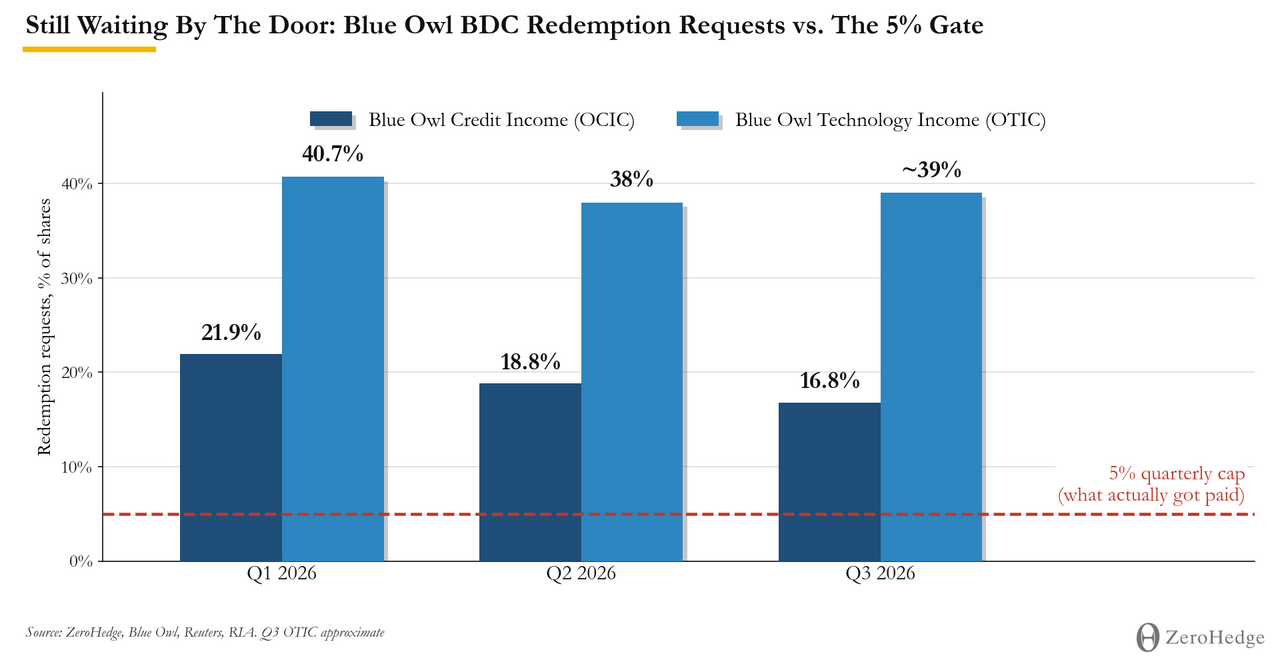
Documented stress on the private-credit side: Blue Owl’s non-traded credit vehicles spent 2026 under heavy redemption pressure. Investors asked to pull about $5.4 billion from Blue Owl’s two largest non-traded credit funds in the first quarter, $4.7 billion in the second and $4.2 billion in the third, with most later requests described as resubmissions of unfilled tenders. Quarterly caps generally limit payouts to about 5 percent of shares. Blue Owl Technology Income Corp. saw requests near 39 percent of shares in the third quarter while still paying only the cap. Separately, Bloomberg reported in February 2026 that Blue Owl sold a $1.4 billion loan portfolio at 99.7 percent of par to large pensions and an affiliated insurance manager to help meet cash needs. Listed sibling OBDC has traded at a clear discount to reported NAV—about 77 cents on the dollar in mid-November 2026, according to market commentary citing the company’s September NAV.
Claimed, not independently confirmed here: that this specific CFO is one of the largest of its kind; that it is rare because CFOs have mostly been sponsored by alternative managers rather than by limited partners; and that the pension’s retained equity is meant to align incentives for debt buyers. Those points come from people familiar with the matter as relayed by Bloomberg and repeated by GuruFocus and Traders Union. They are plausible given how CFOs are usually structured, but they are not on the public record from the Comptroller’s office.
Speculated, and should stay labeled as such: that this structure is a pre-2008-style leverage cycle that will impair New York retirees. What is documented is narrower. A CFO lets an LP raise cash against illiquid fund stakes without a secondary sale that would force a discount and a mark. The pension, if the reported terms hold, would keep first-loss exposure to the same private-credit book. Many underlying private-credit funds already use subscription lines or NAV facilities, so a CFO can sit on top of fund-level borrowing. That is leverage against assets whose cash flows and marks are hard for outsiders to observe. It is not, on the public record, a completed default, a hidden loss, or proof that benefits will be cut. The systemic reading—that opacity plus stacked leverage in a less regulated credit market concentrates risk in retirement systems and in the insurers that buy the senior paper—is an inference from the structure and the redemption data, not a finding the pension or the rating agencies have published.
The transition worth watching is institutional, not rhetorical. CFOs and rated note feeders have moved from GP balance-sheet tools into a market large enough for Evercore and KBRA to treat as a volume story, and a top-tier public pension is now reported to be considering one as an LP. That is a shift from “managers engineer liquidity” to “the retirement system itself engineers liquidity against the same illiquid book,” while retail and institutional investors in evergreen private credit are still queued behind 5 percent gates.
More than a million New York public workers and retirees depend on this fund, and the reported deal would raise cash today while leaving the pension with the first-loss slice of hard-to-value private credit. Insurers that buy the senior paper would be taking the other side of the same illiquid book.
Sources (8)
- [1]New York State Retirement Fund Eyes $4B Private Credit CFO Including Blue Owl Capital(https://www.gurufocus.com/news/9217738/new-york-state-retirement-fund-eyes-4b-private-credit-cfo-including-blue-owl-capital-owl)
- [2]New York pension weighs private credit CFO deal(https://alpha-maven.com/story/private-credit/new-york-pension-weighs-private-credit-cfo-deal-traders-union)
- [3]Evercore Sees Once-Niche Fund-Stake Debt Surging to $30 Billion(https://www.bloomberg.com/news/articles/2026-05-21/debt-tied-to-fund-stakes-may-surge-to-30-billion-evercore-says)
- [4]Insurers drive RNF, CFO surge(https://alternativecreditinvestor.com/2026/11/23/insurers-drive-rnf-cfo-surge/)
- [5]Collateralised Fund Obligations – GLI Pink Book 2026(https://www.dechert.com/knowledge/publication/latest-chapter-in-the-gli-pink-book.html)
- [6]New York State Common Retirement Fund: $310B AUM(https://pipelineroad.com/directory/ny-common)
- [7]Blue Owl Sold Loans to Pensions, Own Insurance Asset Manager(https://www.bloomberg.com/news/articles/2026-02-20/blue-owl-sold-private-loans-to-pension-giants-and-own-insurer)
- [8]Investors Asked to Pull 39% of Blue Owl's Tech Lending Fund. It Will Pay Out 5%.(https://cranberryjournal.com/markets/five-per-cent-of-thirty-nine/)