Continental Drying: How Permadrought Endangers 6 Billion People, Global Food Chains, and Future Stability
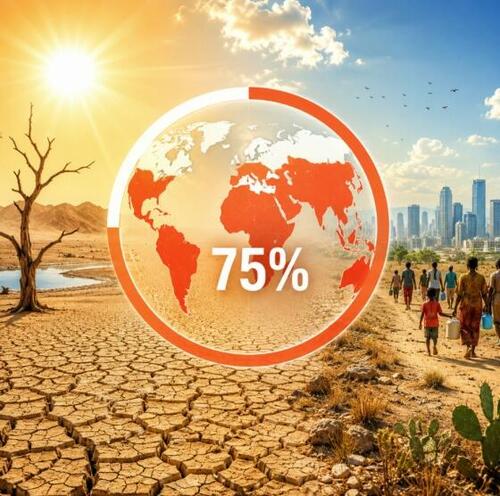
Peer-reviewed research and UN data confirm 75% of humanity faces net freshwater decline from continental drying and aquifer depletion, threatening agriculture, triggering migration, and risking supply chain breakdowns and conflict on a global scale.
A landmark 2025 study published in Science Advances reveals that the planet is undergoing unprecedented 'continental drying,' with profound implications that extend far beyond isolated droughts. Using over two decades of data from NASA's GRACE and GRACE-FO satellites, researchers documented a net loss of terrestrial water storage—including lakes, rivers, soil moisture, snow, and aquifers—across vast regions. The findings confirm that since 2002, 101 countries containing roughly 75% of the global population (nearly 6 billion people) have experienced a sustained decline in freshwater supply.[1][2]
This 'mega-drying' is not uniform: four major continental-scale zones have emerged, primarily in the Northern Hemisphere across western North America, the Mediterranean/Middle East, Central America, and parts of Asia. Drying areas are expanding by an area equivalent to twice the size of California each year, while wetting regions are shrinking. Groundwater extraction now accounts for approximately 68% of freshwater losses in populated, non-glacial latitudes, driven by intensified agricultural pumping during climate-amplified droughts. Aquifers refill over millennia, rendering much of this loss effectively permanent on human timescales.[2]
These trends align with a 2024 UNCCD-linked report warning that drylands now comprise over 40% of global land (excluding Antarctica), with more than three-quarters of the planet's land surface becoming drier over the past three decades. The population living in drylands has doubled to 2.3 billion in 30 years and could reach 5 billion by 2100 under high-emission scenarios.[3]
The slow-moving crisis carries under-reported cascading effects. Agriculture consumes about 70% of global freshwater; as surface water vanishes, reliance on depleting aquifers threatens staple crop production, as seen in current U.S. wheat challenges amid widespread 2026 drought covering over 60% of the continental United States. This portends higher food prices, disrupted global supply chains for grains and water-intensive goods, and potential widespread famines if trends persist.[4]
Connections to human mobility and security are particularly stark yet often quantified separately. Climate-driven water scarcity and food insecurity have already triggered displacement in regions like the Horn of Africa and Central America's Dry Corridor, where droughts destroy livelihoods and spur migration toward more stable environments. The Science Advances authors and related analyses warn of 'potentially staggering' migration, heightened conflict over remaining resources, and 'cascading risks for global order' as drying compounds with sea-level rise from land-based water contributions now outpacing some glacial melt.[2][5]
World Bank assessments on continental drying further highlight disruptions to jobs, incomes, and ecosystems, framing it as a systemic threat to economic stability. Unlike sudden disasters, this permadrought unfolds gradually, allowing vested interests in groundwater overuse to delay systemic adaptation. Without aggressive recharge efforts, efficiency gains, and international cooperation on water management, the intersection of drying continents, supply-chain fragility, and migration pressures could redefine geopolitics in the coming decades. The data demands viewing water not as a local issue but as a foundational driver of 21st-century instability.
LIMINAL: Permadrought will compound into supply-chain failures in agriculture and water-intensive industries, driving mass climate migration and resource conflicts that overwhelm current global governance by the 2030s.
Sources (5)
- [1]Unprecedented continental drying, shrinking freshwater availability, and increasing land contributions to sea level rise(https://www.science.org/doi/10.1126/sciadv.adx0298)
- [2]8 Things to Know About New Research on Earth’s Rapid Drying and the Loss of Its Groundwater(https://www.propublica.org/article/groundwater-fresh-water-depletion-research-science-advances-takeaways)
- [3]New global study shows freshwater is disappearing at alarming rates(https://news.asu.edu/20250725-environment-and-sustainability-new-global-study-shows-freshwater-disappearing-alarming)
- [4]More than 40% of World's Land Now Permanently Dry, UN Report Warns(https://earth.org/more-than-40-of-worlds-land-now-permanently-dry-un-report-warns/)
- [5]The Drying Planet(https://www.circleofblue.org/2025/water-climate/climate-change/the-drying-planet/)