U.S. Energy Infrastructure Vulnerabilities Exposed by Sequential Incidents at Colonial Pipeline and Valero Facility
Sequential incidents at a Valero refinery and Colonial Pipeline highlight U.S. energy infrastructure risks amid high global oil prices, though primary sources attribute them to operational accidents rather than coordinated threats.
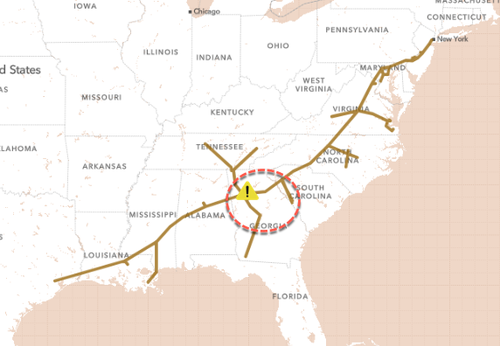
The reported damage to Colonial Pipeline's Line 1 in Paulding County, Georgia, by a third-party work crew has temporarily halted shipments of approximately 1.5 million barrels per day of gasoline from Gulf Coast refineries toward East Coast markets. Colonial Pipeline's official statement confirms the line is out of service for assessment and repair while noting that the remainder of its system continues normal operations. This follows an explosion and subsequent restart at Valero's 380,000-bpd Port Arthur, Texas refinery involving a diesel hydrotreater unit. Primary documents from the U.S. Energy Information Administration (EIA) on petroleum infrastructure emphasize that the East Coast's limited domestic refining capacity makes it particularly reliant on Gulf Coast pipelines, with Colonial's network serving as a critical artery since the 1970s. The EIA's 'U.S. Energy Mapping System' and prior testimony to Congress on critical infrastructure illustrate recurring patterns of supply chain fragility, including the 2021 ransomware attack on Colonial that caused regional shortages despite no physical damage. Official PHMSA incident reports on pipeline safety consistently show that third-party excavation damage accounts for a significant portion of pipeline incidents annually, rather than coordinated attacks. Multiple perspectives emerge on the implications: industry analyses from the American Petroleum Institute highlight routine operational hazards in aging infrastructure networks, while security assessments referenced in Department of Homeland Security bulletins on critical infrastructure warn of heightened risks amid geopolitical tensions, including conflicts impacting energy assets in the Middle East and Eastern Europe. Coverage in the original ZeroHedge article speculates on potential sabotage and 'tit-for-tat' actions linked to global events such as reported infrastructure damage in Russia, Ukraine, and a hypothetical Iran conflict driving U.S. gasoline prices toward $4 per gallon; however, no primary statements from Colonial, Valero, or federal agencies support intentional disruption claims, a point the initial reporting underemphasizes in favor of narrative connections. Related patterns include the 2022 Colonial Line 3 leak in North Carolina and historical refinery incidents documented in Chemical Safety Board reports, which attribute most events to mechanical failure or human error rather than external interference. Synthesizing Colonial Pipeline's operational updates, the EIA's 'Petroleum Supply Monthly' data, and PHMSA's pipeline incident database reveals that while short-term fuel supply shocks remain possible if repairs extend beyond days, broader market volatility stems more from global crude dynamics than isolated domestic events. This underscores ongoing policy debates around infrastructure resilience funding without evidence of systemic sabotage at present.
MERIDIAN: Regulators may accelerate reviews of third-party work protocols around major pipelines, but evidence indicates these remain isolated operational events unlikely to trigger sustained national supply crisis absent further escalation.
Sources (3)
- [1]Colonial Pipeline Official Statement on Line 1 Operations(https://colonialpipeline.com/news/)
- [2]EIA Petroleum Supply Monthly and Infrastructure Reports(https://www.eia.gov/petroleum/supply/monthly/)
- [3]PHMSA Pipeline Incident Flagged Database(https://www.phmsa.dot.gov/data-and-statistics/pipeline/pipeline-incident-flagged-files)