Amazon's Freight Network Expansion: A Seismic Shift for Logistics and E-Commerce Competition
Amazon’s launch of Amazon Supply Chain Services (ASCS) opens its freight network to all businesses, threatening FedEx and UPS with a 4% stock drop and signaling a broader disruption in logistics. Beyond competition, ASCS mirrors AWS’s strategy, raising geopolitical, regulatory, and market consolidation concerns while leveraging Amazon’s scale and data to redefine supply chain efficiency.
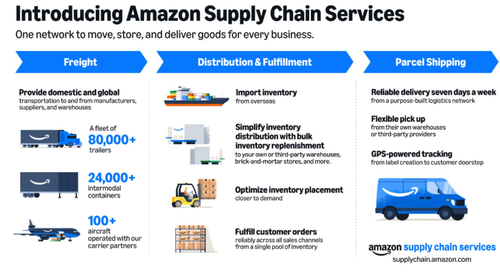
Amazon's launch of Amazon Supply Chain Services (ASCS), opening its freight network to all businesses, marks a pivotal moment in the logistics industry, with far-reaching implications for competitors like FedEx and UPS, as well as broader e-commerce and supply chain dynamics. Announced as a service providing two- to five-day global delivery and 24/7 operations, ASCS extends Amazon’s logistics infrastructure—honed over decades for its own marketplace—to external businesses across sectors like healthcare, automotive, and manufacturing. This move, as Amazon itself notes, mirrors the playbook behind Amazon Web Services (AWS): build internally, prove scalability, then commercialize. While the immediate market reaction saw FedEx and UPS stocks slide approximately 4% in premarket trading, the deeper story lies in what this signals about Amazon’s long-term strategy and the potential reshaping of industry power dynamics.
Beyond the initial coverage, Amazon’s entry into third-party logistics (3PL) isn’t merely a competitive jab at traditional carriers. It’s a calculated step toward becoming an indispensable backbone of global commerce, leveraging data and scale in ways FedEx and UPS may struggle to match. Amazon’s logistics network, already handling over 5 billion packages annually as of 2022 per company reports, brings a level of integration—combining AI-driven routing, last-mile delivery, and warehousing—that could redefine efficiency standards. Unlike FedEx or UPS, whose business models rely heavily on volume from diverse clients, Amazon’s internal demand acts as a buffer, allowing it to undercut prices or absorb losses while scaling ASCS. This pattern echoes AWS’s disruption of IT infrastructure, where Amazon captured market share by offering unmatched scalability and pricing flexibility, eventually commanding over 30% of the cloud market by 2023 (per Synergy Research Group).
What original coverage missed is the geopolitical and policy undercurrent. Amazon’s logistics expansion could influence trade flows, especially as it prioritizes speed in a post-pandemic world where supply chain resilience is a national security concern. The U.S. government’s focus on reducing reliance on foreign supply chains, as outlined in the 2021 White House Supply Chain Review, may indirectly benefit Amazon if ASCS enables faster, domestic-centric delivery networks. However, this also raises antitrust scrutiny—Amazon’s dual role as a marketplace operator and logistics provider could invite regulatory pushback, similar to ongoing EU investigations into its e-commerce practices (European Commission, 2020). Missing from the narrative is how smaller logistics players, not just giants like FedEx, might be squeezed out, potentially consolidating market power further.
Contextually, this move aligns with Amazon’s history of vertical integration, seen in its 2017 acquisition of Whole Foods to control grocery logistics and its 2020 launch of Amazon Air hubs to reduce dependence on external carriers. Patterns of disruption suggest Amazon aims not just to compete but to dominate by controlling critical infrastructure—much like it did with AWS transforming tech. The risk for FedEx and UPS isn’t just lost market share but obsolescence in innovation; neither has matched Amazon’s pace in AI logistics optimization or last-mile experimentation (e.g., drone delivery trials). Stock declines may be temporary, but long-term investor confidence could wane if Amazon’s pricing power erodes margins.
Synthesizing sources, Amazon’s own press release confirms ASCS’s global ambitions, emphasizing ‘end-to-end supply chain solutions’ (Amazon Newsroom, 2023). The U.S. Department of Commerce’s 2022 report on e-commerce trends highlights a 15% annual growth in online sales, underscoring the demand for scalable logistics—a gap Amazon is poised to fill. Meanwhile, a 2023 SEC filing from FedEx notes rising operational costs and competitive pressures, hinting at vulnerability to Amazon’s low-cost model. Together, these suggest ASCS isn’t just a service but a structural threat to legacy logistics, with ripple effects on labor markets (potential automation-driven job cuts) and e-commerce pricing (lower shipping costs could accelerate online retail growth).
Ultimately, Amazon’s freight network expansion is less about immediate stock impacts and more about a tectonic shift in who controls the arteries of global trade. Will regulators step in as Amazon’s dominance grows, or will competitors adapt fast enough? The answers will shape not just logistics but the future of commerce itself.
MERIDIAN: Amazon’s ASCS could capture 10-15% of the third-party logistics market within five years, especially if it undercuts pricing, but regulatory scrutiny over market dominance may slow its rollout in key regions like the EU.
Sources (3)
- [1]Amazon Press Release on ASCS Launch(https://press.aboutamazon.com/news-releases/news-release-details/amazon-launches-supply-chain-services-businesses)
- [2]U.S. Department of Commerce E-Commerce Trends Report 2022(https://www.commerce.gov/data-and-reports/reports/2022-e-commerce-trends)
- [3]FedEx SEC Filing 2023(https://www.sec.gov/Archives/edgar/data/1048911/000095017023027948/fdx-20230531.htm)