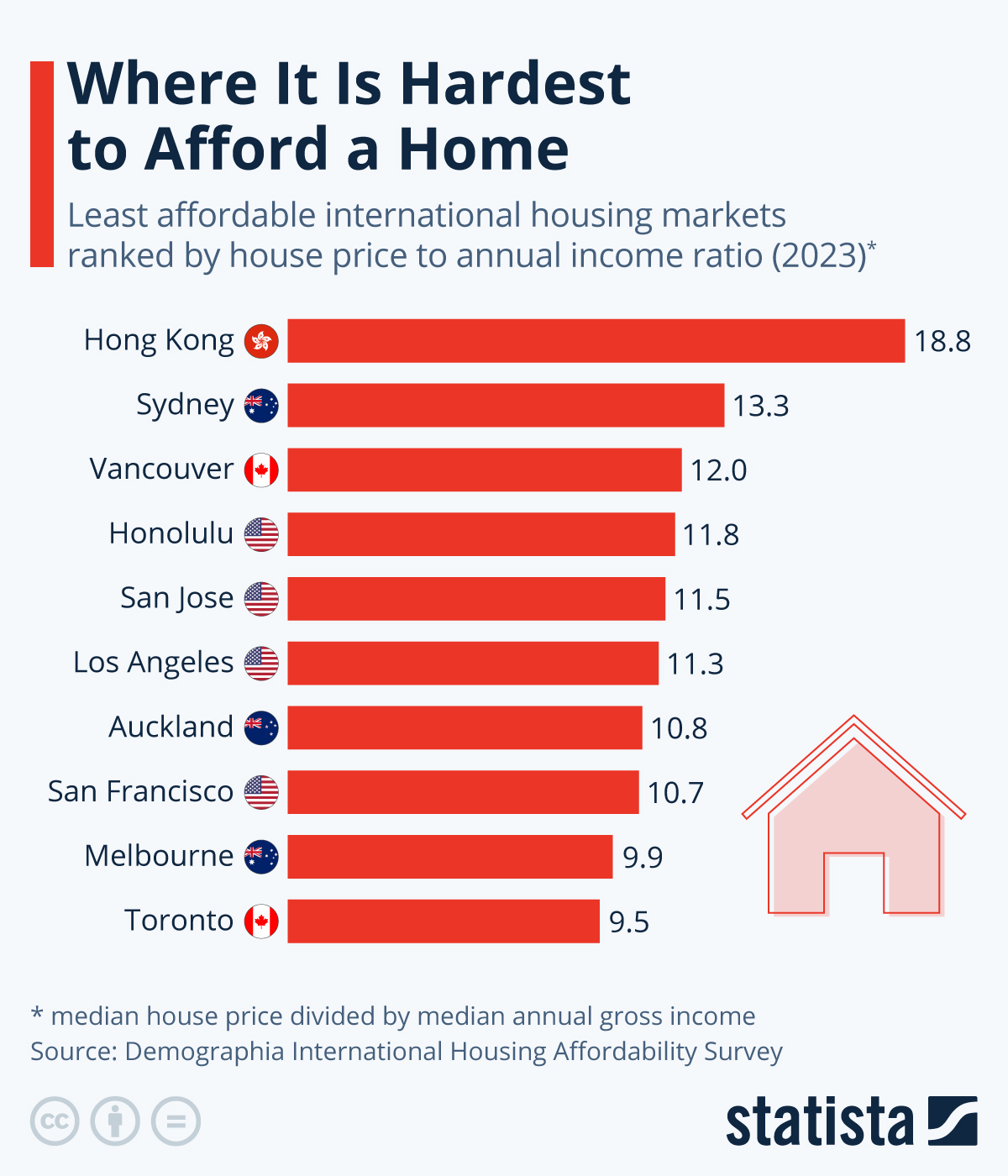
Hong Kong, Sydney Lead Global Housing Crunch as 2026 Data Reveals Price-to-Income Ratios Far Beyond Historic Norms
2026 rankings confirm Hong Kong (16.7x), Sydney (13.8x), and other Pacific Rim and North American cities remain severely unaffordable, with ratios triple historic averages. This locks out younger generations, widens wealth gaps, and influences life decisions from family planning to migration.
Housing affordability has become one of the most tangible pressures shaping daily life, career choices, and family decisions across major global cities. According to a 2026 Forbes ranking highlighted by Statista, Hong Kong tops the list with a median home price-to-income ratio of 16.7, followed by Sydney at 13.8 and Vancouver at 11.8. U.S. tech hubs like San Jose (11.4), Los Angeles (10.9), and Honolulu (10.5) also rank among the least affordable, with London marking Europe's entry at 8.1. These figures, drawn from median prices against pre-tax household incomes for dominant housing types, remain well above the historic norm of around 3.0, despite slight recent easing in some markets.
Corroborating data from Numbeo’s 2026 Property Prices Index shows similarly elevated ratios, with Hong Kong, Sydney, and Vancouver consistently in the severely unaffordable category. The underlying Demographia International Housing Affordability Survey, frequently cited in Forbes and news coverage, has labeled these markets 'impossibly unaffordable' for over a decade. A report from The Standard notes Hong Kong has held the least affordable title for 16 years running, though its ratio has improved from a 2021 peak of 23.2 as prices moderated.
What the raw ratios obscure is the deeper human and societal impact: young adults face years or decades of renting, delaying marriage, children, and wealth-building while older homeowners enjoy windfall gains from asset inflation fueled by post-2008 low rates, foreign investment, restrictive zoning, and supply shortages. In Australia, where five major markets rank in the global top 14 for unaffordability, this has sparked debates over immigration levels, investor taxes, and upzoning resistance from NIMBY homeowners. Similar dynamics in Canada and California link high ratios to out-migration, tech worker burnout, and rising inequality. Concrete numbers like these don’t just spark outrage on social media—they drive real decisions: relocating to affordable mid-tier cities, choosing renter-friendly careers, or giving up on ownership dreams entirely. Without meaningful supply reforms, these trends risk entrenching a permanent renter class and fueling political backlash in cities where shelter consumes an ever-larger share of income.
LIMINAL: Sky-high price-to-income ratios in these cities will accelerate generational wealth transfers to existing homeowners, push more young people toward delayed milestones or relocation, and heighten political pressure for radical housing supply reforms or populist policies.
Sources (4)
- [1]The World's Most Expensive Cities For Housing In 2026, Ranked(https://www.forbes.com.au/covers/magazine/the-worlds-most-expensive-cities-for-housing-in-2026-ranked/)
- [2]HK Remains World's Least Affordable Housing Market For 16th Year(https://www.thestandard.com.hk/property/article/333698/HK-remains-worlds-least-affordable-housing-market-for-16th-year-survey-shows)
- [3]Property Prices Index by City 2026(https://www.numbeo.com/property-investment/rankings.jsp)
- [4]Demographia International Housing Affordability 2025 Edition(https://www.chapman.edu/communication/_files/Demographia-International-Housing-Affordability-2025-Edition.pdf)