Global Internet Traffic Doubles Since 2020, Exposing Underreported Infrastructure Strain and Digital Dependency Risks
ITU-confirmed doubling of global internet traffic since 2020, corroborated by DE-CIX and others, highlights accelerating infrastructure and energy strains from data centers (per IEA and Pew), deepening societal digital dependency with under-discussed surveillance and systemic risk implications.
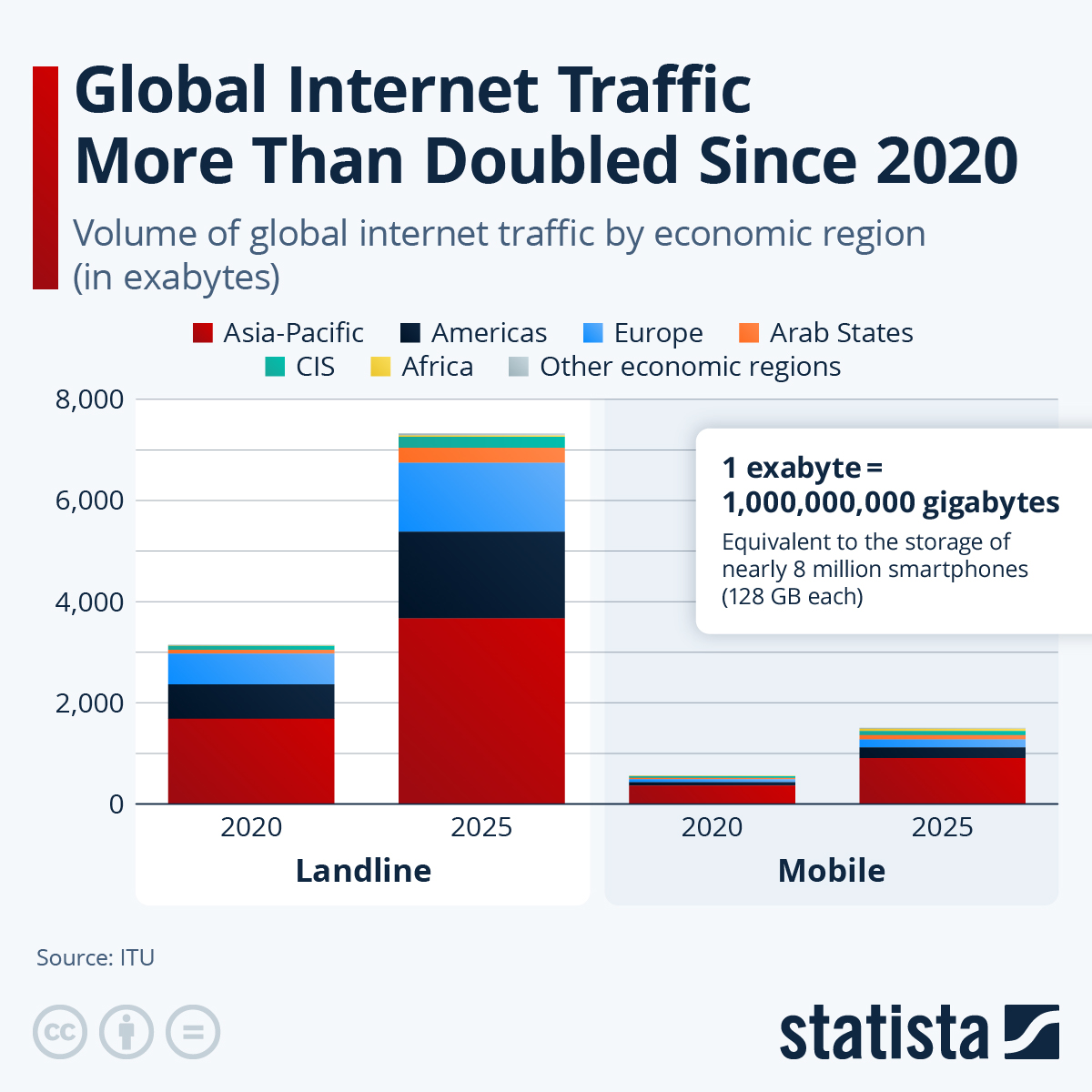
According to data from the International Telecommunication Union (ITU), global internet traffic has more than doubled between 2020 and 2025. Fixed broadband traffic reached 7.3 zettabytes (ZB) in 2025, up significantly from prior levels around 3.1 ZB equivalent in 2020, while mobile broadband traffic hit 1.5 ZB. Asia-Pacific dominates with 50-60% shares, but strong relative growth appears in Africa and the Arab States amid rising connectivity. DE-CIX, a major internet exchange operator, reported 79 exabytes of data exchanged across its platforms in 2025—more than double the 2020 figure—driven by streaming, cloud computing, AI workloads, and connected devices.
This exponential growth, while celebrated for enabling the digital economy, reveals underreported infrastructure strains. The International Energy Agency (IEA) notes that data centers and data transmission networks each accounted for roughly 1-1.5% of global electricity consumption in recent years, with internet traffic having expanded over 600% since 2010 alongside user growth. Efficiency gains have historically masked impacts—Ericsson reports that while data traffic grew roughly 80-fold from 2007 to 2023, ICT sector electricity use rose only 1.4 times. However, the AI boom is changing this dynamic. Pew Research Center analysis shows U.S. data centers consumed 4% of national electricity in 2024 (183 TWh), with projections of more than doubling to 426 TWh by 2030, straining regional grids in areas like Virginia where data centers already dominate local power demand. Lawrence Berkeley National Lab and World Resources Institute reports warn of data centers potentially reaching 6.7-12% of U.S. electricity by 2028, creating concentrated risks of overload, higher costs, and reliability issues.
These patterns underscore broader digital dependency: societies increasingly reliant on always-on infrastructure face systemic fragility. Traffic surges during events like the early COVID-19 lockdowns demonstrated rapid 15-50% jumps that well-provisioned networks absorbed, but sustained growth tied to AI, IoT, and cloud services amplifies vulnerabilities in undersea cables, exchanges, and power systems. Mainstream coverage rarely quantifies the surveillance implications—vast data volumes flowing through centralized chokepoints enable unprecedented monitoring potential by governments and corporations, reinforcing control mechanisms within expanding digital ecosystems. As infrastructure demands accelerate without proportional visibility in policy discourse, the trajectory points to tighter integration between data growth, energy realities, and power concentration.
[LIMINAL]: The doubling of internet traffic is forging unbreakable digital dependency chains that mask grid overload risks and enable mass-scale surveillance through centralized data chokepoints, quietly reshaping power structures while mainstream metrics focus only on growth.
Sources (6)
- [1]ITU Internet Traffic Statistics 2025(https://www.itu.int/itu-d/reports/statistics/2025/10/15/ff25-internet-traffic/)
- [2]ITU Facts and Figures 2025(https://www.itu.int/en/mediacentre/Pages/PR-2025-11-17-Facts-and-Figures.aspx)
- [3]IEA Data Centres and Data Transmission Networks(https://www.iea.org/energy-system/buildings/data-centres-and-data-transmission-networks)
- [4]Pew Research: Energy Use at U.S. Data Centers Amid the AI Boom(https://www.pewresearch.org/short-reads/2025/10/24/what-we-know-about-energy-use-at-us-data-centers-amid-the-ai-boom/)
- [5]DE-CIX Global Data Traffic Hits Record 79 Exabytes in 2025(https://www.de-cix.net/en/about-de-cix/media/press-releases/de-cix-global-data-traffic-volume-hits-record-breaking-79-exabytes-at-internet-exchanges-in-2025)
- [6]Ericsson ICT Energy Evolution White Paper(https://www.ericsson.com/en/reports-and-papers/white-papers/ict-energy-evolution-telecom-data-centers-and-ai)