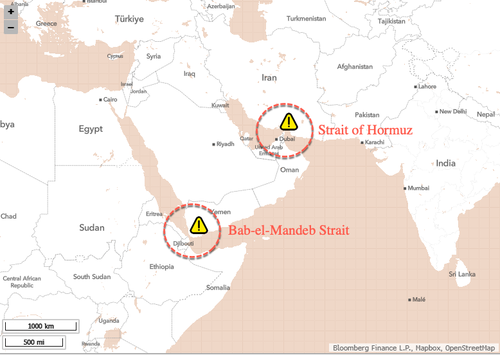
Dual Chokepoint Siege: Houthis' Total Ban on Israeli Shipping Exposes Asymmetric Warfare Targeting Global Trade Arteries
Houthis' June 8, 2026 declaration of a total ban on Israeli shipping in the Red Sea, amid oil prices nearing $98/barrel from Iran-Israel tensions, exemplifies asymmetric hybrid warfare aimed at dual chokepoints (Bab el-Mandeb and Hormuz). This risks renewed global supply chain disruptions, higher shipping costs, and inflationary waves far beyond direct Israel links.
On June 8, 2026, Yemen's Iran-backed Houthis declared a 'complete and total ban' on Israeli maritime navigation in the Red Sea, stating that any vessel linked to Israel would be treated as a military target from the moment of the announcement. The statement explicitly tied the move to broader escalation against 'American-Israeli aggression' and the 'axis of Jihad and Resistance' spanning Palestine, Gaza, Iran, Lebanon, and Iraq. This development coincides with renewed Israel-Iran tensions that have pushed Brent crude futures near $97.83 per barrel, with WTI trading around $95, as fears mount over potential simultaneous disruption of the Bab el-Mandeb Strait and the Strait of Hormuz.
While mainstream coverage has focused on the immediate Red Sea threat reminiscent of the group's 2023-2024 campaign that halved Suez Canal traffic, the deeper pattern reveals a sophisticated asymmetric strategy. By leveraging proxy forces to threaten the world's two most critical maritime chokepoints, Iran-aligned actors can exert outsized influence on global energy and trade flows without direct state-on-state confrontation. The Bab el-Mandeb, at its narrowest just 18 miles wide, has already proven vulnerable to drones, missiles, and small boat swarms; a simultaneous threat to Hormuz — through which roughly 20% of global oil passes — would create compounding shocks to both consumer goods routes and energy supplies.
This dual-chokepoint approach connects to a broader evolution in hybrid warfare: non-state militias functioning as deniable instruments to impose economic costs on adversaries. Previous Houthi actions forced massive rerouting around the Cape of Good Hope, spiking fuel, insurance, and freight rates while contributing to inflationary pressures tracked by bodies like the IMF. Current oil price jumps reflect market anticipation of precisely such cascading effects, with shipping firms already recalculating risk models for 'Israeli-linked' vessels — a category that can be interpreted expansively.
What others miss is the signaling value within the 'axis of resistance' network. The Houthi statement explicitly frames their operations as synchronized with events in multiple theaters, suggesting coordinated pressure points designed to stretch Western naval resources thin across disparate regions. Should the ban expand in practice or inspire parallel actions near Hormuz, the result could be sustained elevation in commodity prices, renewed supply-chain stress indices (as previously flagged by UBS), and transmission of volatility into global inflation — effects that disproportionately burden import-dependent economies. Official statements and reporting confirm the ban's issuance and the concurrent oil spike, underscoring how control of narrow sea lanes has become the ultimate high-leverage tool in modern geopolitical competition.[1][2][3]
LIMINAL: Coordinated pressure on Red Sea and Hormuz chokepoints by proxy forces risks converting short-term oil volatility into structural increases in global freight costs and inflation, exposing the fragility of just-in-time trade networks to sustained asymmetric campaigns.
Sources (4)
- [1]Houthis Declare Total Ban on Israeli Ships in the Red Sea(https://www.bloomberg.com/news/articles/2026-06-08/houthis-to-impose-complete-ban-on-israeli-ships-in-the-red-sea)
- [2]Yemen's Houthis declare ban on Israeli ships sailing the Red Sea(https://www.aljazeera.com/video/newsfeed/2026/6/8/yemens-houthis-declare-ban-on-israeli-ships-sailing-the-red-sea)
- [3]Houthis to Impose 'Complete Ban' on Israeli Ships in Red Sea(https://www.insurancejournal.com/news/international/2026/06/08/872860.htm)
- [4]Brent crude oil - Price - Chart - Historical Data - News(https://tradingeconomics.com/commodity/brent-crude-oil)