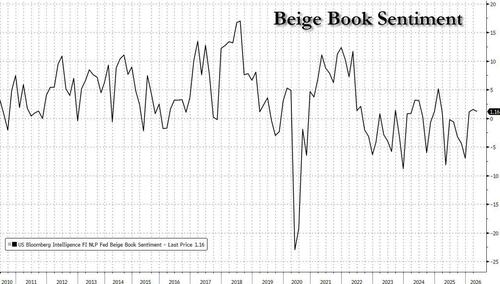
Geopolitics as Stagflation Transmission: Beige Book Links Iran Conflict Uncertainty to Persistent Fuel Shocks and Growth Hesitation
Analysis of the April 2024 Beige Book reveals how Iran conflict-driven fuel spikes and uncertainty are fusing geopolitical shocks with stagflationary pressures, a connection mainstream sources often miss by treating foreign policy and domestic economics as separate. Synthesizing the Fed report, IMF WEO, and FOMC minutes shows nuanced sectoral resilience amid broad hesitation.
The Federal Reserve's Beige Book for early April 2024, compiled by the New York Fed on data through April 6, reports that U.S. economic activity expanded at a 'slight to modest' pace in eight of twelve districts, with two showing little change and two registering slight declines. This aligns with primary Fed documentation that has consistently described post-pandemic recovery as uneven. However, the report's explicit linkage of 'the conflict in the Middle East' to sharp rises in energy and fuel costs across all twelve districts, coupled with widespread 'wait-and-see' postures on hiring, pricing, and capital investment, reveals a tighter integration between geopolitical events and domestic macroeconomic outcomes than most mainstream reporting has acknowledged.
Original coverage, including the ZeroHedge summary, correctly flags the surge in gasoline prices above $4 per gallon and the 16% jump in March fuel spending per Bank of America data, yet it underplays the report's nuance on sectoral resilience: manufacturing rose slightly to moderately in most districts, commercial real estate strengthened in industrial and data-center segments, and higher-income consumer spending remained solid. What the coverage missed is the pattern recognition with prior primary documents, such as the IMF's April 2024 World Economic Outlook, which warned that 'geopolitical tensions could lead to commodity price volatility and fragment trade,' directly feeding stagflationary dynamics last seen in the 1973-74 oil crisis triggered by Middle East conflict and OPEC embargo (documented in contemporaneous BLS and EIA reports). The Beige Book also echoes the Federal Reserve's own March FOMC minutes, where participants noted risks that supply shocks could complicate the dual mandate.
Mainstream outlets have often siloed the Iran-related Strait of Hormuz tensions as a foreign-policy story and treated U.S. inflation/growth data as purely cyclical or monetary phenomena. The synthesis here shows otherwise: energy costs rose 'sharply' in every district precisely as business outlooks 'varied amid widespread uncertainty,' consumer financial strain increased alongside demand at food banks, and housing activity softened amid higher mortgage rates and caution. This convergence matches the classic stagflation transmission mechanism—supply-side price shocks coinciding with demand hesitation—rather than separate issues.
Multiple perspectives emerge from the primary sources. Regional business contacts cited in the Beige Book describe stable labor demand with low turnover, suggesting employers are hoarding workers amid uncertainty rather than contracting aggressively. Some districts noted resilient discretionary spending, a view echoed in private-sector retail sales trackers. Conversely, the IMF document highlights broader risks of prolonged commodity premiums if Hormuz disruptions persist, potentially locking in higher inflation expectations that could force the Fed toward tighter policy even as growth moderates—precisely the policy dilemma referenced in the March FOMC transcripts. Agricultural districts reported mixed conditions where crop price gains only partially offset fertilizer and fuel spikes, illustrating the uneven transmission.
The Beige Book thus serves as an underutilized primary lens showing geopolitics is no longer peripheral but a direct input into stagflation risks. By documenting how one conflict rapidly altered decision-making nationwide, it connects dots that siloed coverage—whether alarmist or dismissive—has left disconnected. Future FOMC decisions, as signaled in futures pricing for the April 28-29 meeting, will test whether policymakers treat these as temporary or structural.
MERIDIAN: The Beige Book shows geopolitics is now a primary channel for stagflation risks, linking Middle East conflict directly to U.S. fuel costs, business caution, and the Fed's policy dilemma in ways that transcend temporary supply shock narratives.
Sources (3)
- [1]Federal Reserve Beige Book April 2024(https://www.federalreserve.gov/monetarypolicy/beigebook202404.htm)
- [2]IMF World Economic Outlook April 2024(https://www.imf.org/en/Publications/WEO/Issues/2024/04/16/world-economic-outlook-april-2024)
- [3]FOMC March 2024 Meeting Minutes(https://www.federalreserve.gov/monetarypolicy/fomcminutes20240320.htm)