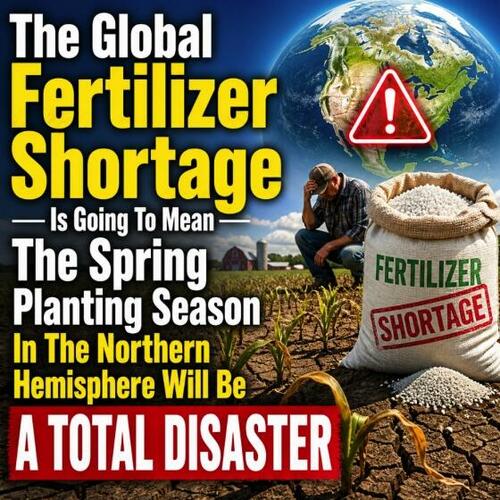
Global Fertilizer Shortage: A Slow-Motion Food Crisis Threatens Spring Planting and Beyond
The global fertilizer shortage, worsened by the Strait of Hormuz blockade and geopolitical tensions, threatens Northern Hemisphere spring planting, risking massive crop shortfalls and food price spikes. Beyond immediate supply issues, historical trade disruptions and policy gaps amplify the crisis, with severe implications for food security in Asia and Africa. Urgent international coordination is needed to avert a deeper catastrophe.
The global fertilizer shortage, driven by geopolitical tensions and supply chain disruptions, is poised to devastate the spring planting season across the Northern Hemisphere. As highlighted by ZeroHedge, approximately one-third of globally traded nitrogen fertilizer typically passes through the Strait of Hormuz, a critical chokepoint now disrupted by Iranian actions amid escalating regional conflict. This bottleneck, combined with soaring fuel costs and pre-existing supply chain strains, threatens to reduce global agricultural yields significantly, with the International Grains Council projecting a potential shortfall of 53 million tons in wheat and coarse grain output—a volume exceeding Ukraine’s typical annual grain exports.
Beyond the immediate crisis in the Strait of Hormuz, the ripple effects are already visible in key agricultural regions. In Asia, fertilizer shortages and high input costs have forced farmers to scale back rice planting, a staple for billions, at a time when El Niño patterns are expected to further constrain output. In Africa, where planting seasons are underway, the risk of missed application windows could eliminate harvests entirely, exacerbating food insecurity for the continent’s most vulnerable populations. Svein Tore Holsether, CEO of Yara International, has warned of a ‘de facto global auction’ for limited fertilizer supplies, where wealthier nations outbid poorer ones, leaving countries in Africa and parts of Asia facing dramatic price spikes and shortages.
What the original coverage misses is the broader geopolitical and historical context that amplifies this crisis. The Strait of Hormuz disruption is not an isolated event but part of a pattern of weaponized trade routes in resource conflicts—recall the 2021 Suez Canal blockage by the Ever Given, which delayed $9.6 billion in daily trade, or Russia’s grain export restrictions during the Ukraine conflict, which tightened global food supplies. Additionally, the fertilizer crisis intersects with existing inflationary pressures from post-COVID supply chain recovery and energy price volatility tied to sanctions on Russian gas, a key input for nitrogen fertilizer production. The original article also underplays the role of domestic policy failures in major agricultural exporters like the United States and Canada, where inadequate stockpiling and over-reliance on just-in-time supply chains have left farmers vulnerable to sudden shocks.
A critical oversight in the ZeroHedge piece is the lack of attention to potential mitigation strategies or historical parallels that could inform policy responses. During the 1973 oil embargo, for instance, nations like the U.S. implemented emergency agricultural input allocations to prioritize food security—an approach that could be revisited today. Current data from the Food and Agriculture Organization (FAO) indicates that global cereal stocks are at their lowest in a decade, with a stock-to-use ratio of 29.7% in 2023, leaving little buffer for a failed planting season. Without urgent international coordination—such as redirecting fertilizer shipments through alternative routes like the Cape of Good Hope or accelerating production in unaffected regions—the crisis will not merely raise prices but could trigger localized famines by late 2023 or early 2024.
Synthesizing multiple sources, the intersection of fertilizer shortages with other systemic risks becomes clearer. The World Bank’s 2023 Commodity Price Outlook warns that sustained high input costs could reduce global agricultural productivity by 5-7% over the next two years, disproportionately impacting low-income countries. Meanwhile, the UN’s World Food Programme (WFP) notes that 345 million people are already facing acute food insecurity—a figure likely to rise if harvests fail. These data points underscore a slow-motion catastrophe that demands more than just market adjustments; it requires geopolitical de-escalation in the Persian Gulf and strategic interventions to stabilize food supply chains.
The fertilizer shortage is not just a spring planting disaster—it is a harbinger of deeper structural vulnerabilities in global food systems. As populations grow and climate variability intensifies, the failure to address these chokepoints today will compound tomorrow’s crises. The question remains: will world leaders act before empty shelves become the norm?
MERIDIAN: The fertilizer crisis could reduce global agricultural output by 5-7% over the next two years, per World Bank estimates, pushing food prices higher and risking localized famines in vulnerable regions by 2024 if no coordinated action is taken.
Sources (3)
- [1]Global Fertilizer Shortage Means Spring Planting Season Disaster In The Northern Hemisphere(https://www.zerohedge.com/geopolitical/global-fertilizer-shortage-means-spring-planting-season-disaster-northern-hemisphere)
- [2]World Bank Commodity Price Outlook 2023(https://www.worldbank.org/en/research/commodity-markets)
- [3]UN World Food Programme: Global Report on Food Crises 2023(https://www.wfp.org/publications/global-report-food-crises-2023)