Economic Indicators and Geopolitical Summits: Unpacking CPI, PPI, and Trump-Xi Dynamics
This analysis delves into the interconnected impacts of upcoming U.S. economic indicators (CPI, PPI, retail sales) and the Trump-Xi summit, highlighting missed links between inflation trends, consumer behavior, and U.S.-China trade dynamics. It explores how these events could shape Federal Reserve policy and global markets amidst geopolitical tensions like the Iran conflict.
This week’s economic calendar and geopolitical events, including the U.S. Consumer Price Index (CPI) and Producer Price Index (PPI) releases, alongside the Trump-Xi summit, present a confluence of factors with potential to sway global markets and policy directions. The original coverage by ZeroHedge highlights these events but treats them in relative isolation, missing critical interconnections between inflation trends, consumer behavior, and U.S.-China trade relations amidst broader geopolitical tensions.
Starting with the economic indicators, the anticipated CPI report for April, as projected by Deutsche Bank economists, suggests a headline inflation increase of +0.58% month-on-month (MoM), down from March’s +0.9%, while core inflation is expected to rise to +0.39% MoM from +0.2%. This indicates persistent underlying price pressures, a concern not fully addressed in the original piece. The PPI data, following a day later, will provide upstream insights into cost pressures that could further validate or challenge these inflation expectations. Combined with retail sales projected to decline by -0.3% MoM after a robust +1.7% in March, these indicators suggest a potential cooling of consumer spending—a critical driver of U.S. economic growth. This cooling, if confirmed, could signal a broader slowdown, especially when juxtaposed with industrial production’s modest +0.2% MoM forecast. The original coverage fails to connect these dots to the Federal Reserve’s upcoming policy decisions, particularly under the shadow of Kevin Warsh’s potential confirmation as Fed Chair, whose hawkish leanings could amplify focus on inflation control over growth stimulus.
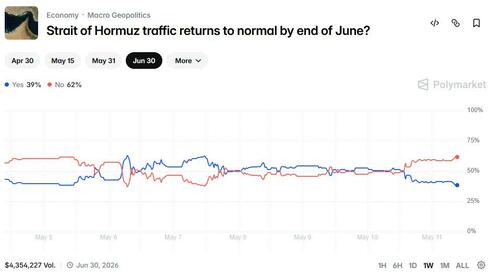
Geopolitically, the Trump-Xi summit in Beijing emerges as a pivotal event, not just for U.S.-China trade negotiations but also for its potential ripple effects on global commodity markets, especially oil, given the ongoing Iran conflict and the Strait of Hormuz closure. ZeroHedge notes the summit as a 'headline event' but underplays its intersection with economic data. A key missed angle is how trade discussions could influence inflation trajectories: a breakthrough in tariff reductions might ease input costs for U.S. producers, potentially softening PPI numbers in future months. Conversely, a hardline stance from either leader could exacerbate supply chain disruptions, feeding into inflationary pressures already evident in the CPI forecasts. Moreover, with Brent crude up +4.23% following Trump’s rejection of Iran’s nuclear proposal, as reported, the summit’s outcomes could indirectly affect energy prices—a major CPI component—depending on how China positions itself as a mediator or stakeholder in Middle Eastern stability.
Historical patterns provide context for these interconnections. The 2018-2019 U.S.-China trade war saw tariffs directly impact consumer prices, with a 2019 Federal Reserve study estimating a 0.4 percentage point increase in inflation due to tariff costs passed onto consumers. Current CPI projections, while not directly tied to new tariffs, operate in a similar environment of uncertainty. Additionally, China’s role in global oil markets—being the world’s largest importer—means its diplomatic stance during the summit could sway OPEC+ dynamics, a factor absent from the original analysis.
Synthesizing multiple sources, the U.S. Bureau of Labor Statistics’ historical CPI data (BLS.gov) confirms that energy and core goods remain significant inflation drivers, aligning with current forecasts. Meanwhile, the U.S.-China Business Council’s 2023 report on bilateral trade underscores that unresolved trade tensions continue to cost U.S. businesses $40 billion annually in lost exports, a figure likely to loom over Trump-Xi discussions. Lastly, the International Energy Agency’s (IEA) latest oil market report highlights how geopolitical risks, including the Strait of Hormuz situation, keep upward pressure on prices, reinforcing the summit’s broader relevance.
What ZeroHedge misses is the feedback loop between these economic and geopolitical spheres. Inflation data will not only inform Fed policy but also shape Trump’s negotiating leverage with Xi, as domestic economic resilience or fragility dictates how aggressively the U.S. can push on trade or geopolitical fronts. Conversely, summit outcomes could recalibrate market expectations for inflation and growth, influencing how CPI and PPI data are interpreted by investors. This week, therefore, is not merely a sequence of isolated events but a critical nexus for understanding the interplay of domestic policy and international relations.
MERIDIAN: The Trump-Xi summit could either ease or exacerbate inflationary pressures depending on trade outcomes, with a potential softening of PPI if tariffs are addressed. However, persistent geopolitical risks may keep oil-driven CPI components elevated.
Sources (3)
- [1]U.S. Bureau of Labor Statistics - CPI Historical Data(https://www.bls.gov/cpi/)
- [2]U.S.-China Business Council - 2023 Trade Report(https://www.uschina.org/reports/us-china-economic-report-2023)
- [3]International Energy Agency - Oil Market Report(https://www.iea.org/reports/oil-market-report)