France Grapples with Widespread Unrest Following Cost-of-Living Protests That Turned Violent
Documented riots and looting followed economic protests in France on Oct 17-18 2026, with mainstream sources confirming arrests, injuries, and damage; immigration-centric narratives appear in commentary but are not the primary framing in credible reporting. Events signal real social and fiscal pressures with potential electoral and economic ripple effects.
On October 17, 2026, large-scale demonstrations across France against rising living costs, education standards, and declining public services escalated into riots in multiple cities, resulting in arson, looting, and clashes with police. Mainstream reports document over 550,000 participants in largely peaceful marches that were marred by violence from fringe groups, leading to 1,200–1,800 arrests, approximately 500–600 injuries among police, firefighters, and paramedics, and significant property damage including the partial destruction of Limoges city hall by fire. [web:0][web:1][web:2]
Looting targeted hundreds of retail stores, with estimates of 1,500 businesses affected in some accounts and damages running into tens or hundreds of millions of euros; Carrefour CEO Alexandre Bompard publicly addressed impacts on the company's outlets. [web:18][web:15] French Interior Minister Laurent Nuñez reported the figures and attributed much of the violence to 'ultra-left' elements and criminals, while President Macron condemned the 'shocking' scenes and ordered reviews of security preparedness ahead of the 2027 presidential election. [web:0][web:21]
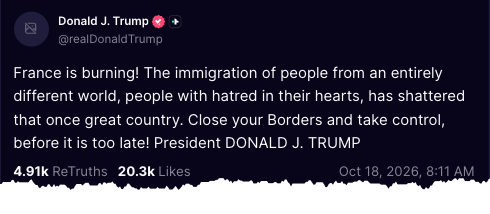
U.S. figures including President Trump and Vice President JD Vance publicly commented on the events, linking them to immigration and assimilation issues. [web:3] However, official and journalistic accounts primarily frame the unrest as stemming from economic grievances and social discontent rather than a singular demographic driver. The episode highlights strains on France's welfare state and fiscal position, occurring against a backdrop of unresolved budget deficits and pre-election tensions.
Broader context includes ongoing debates over public services, inequality, and institutional capacity, with the violence amplifying concerns about social cohesion and economic stability in the lead-up to national votes.
Analyst: The unrest underscores fiscal and social fault lines that could intensify political polarization ahead of 2027 elections, potentially pressuring markets and migration policy debates without immediate systemic collapse.
Sources (5)
- [1]France faces aftermath of worst unrest in years(https://www.reuters.com/world/europe/france-faces-aftermath-worst-unrest-years-2026-10-18/)
- [2]French government in crisis talks after ‘colossal failure of the state’(https://www.theguardian.com/world/2026/oct/18/french-government-crisis-talks-violent-unrest-policing-macron)
- [3]France protests: Violent clashes, looting and buildings ablaze as over 1,000 arrested(https://www.bbc.co.uk/news/articles/c6d937wedj7jo)
- [4]'Like we had a war': France counts cost of violent protests(https://www.afp.com/en/we-had-war-france-counts-cost-violent-protests)
- [5]La France sonnée après une journée de chaos en marge des manifestations de masse contre la vie chère(https://fr.euronews.com/2026/10/18/la-france-sonnee-apres-une-journee-de-chaos-en-marge-des-manifestations-de-masse-contre-la)