Canvas Breach Exposes EdTech Vulnerabilities, Signals Broader Infrastructure Risks
The Canvas breach by ShinyHunters, affecting 275 million users, exposes critical vulnerabilities in edtech infrastructure, disrupting U.S. schools during exams. Beyond data theft, it reflects a pattern of ransomware targeting essential services, raising national security concerns and demanding urgent cybersecurity reforms in education.
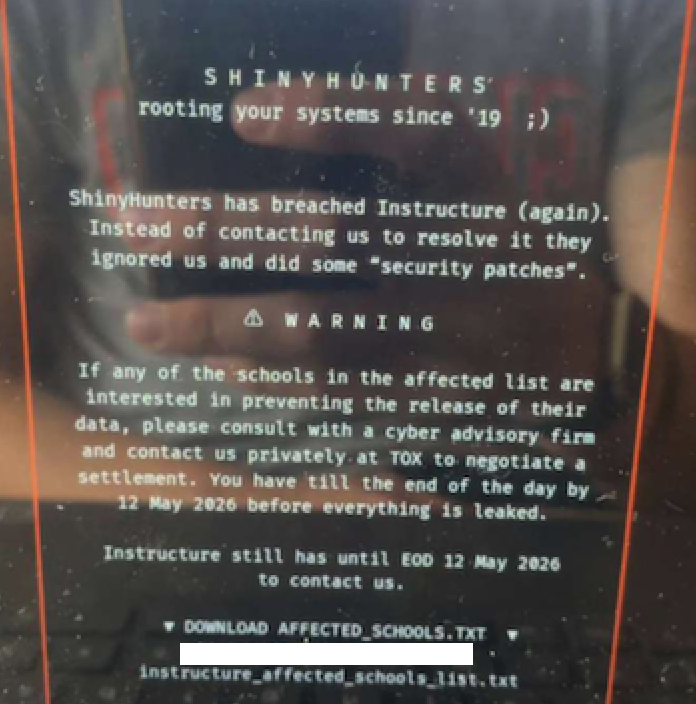
The recent data extortion attack on Canvas, a critical education technology platform managed by Instructure, has disrupted thousands of schools and universities across the United States, affecting an estimated 275 million students and faculty. Beyond the immediate chaos of defaced login pages and forced outages during final exams, as reported by KrebsOnSecurity, this breach underscores a systemic vulnerability in edtech infrastructure and mirrors a growing trend of ransomware and extortion campaigns targeting critical societal sectors. ShinyHunters, the cybercrime group behind the attack, claimed to have accessed billions of private messages, names, email addresses, and other identifying data, exploiting Instructure’s delayed response and inadequate initial containment measures. While Instructure downplayed the severity by labeling the outage as 'scheduled maintenance' and asserting no sensitive data like passwords or financial information was compromised, the scale of the breach and the timing suggest deeper operational and reputational damage.
This incident is not an isolated event but part of a broader pattern of cyberattacks targeting infrastructure critical to daily life—education, healthcare, and utilities have all faced similar threats in recent years. The 2021 Colonial Pipeline ransomware attack, which disrupted fuel supply chains, and the 2023 Cl0p ransomware campaign exploiting MOVEit software vulnerabilities, affecting educational institutions among others, illustrate how cybercriminals are increasingly weaponizing access to essential services for financial gain or geopolitical leverage. The Canvas breach highlights a critical oversight in the original coverage: the lack of focus on edtech as a national security concern. Educational platforms are not merely tools for coursework; they are repositories of sensitive data on future generations, making them prime targets for state-sponsored actors or organized crime groups seeking to exploit personal information for espionage or identity theft.
Instructure’s response, characterized by delayed transparency and an initial dismissal of ongoing threats, mirrors a troubling trend of underestimating cyber risks in sectors unprepared for sophisticated attacks. The company’s claim of containment on May 6 was quickly contradicted by the widespread defacement on May 7, raising questions about internal security protocols and incident response capabilities. Moreover, KrebsOnSecurity’s report missed the geopolitical angle: ShinyHunters has previously been linked to data leaks affecting government contractors and critical infrastructure in multiple countries, suggesting potential motives beyond ransom—possibly data harvesting for foreign intelligence or disruption of societal stability during key academic periods.
Drawing from additional sources, such as the 2023 Verizon Data Breach Investigations Report, which notes a 25% increase in ransomware targeting educational institutions, and a CISA alert on vulnerabilities in widely-used edtech software, it’s clear that the sector lags in adopting robust cybersecurity frameworks compared to financial or defense industries. This breach could catalyze regulatory scrutiny, with potential calls for mandatory security standards under frameworks like FERPA or GDPR for U.S.-based platforms handling student data. The risk extends beyond data exposure to operational continuity—prolonged outages could erode trust in digital learning environments, pushing institutions back to less efficient analog systems at a time when hybrid education is a cornerstone of modern pedagogy.
Ultimately, the Canvas breach is a wake-up call. It reveals not just technical failings but a strategic blind spot in how society prioritizes cybersecurity for non-traditional infrastructure. As education becomes increasingly digitized, the stakes of such attacks will only rise, potentially disrupting not just exams but the foundational trust in systems shaping future generations. Policymakers, edtech providers, and institutions must treat these platforms with the same urgency as physical infrastructure, lest they become the soft underbelly of national resilience.
SENTINEL: Expect increased regulatory pressure on edtech providers like Instructure to adopt stringent cybersecurity measures, potentially under expanded FERPA guidelines, as breaches like Canvas become focal points for national security debates.
Sources (3)
- [1]Canvas Breach Disrupts Schools & Colleges Nationwide(https://krebsonsecurity.com/2026/05/canvas-breach-disrupts-schools-colleges-nationwide/)
- [2]2023 Verizon Data Breach Investigations Report(https://www.verizon.com/business/resources/reports/dbir/)
- [3]CISA Alerts on EdTech Software Vulnerabilities(https://www.cisa.gov/news-events/alerts)