Trump Moves to Ease Meat Processing Rules for Ranchers Amid Backlash Over Imports and Industry Consolidation
Trump's August 28, 2026, announcement to deregulate on-farm meat processing for ranchers responds to industry concentration concerns and import policy backlash, potentially empowering small operators while building on ongoing antitrust and support efforts.
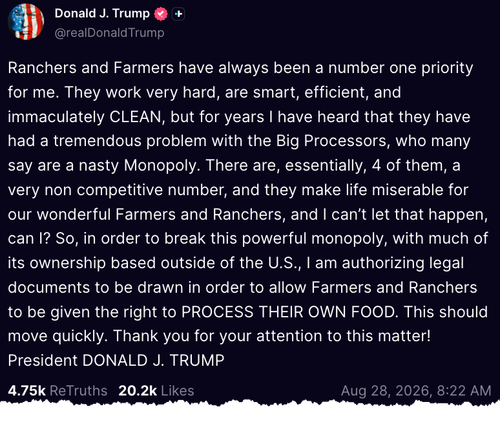
President Donald Trump announced on August 28, 2026, via Truth Social that he is authorizing legal documents to allow farmers and ranchers to process their own meat, aiming to challenge the dominance of the 'Big Four' meatpackers—Tyson Foods, Cargill, JBS USA, and National Beef Packing Co.—which control roughly 85% of U.S. beef processing.[1][2] The move follows an interview with conservative radio host Glenn Beck, who urged deregulation to 'break the back' of processing restrictions, and comes amid rancher backlash against Trump's temporary pause on tariffs for imported ground beef to ease consumer prices.[3][4]
Agriculture Secretary Brooke Rollins indicated additional steps would be detailed starting the following Monday, including waiving outdated regulations, expanding ranchers' ability to sell meat across state lines, boosting funding for small processors, and addressing industry consolidation.[1][5] This builds on prior administration actions, such as a 2025 Justice Department antitrust investigation into the meatpacking sector for potential collusion and price manipulation, and $60 million in support for small and very small meat processors announced in June 2026.[6][7]
The proposal echoes long-standing legislative efforts like the PRIME Act, sponsored by Rep. Thomas Massie (R-Ky.) with bipartisan support, which seeks to exempt intrastate sales of meat from custom slaughter facilities from federal inspection requirements. Massie welcomed the announcement but stressed it should become law rather than rely on executive action.[5][8] For small ranchers, such changes could enable vertical integration—raising, processing, and selling meat locally—potentially increasing margins, shortening supply chains, reducing reliance on distant facilities, and enhancing resilience against disruptions in the concentrated industry. However, implementation details remain unclear, food safety concerns persist among critics, and major changes may require congressional involvement or face legal and industry pushback.[9]
Policy Analyst: Reduced regulatory barriers could enable more decentralized processing, boosting small rancher viability and local supply resilience, but success hinges on balancing safety standards with practical implementation amid entrenched industry interests.
Sources (7)
- [1]Trump says he’ll make it easier for ranchers to process their own food after blowback over his beef policies(https://www.cnn.com/2026/08/28/politics/trump-beef-tariffs-farmers)
- [2]Trump suggests allowing ranchers to bypass USDA-inspected meat plants(https://www.washingtonpost.com/politics/2026/08/28/trump-suggests-allowing-ranchers-bypass-usda-inspected-meat-plants/)
- [3]Trump moves to let ranchers process own food(https://justthenews.com/politics-policy/trump-moves-let-ranchers-process-own-food)
- [4]Trump looks to ease beef processing regulations(https://www.politico.com/news/2026/08/28/trump-beef-processing-regulations-01053957)
- [5]Trump vows legal order to break up 'nasty monopoly' in food processing(https://www.reuters.com/world/trump-vows-legal-order-break-up-food-processing-nasty-monopoly-2026-08-28/)
- [6]Trump faces pushback over meat processing pledge(https://www.axios.com/2026/08/28/meat-processing-trump-beef-cattle-farmer)
- [7]USDA Announces Improved Support, Reduced Burdens, and $60 million in Investments to Support Small Meat and Poultry Plants(https://www.usda.gov/about-usda/news/press-releases/2026/06/03/usda-announces-improved-support-reduced-burdens-and-60-million-investments-support-small-meat-and)