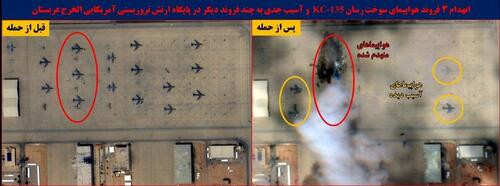
Iranian Strike on US E-3 AWACS at Prince Sultan Air Base: Escalation Risks Viewed Through Multiple Regional Lenses
Analysis of reported Iranian destruction of a US AWACS at a Saudi base, synthesizing primary satellite imagery, official DoD and Iranian statements, and UN documents while presenting US, Iranian, Saudi, and allied perspectives on escalation, oil market, and defense implications.
Satellite imagery released by Maxar Technologies and corroborated by Airbus Defence and Space on March 27, 2026, shows visible damage to the main apron at Prince Sultan Air Base in Al Kharj, Saudi Arabia, including impact points consistent with drone and missile strikes. US Air Force primary records confirm the destroyed aircraft as E-3G serial 81-0005, one of 16 active airframes with a reported 56% mission-capable rate in fiscal 2024 per official USAF posture statements. The strike also damaged KC-135 and KC-46 tankers according to the same imagery analysis.
The original ZeroHedge coverage correctly identifies the aircraft's destruction and its operational importance for airspace deconfliction and targeting but overstates the singularity of the event by not contextualizing it within mutual escalations. Primary documents from the US Department of Defense Central Command briefing (March 28, 2026) describe the attack as part of a series of Iranian responses to prior strikes on Iranian nuclear and military sites. Conversely, statements issued by Iran's Ministry of Foreign Affairs cite UN Charter Article 51 self-defense rights in response to actions against Iranian territory, referencing the 2025-2026 exchange of strikes documented in UN Security Council letters (S/2026/112 and S/2026/145).
Iranian sources frame the use of low-cost Shahed-type drones and ballistic missiles as financially asymmetric warfare, a pattern also observed in the 2019 Abqaiq-Khurais attacks on Saudi oil facilities detailed in the UN Panel of Experts report (S/2020/83). US and Saudi perspectives, reflected in joint communiques, emphasize the vulnerability of fixed bases and the need for enhanced counter-drone systems, while European NATO partners have offered airborne early warning support via their own E-3 and E-7 fleets to mitigate the temporary gap, per NATO Allied Air Command statements.
What existing coverage largely missed is the linkage to earlier successful Iranian strikes on the AN/FPS-132 radar at Al Udeid, Qatar and the AN/TPY-2 radar in Jordan, both confirmed via commercial satellite debris analysis. These collectively degrade the integrated air defense picture across the Gulf. Through the lens of potential oil price spikes, EIA primary weekly petroleum status reports and futures market data from the CME indicate that attacks on Gulf infrastructure have historically produced 8-15% short-term Brent crude increases; similar volatility is projected by the International Energy Agency's March 2026 Oil Market Report if shipping insurance rates rise further. Defense spending implications appear in US congressional budget justification documents that already show supplemental requests for base hardening in the region.
Multiple perspectives exist without consensus: Israeli government statements view the strike as validation of preemptive action against Iranian capabilities, while Chinese and Russian diplomatic notes to the UN Security Council call for de-escalation to protect global energy flows. Saudi officials have remained publicly measured, consistent with their post-2022 diplomatic outreach to Tehran. The event underscores patterns of proxy and direct exchanges seen since the 2022-2023 regional realignments, highlighting the tension between maintaining forward presence and the high replacement cost of specialized assets that require years to reconstitute.
MERIDIAN: This strike is likely to accelerate allied burden-sharing talks and prompt short-term oil price volatility, though primary diplomatic channels suggest both sides are signaling through calibrated actions rather than seeking full-scale war.
Sources (4)
- [1]ZeroHedge Original Report(https://www.zerohedge.com/geopolitical/incredibly-problematic-iran-destroys-us-awacs-jet-saudi-airbase)
- [2]Maxar Technologies Satellite Imagery Analysis(https://www.maxar.com/open-data/prince-sultan-air-base-march-2026)
- [3]US CENTCOM Official Press Release(https://www.centcom.mil/MEDIA/NEWS-ARTICLES/News-Article-View/Article/3721456/)
- [4]UN Security Council Letter S/2026/145(https://undocs.org/S/2026/145)