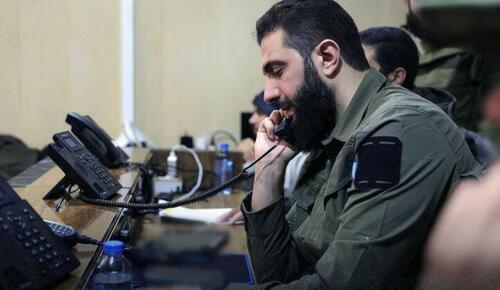
From Al-Qaeda Commander to G7 Guest: Sharaa's Syria Signals Radical Realignment in Global Power Structures
Sharaa's G7 invitation marks Syria's pivot from jihadist insurgency roots to Western-aligned economic actor, confirming rapid post-Assad realignment amid persistent economic crises, sectarian violence against minorities, and strategic port/logistics value in a tense region.
The invitation extended to Syrian President Ahmed al-Sharaa—formerly known as Abu Mohammad al-Jolani, the one-time leader of al-Qaeda's Nusra Front—to attend the G7 summit in France represents far more than diplomatic protocol. It encapsulates a stunning geopolitical metamorphosis: a former jihadist whose group once battled Western-backed forces is now positioned as a potential strategic partner in Western finance and supply chain diplomacy. This shift, confirmed across multiple outlets, underscores how rapidly alliances realign when strategic geography, sanctions relief, and regional counterweights align.[1][2]
According to Reuters, Sharaa will lead Syria's first-ever delegation to the G7 leaders' summit scheduled for June 15-17, 2026, in Évian-les-Bains. The invitation was personally delivered to Syrian Finance Minister Yisr Barnieh during preparatory talks in Paris, with discussions expected to center on Syria's potential as a 'strategic hub for supply chains' amid ongoing Iran-related disruptions in the Hormuz Strait. Neighboring states have reportedly sought access to Syrian ports as contingency plans. This comes less than two years after HTS forces toppled Bashar al-Assad in December 2024, ending over five decades of Baathist rule.[3]
Sharaa's evolution traces a deliberate rebranding. Once embedded in al-Qaeda in Iraq and tasked with establishing the Nusra Front in 2011, he severed formal ties with al-Qaeda by 2016, rebranded his organization multiple times, and positioned HTS as a governing entity in Idlib with technocratic elements. By 2025, he had shed his nom de guerre, met with international figures, and begun the process of normalizing Syria's standing. This 'from jihadist to statesman' arc, documented by the BBC and others, reveals pragmatism trumping ideology: HTS provided administration where the Assad regime could not, enabling a pivot toward reintegration.[4]
Yet this realignment exposes deeper contradictions others often overlook. While U.S. sanctions were largely lifted in 2025 under President Trump—who previously vouched for Sharaa—economic relief has lagged. Over 90% of Syrians remain in poverty, the currency has tumbled, and fuel, food, and electricity prices have surged. Attracting investment and restoring banking ties has proven slower than anticipated despite the lifting of Caesar Act provisions and EU measures. Syria's ports and location offer leverage, but war devastation, corruption risks, and incomplete governance hinder progress.[5]
More critically, the 'ISIS in suits' critique lingers amid documented sectarian fallout. Post-Assad Syria saw mass violence against Alawites in coastal regions in March 2025, with reports of 1,400+ deaths, revenge killings, and involvement of some militias linked to the new order. Christians and Druze have faced targeted attacks, including a 2025 church bombing. These events, investigated by Amnesty International, the UN, and UK parliamentary briefings, highlight how Sunni extremist elements within the new power structure continue to threaten minorities, echoing the very ideologies Sharaa once embodied. This suggests the Western embrace may prioritize anti-Iran containment and proxy realignment over full accountability or inclusive transition.[6]
The optics are striking: a nation once central to 'pipeline wars' and CIA-Gulf-Israeli proxy efforts against Assad now courts G7 finance while Russia remains sidelined. This illustrates fluid power structures where yesterday's designated terrorists become today's interlocutors when they control territory, moderate rhetoric, and offer logistical value. Sharaa's attendance may accelerate reintegration but risks papering over unresolved fractures—sectarian cleansing, economic despair, and governance by former militants—that could unravel the makeover. History shows such rapid rehabilitations often serve great-power competition more than local stability.
LIMINAL: This normalization of a rebranded HTS leader at the G7 table foreshadows a pragmatic realpolitik where ideological enemies are recycled as bulwarks against Iran and chaos, yet unaddressed minority massacres and economic fragility signal the realignment rests on unstable foundations likely to produce new proxy conflicts by 2028.
Sources (5)
- [1]Syria's Sharaa to attend G7 summit in France, sources say(https://www.reuters.com/world/middle-east/syrias-sharaa-attend-g7-summit-france-sources-say-2026-05-21/)
- [2]How Syria rebel leader Abu Mohammed al-Jolani reinvented himself(https://www.bbc.com/news/articles/c0q0w1g8zqvo)
- [3]Syria one year after Assad: Religious minorities(https://commonslibrary.parliament.uk/research-briefings/cbp-10429/)
- [4]Syria one year after Assad: Reconstruction and sanctions(https://commonslibrary.parliament.uk/research-briefings/cbp-10428/)
- [5]G7 extends Syria 1st-ever invitation to upcoming France summit(https://www.dailysabah.com/world/mid-east/g7-extends-syria-1st-ever-invitation-to-upcoming-france-summit)