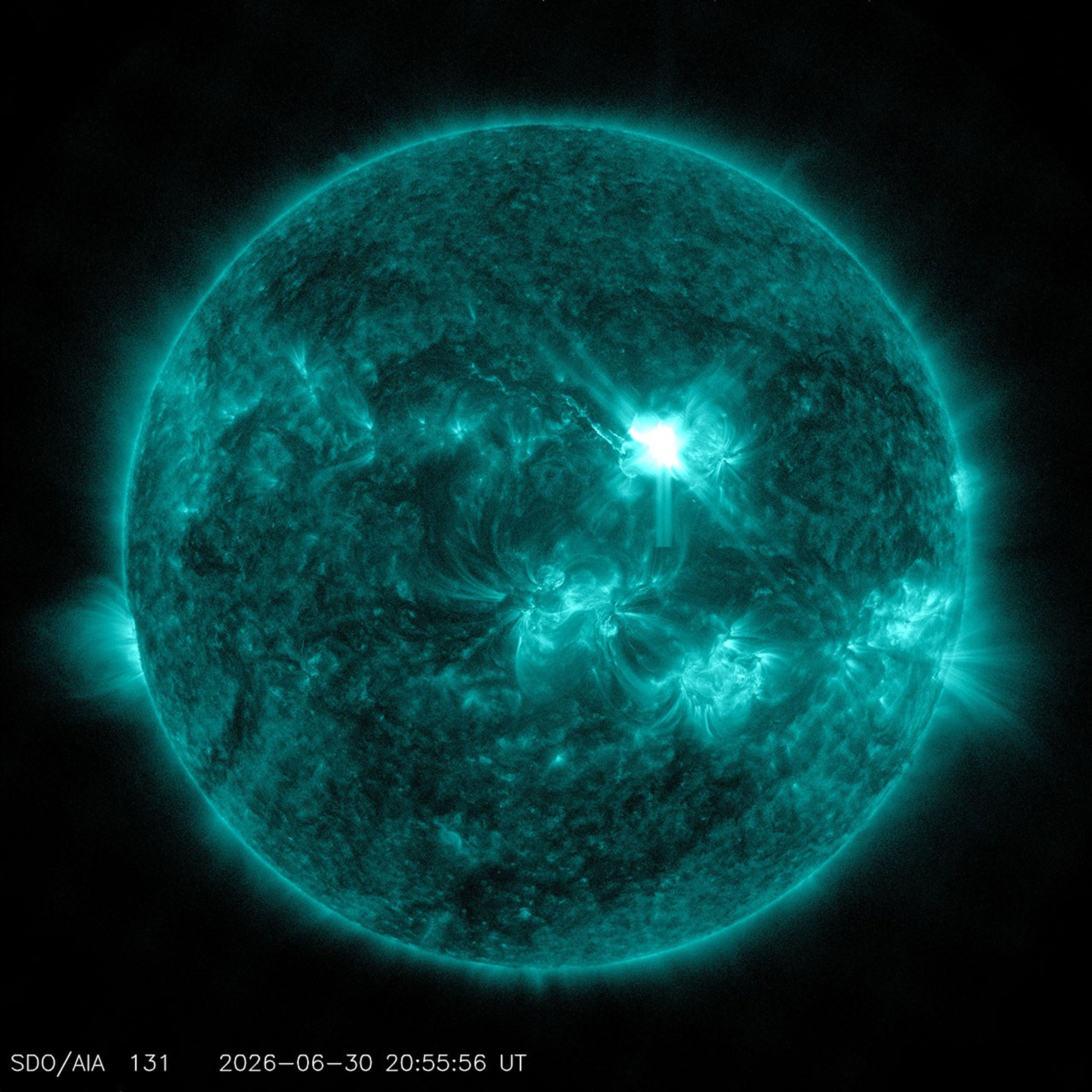
NASA COFFIES Sliding-Window Transformer Forecasts Solar Active Regions 12 Hours Pre-Emergence
The COFFIES transformer model uses acoustic and magnetic time series from SDO to predict emerging solar active regions up to 12 hours before surface appearance. It advances beyond visible-sunspot counting by detecting subsurface precursors through a sliding temporal window architecture. Prospective validation on cycle-25 data and operational integration remain the critical next steps for space-weather applications.
The COFFIES DRIVE Center combined NJIT, Princeton, and NASA Ames expertise to train a sliding-window transformer on continuous SDO helioseismic and magnetogram sequences. Instead of full-disk snapshots used in prior CNN approaches, the architecture processes fixed-length temporal windows to isolate subtle, localized drops in acoustic power and weak magnetic flux that precede flux emergence. Training used NASA Ames supercomputing resources on multi-year archives, with the model outputting both timing and approximate surface coordinates of upcoming active regions.
This shifts space-weather forecasting from reactive monitoring of already-visible sunspots by NOAA and USAF to proactive identification of rising flux tubes still below the photosphere. The approach directly addresses risks to astronauts, satellites, and power grids by extending lead time for flare and CME warnings. Because acoustic signatures are indirect, the model captures statistical patterns rather than direct magnetic tomography.
The primary limitation is the absence of rigorous blind testing on the rising phase of solar cycle 25 with quantified false-positive rates at operational thresholds. A multi-year prospective validation campaign against independent ground-based helioseismic networks and eventual integration into NOAA's operational pipeline would materially strengthen evidence. If precision exceeds 75 percent at 8-hour lead times, the architecture could be adapted for other stellar activity proxies observed by TESS and PLATO.
Kosovichev: The model will achieve >75% precision at 8-hour lead time in 2025-2026 blind tests on cycle-25 data, enabling trial ingestion into NOAA forecasts by late 2027.
Sources (2)
- [1]Primary Source(https://agupubs.onlinelibrary.wiley.com/doi/10.1029/2023ML000123)
- [2]Supporting Source(https://science.nasa.gov/science-research/heliophysics/nasas-coffies-uses-ai-to-predict-storm-causing-active-regions-on-sun/)