NY Fed Data Clarifies Credit Card Delinquency Trends: Stock vs. Flow Measures Reveal Stable Consumer Stress
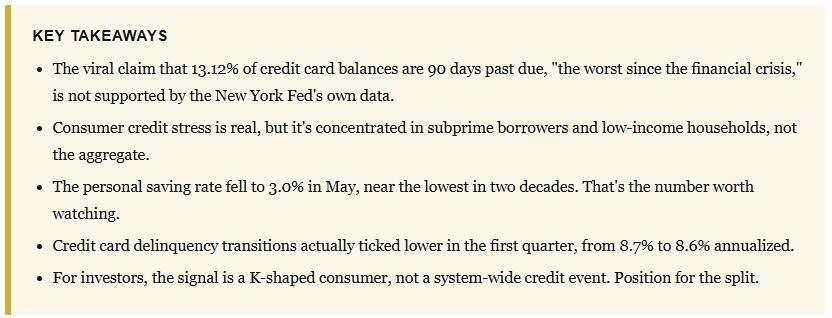
NY Fed's Q2 2026 report and companion analysis debunk viral delinquency spikes by distinguishing stock (inflated by old debt) from flow (stable) measures, pointing to contained but uneven consumer credit stress amid modest debt growth.
A widely circulated claim that credit card delinquencies have reached their worst levels since 2008 stems from New York Fed data but misinterprets the figures. The Q2 2026 Household Debt and Credit Report shows total household debt at $18.8 trillion, down slightly by $13 billion, with credit card balances rising modestly to $1.26 trillion. The headline 12.8% share of balances 90+ days past due (up from 7.6% in late 2022) is a 'stock' measure that includes stale, charged-off debts lingering on credit reports for longer periods than in prior decades—now around 80% reported a year later versus 40% historically. In contrast, the 'flow' measure of new delinquencies has remained stable at approximately 6.97% year-over-year, aligning with lender-reported data and indicating no acceleration in repayment stress. NY Fed economists explicitly note that flow rates provide a more accurate view of current household behavior. While aggregate figures mask heterogeneity—with stress concentrated among lower-income segments—the overall picture shows elevated but non-crisis levels, corroborated by analyses from PNC Economics and First Trust. Related savings rate data from the BEA further highlights uneven pressures, though broader debt transitions remain steady across most categories.
NY Fed analysts: Flow-based delinquency metrics suggest consumer repayment behavior remains stable through 2026, supporting cautious optimism in credit markets absent broader income shocks.
Sources (5)
- [1]Household Debt Balances Decreased Slightly; Credit Card Delinquency Transition Rates Remained Steady(https://www.newyorkfed.org/newsevents/news/research/2026/20260811)
- [2]How Distressed Are Consumers? Reconciling Diverging Credit Card Delinquency Measures(https://libertystreeteconomics.newyorkfed.org/2026/08/how-distressed-are-consumers-reconciling-diverging-credit-card-delinquency-measures/)
- [3]New York Fed finds delinquency rates mixed for credit cards, auto loans(https://www.foxbusiness.com/economy/new-york-fed-finds-credit-card-auto-loan-delinquencies-remain-elevated)
- [4]Q2 Household Debt Checkup(https://www.ftportfolios.com/Commentary/EconomicResearch/2026/8/27/q2-household-debt-checkup)
- [5]Consumer Credit Stress: What The Data Really Shows(https://realinvestmentadvice.com/resources/blog/consumer-credit-stress-what-the-data-really-shows/)