China's Car Sales Slump Signals Deeper Economic and Global Supply Chain Risks
China's 21.5% car sales drop in April reflects not just high fuel prices or subsidy cuts but deeper economic woes, including unemployment and a property crisis. This slump risks global supply chain disruptions, commodity price volatility, and heightened geopolitical trade tensions over EV exports.
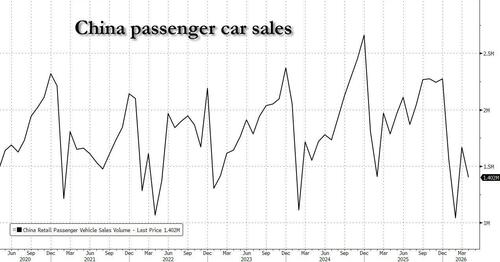
China's car sales plummeted by 21.5% in April, reaching a low of 1.4 million units, the weakest since the 2022 Covid lockdowns, according to Bloomberg data cited by OilPrice.com. This decline, driven by a 30% drop in internal combustion engine (ICE) vehicle sales and a 6.8% fall in electric vehicle (EV) and hybrid sales, reflects more than just high fuel prices or subsidy rollbacks. It points to systemic economic challenges in the world's second-largest economy, with far-reaching implications for global supply chains and commodity markets that mainstream coverage often underplays.
The original reporting attributes the sales slump to higher fuel costs, reduced EV subsidies, and weaker consumer purchasing power amid Middle East tensions. However, this analysis misses the broader structural issues within China's economy. Beyond immediate factors like fuel prices, the decline in car sales is a symptom of stagnant wage growth, rising unemployment, and a property sector crisis that has eroded household wealth. Data from the National Bureau of Statistics of China shows urban unemployment rose to 5.2% in early 2023, while youth unemployment remains alarmingly high at over 14%. The property market, which accounts for roughly 25% of China's GDP, continues to falter with developers like Evergrande defaulting on debts, further dampening consumer confidence.
Moreover, the shift toward new energy vehicles (NEVs), which now comprise 60% of new car sales, masks a critical vulnerability: China's EV boom relies heavily on lithium and cobalt imports, markets already strained by geopolitical tensions and supply chain bottlenecks. The International Energy Agency (IEA) notes in its 2023 World Energy Outlook that China accounts for over 50% of global lithium processing capacity, yet remains dependent on volatile supply chains from countries like Australia and Chile. A slowdown in EV sales, even if modest compared to ICE vehicles, could signal peaking domestic demand, risking overcapacity in China's battery and EV manufacturing sectors—a ripple effect that could destabilize global commodity prices.
The original coverage also overlooks the global implications of cratering gasoline demand in China, the world's largest crude oil importer. While China's strategic reserves (estimated at 1-1.3 billion barrels) buffer against supply shocks like those from the Strait of Hormuz, a sustained drop in demand could depress global oil prices, impacting OPEC+ strategies and energy exporters like Saudi Arabia and Russia. Conversely, reduced Chinese demand for automotive components—ranging from steel to semiconductors—could exacerbate supply chain disruptions already strained by post-Covid recovery and the Ukraine conflict. The World Trade Organization's 2023 report highlights that China accounts for nearly 30% of global manufacturing exports, meaning any contraction in its domestic market reverberates worldwide.
Finally, the interplay between China's economic slowdown and its geopolitical ambitions deserves scrutiny. Beijing's push for NEV dominance is not just an environmental or economic strategy but a geopolitical one, aimed at reducing reliance on foreign oil while asserting leadership in green tech. Yet, if domestic consumption falters, as current car sales data suggests, China may double down on exports, potentially intensifying trade tensions with the U.S. and EU, both of which have already raised concerns over Chinese EV dumping and subsidies.
In sum, China's car sales slump is not merely a domestic issue of fuel prices or subsidies but a warning sign of deeper economic fragility. Its cascading effects on global energy markets, supply chains, and geopolitical dynamics are critical yet underexplored dimensions of this story.
MERIDIAN: China's economic slowdown, evidenced by cratering car sales, may accelerate export-driven strategies in the EV sector, risking trade conflicts with the West within the next 12 months.
Sources (3)
- [1]China's Car Sales Slump As Gasoline Demand Craters(https://www.zerohedge.com/economics/chinas-car-sales-slump-gasoline-demand-craters)
- [2]World Energy Outlook 2023 - International Energy Agency(https://www.iea.org/reports/world-energy-outlook-2023)
- [3]World Trade Report 2023 - World Trade Organization(https://www.wto.org/english/res_e/publications_e/wtr23_e.htm)