Australia's 2026 Defence Recalibration: Hedging Doubts on US Reliability While Building Integrated Deterrence Against China
Australia's 2026 NDS and IIP updates signal a maturing Indo-Pacific strategy focused on countering Chinese military coercion through enhanced self-reliance, civil preparedness, long-range maritime strike, and deeper AUKUS and Quad integration, while pushing defense spending toward 3% of GDP amid doubts about future U.S. reliability.
While Defense News accurately reports the spending figures and priority lists in Australia's newly released National Defence Strategy 2026 and Integrated Investment Program, its coverage treats the documents as little more than an incremental refresh. This misses the deeper strategic signal: Canberra is executing a long-term repositioning to counter Chinese coercion in the Indo-Pacific, quietly preparing for a future in which American extended deterrence cannot be taken for granted.
The language in the NDS is deliberately calibrated. References to "a more overt struggle among states" where "thresholds against the use of force are being eroded" and risks "not seen since the Second World War" directly echo classified assessments circulating since China's 2022-2023 Pacific island diplomatic offensive and intensified South China Sea militia operations. What the original reporting understates is how these documents synthesize lessons from three parallel developments: Russia's attritional war in Ukraine, which exposed Western munitions and fuel vulnerabilities; Beijing's rapid expansion of its naval fleet to over 370 ships; and domestic American political volatility that has Australian planners privately questioning long-term U.S. commitment.
The decision to broaden the definition of national defense beyond purely military domains to encompass civil preparedness, fuel stockpiles, and economic security represents a significant evolution from the 2024 strategy. This mirrors the "total defense" models adopted by Taiwan, Singapore, and the Baltic states. Mick Ryan's Lowy Institute assessment correctly notes continuity, yet even he underplays how the explicit inclusion of economic security implicitly targets over-reliance on Chinese supply chains, a vulnerability exposed during the COVID-era trade coercion campaign against Australian coal, wine, and barley.
Synthesizing the official Australian documents with the Lowy Institute's 2026 strategy review and a recent ASPI report on "integrated deterrence," three key adjustments stand out. First, the 41 percent allocation to maritime capabilities combined with accelerated long-range strike and uncrewed systems is explicitly designed to impose costs on PLA Navy operations in a Taiwan contingency or blockade scenario, aligning Australian planning with classified U.S. and Japanese operational concepts. Second, the priority on a resilient multi-orbit satellite network and integrated air and missile defense addresses glaring deficiencies that Chinese DF-21 and DF-26 "carrier killer" missiles would otherwise exploit. Third, the A$53 billion additional funding over the decade, pushing toward 3 percent of GDP by 2033-34, functions as both capability investment and strategic communication to Washington, Tokyo, and Beijing alike.
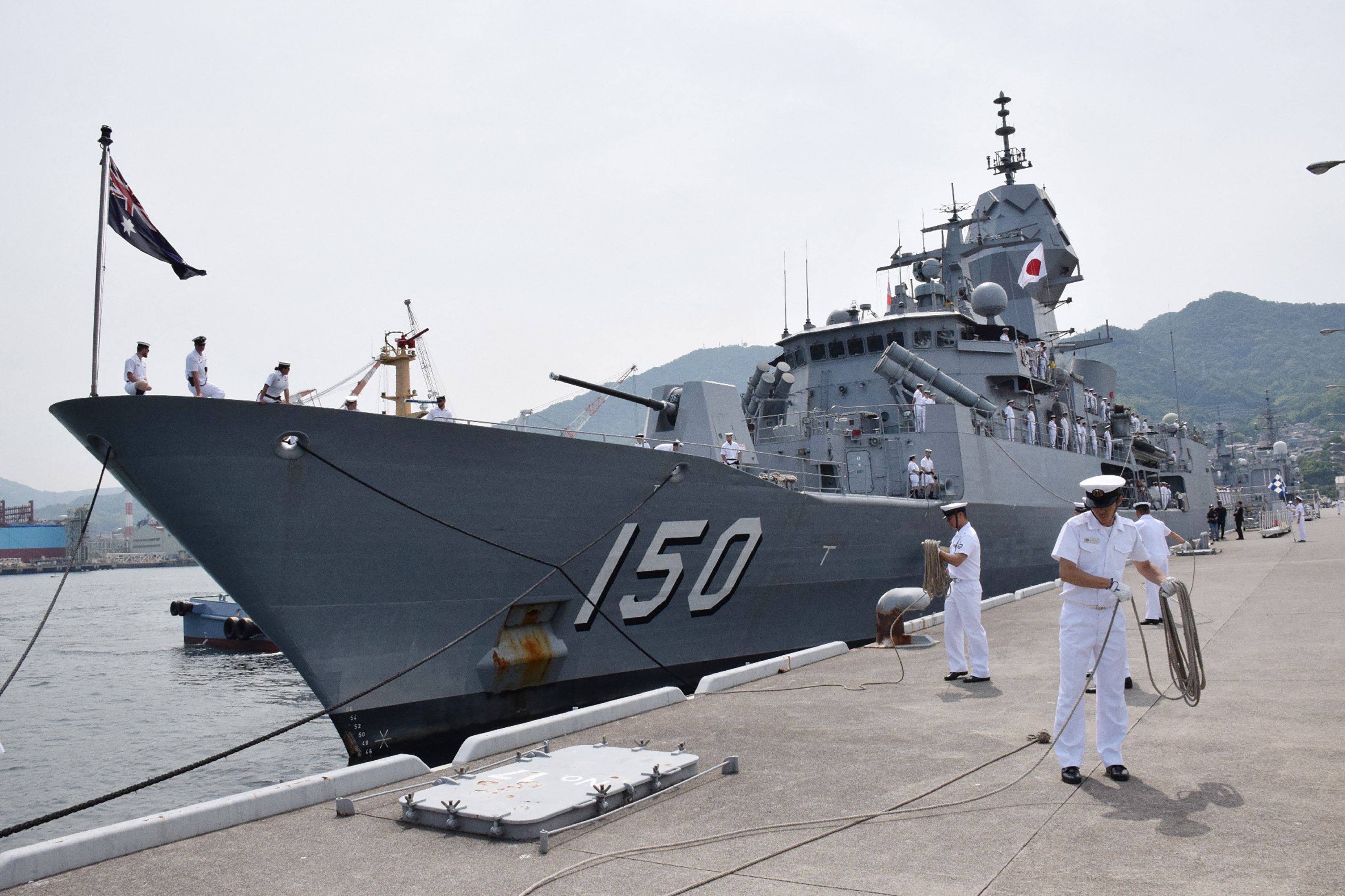
These moves illuminate alliance shifts frequently absent from daily coverage. The reaffirmed U.S. relationship is now framed as one pillar among several. Port visits such as HMAS Anzac to Japan's Kure base are not ceremonial; they foreshadow deeper industrial integration under AUKUS Pillar 2 and the emerging "Squad" architecture linking the U.S., Japan, Australia, and the Philippines. Canberra is transitioning from consumer to co-producer of advanced military technology, reducing the historical asymmetry in the alliance.
The coverage also glossed over timing. Commencing a medium-range air defense program in 2026 is no accident. It aligns with projected PLA modernization milestones around 2027-2030 and anticipated peak tensions over Taiwan. By prioritizing sovereign industrial resilience and autonomous systems, Australia is applying Ukraine-derived lessons: in high-intensity conflict, attritional mass and rapid reconstitution matter more than exquisite platforms alone.
Ultimately, these documents reflect Canberra's conclusion that the era of strategic warning has shortened dramatically. The refined strategy is less about dramatic departure than about locking in momentum before domestic budgets tighten and great-power competition intensifies further. In an environment where thresholds for gray-zone coercion continue eroding, Australia's willingness to spend nearly A$900 billion over a decade while broadening its definition of defense sends the clearest signal yet that it intends to be a formidable actor, not a bystander, in the emerging Indo-Pacific order.
SENTINEL: Australia's trajectory toward 3% GDP defense spending and whole-of-nation resilience reveals preparation for protracted high-intensity conflict with China; expect accelerated AUKUS technology sharing and forward deployment of long-range strike systems in northern Australia by 2030.
Sources (3)
- [1]Australia refines its defense strategy and investment plan(https://www.defensenews.com/global/asia-pacific/2026/04/17/australia-refines-its-defense-strategy-and-investment-plan/)
- [2]Lowy Institute: The 2026 National Defence Strategy(https://www.lowyinstitute.org/publications/2026-national-defence-strategy)
- [3]ASPI Strategist: Total Defence and Economic Resilience(https://www.aspistrategist.org.au/australias-2026-nds-total-defence/)