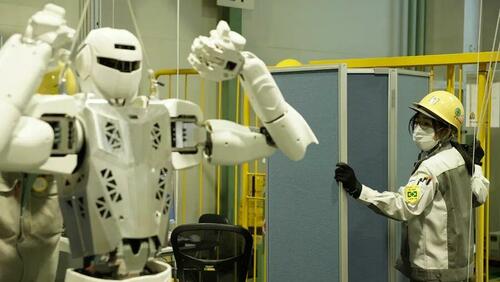
Japan Advances Sovereign AI and Robotics Strategy with 10 Million Robot Target by 2040
Japan's updated AI robotics strategy targets 10M robots by 2040 across 18 sectors via Noetra consortium and up to $6.1B funding, part of a $2.3T broader investment plan, driven by labor shortages and sovereign tech goals. Corroborated by multiple mainstream outlets.
Japan has formalized an ambitious update to its national AI and robotics strategy, aiming to deploy approximately 10 million AI-equipped robots across 18 sectors by 2040 to address severe labor shortages driven by its aging population. The plan, announced by Industry Minister Ryosei Akazawa, expands on a broader 14-year growth strategy unveiled last month targeting ¥370 trillion ($2.3 trillion) in combined public and private investment across 17 priority areas, including physical AI, semiconductors, quantum technology, and nuclear fusion.[1][2]
Central to the initiative is the development of a domestically controlled multimodal foundation model for 'physical AI'—AI systems capable of processing language, images, video, and sensor data to enable robots to operate autonomously in real-world environments. This model will be developed by Noetra, a new consortium majority-owned by SoftBank, NEC, Sony Group, and Honda, in collaboration with Japan's National Institute of Advanced Industrial Science and Technology (AIST). The government has committed up to 1 trillion yen (about $6.1 billion) in funding over five years, subject to milestone reviews, with an initial 380 billion yen allocation for fiscal 2026.[3][4]
The strategy now covers 18 sectors, newly including restaurants, food manufacturing, and medicine, building on Japan's existing dominance in industrial robotics—producing roughly half of global industrial robots and leading in robot density per manufacturing worker. This push for 'sovereign AI' seeks to reduce reliance on U.S. and Chinese technologies while leveraging national strengths in manufacturing and data infrastructure.[1]
Analysts note the plan's alignment with demographic realities: over 29% of Japan's population is aged 65 or older, with the working-age population declining since 1995. Robotics is positioned as a core solution for workforce gaps rather than mere augmentation. Early traction is evident in institutional backing from METI and NEDO, though success hinges on execution, private-sector participation (targeting up to 44 companies), and technical milestones in multimodal AI for robotics.[5]
[METI/NEDO]: Japan's focused execution on physical AI infrastructure and consortium-led models positions it to scale robotics adoption faster than peers, potentially mitigating 20-30% of projected labor gaps in targeted sectors by 2035 while exporting sovereign AI tech.
Sources (5)
- [1]Japan plans sovereign AI model and 10 million AI robots(https://www.japantimes.co.jp/news/2026/07/01/japan/japan-ai-plans/)
- [2]Japan aims to deploy 10 million AI robots by 2040(https://www3.nhk.or.jp/nhkworld/en/news/20260630_21/)
- [3]Japan plans sovereign AI model, 10 million AI robots(https://www.channelnewsasia.com/east-asia/japan-plans-sovereign-ai-model-10-million-ai-robots-6223956)
- [4]Japan wants 10 million more robots by 2040, some providing medical care(https://www.theregister.com/ai-and-ml/2026/07/01/japan-wants-10-million-more-robots-by-2040-some-providing-medical-care/5264813)
- [5]Japan Bets on AI Robots to Solve a Worker Shortage(https://www.artificialintelligence-news.com/news/japan-ai-robots-2040-national-ai-model/)