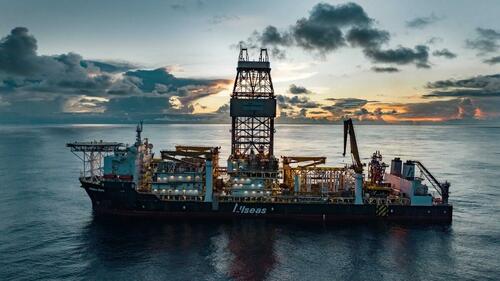
Deep-Sea Mining Approval Signals Shift in Global Critical Mineral Supply Chains Amid Environmental and Geopolitical Tensions
The U.S. approval of The Metals Company’s deep-sea mining plan in the Pacific’s Clarion-Clipperton Zone marks a strategic move to secure critical minerals amid tensions with China, but it raises environmental risks and legal disputes over international seabed governance. This could impact commodity prices and green tech investments while straining diplomatic ties.
On May 1, the Trump administration, through the National Oceanic and Atmospheric Administration (NOAA), approved the first deep-sea mining exploration application by The Metals Company USA (TMC), a subsidiary of a Canadian firm, targeting critical minerals in the Pacific Ocean's Clarion-Clipperton Zone (CCZ). This decision, as reported by NOAA, marks a pivotal moment in the U.S. strategy to secure domestic supplies of nickel, copper, cobalt, and manganese—minerals essential for electric vehicle batteries, infrastructure, and defense systems. While the original coverage by ZeroHedge and The Epoch Times highlights the procedural milestone and TMC’s ambitious estimates of resource yields (e.g., 17 million tons of nickel), it underplays the broader geopolitical, environmental, and economic implications of this move. This analysis delves into these overlooked dimensions, situating the approval within global supply chain dynamics, environmental debates, and international legal frameworks.
Geopolitical Context and Supply Chain Implications: The U.S. decision to expedite deep-sea mining permits under the Deep Seabed Hard Mineral Resources Act reflects a strategic pivot amid rising tensions with China, which dominates global critical mineral markets. According to the U.S. Geological Survey’s 2022 Mineral Commodity Summaries, China controls over 70% of cobalt refining and significant shares of nickel and manganese processing. The U.S. push for independent access to seabed resources, bypassing the International Seabed Authority (ISA) regulations still under negotiation, aligns with broader efforts to reduce reliance on foreign supply chains—a trend accelerated by China’s export restrictions on rare earths in 2023 (as documented by the U.S. Department of Commerce). This approval could depress global commodity prices for critical minerals in the medium term if TMC’s projected yields materialize, reshaping investment landscapes for green technologies. However, it risks escalating diplomatic friction, as several nations, including EU members, argue that unilateral U.S. action violates the 'common heritage of mankind' principle enshrined in the U.N. Convention on the Law of the Sea (UNCLOS), to which the U.S. is not a signatory.
Environmental Concerns and Green Tech Paradox: The original coverage mentions public opposition, such as comments against disrupting oxygen-producing nodules, but fails to explore the scientific and policy debates surrounding deep-sea mining’s ecological impact. Research published by the Deep-Sea Conservation Coalition (2023) warns that mining in the CCZ could irreversibly damage biodiversity hotspots, disrupt carbon sequestration processes, and release sediment plumes affecting marine ecosystems over vast areas. TMC claims its methods, using water jets to collect nodules, minimize impact, but independent studies, such as those by the University of Hawaii (2021), question the long-term consequences of such operations at 4-kilometer depths. This tension poses a paradox for green technology: while deep-sea minerals are vital for scaling up renewable energy infrastructure, their extraction could undermine environmental goals, potentially deterring ESG-focused investors and complicating the Biden administration’s climate agenda if it inherits this policy trajectory.
Missed Angles in Original Reporting: The ZeroHedge article overlooks the legal ambiguity of the U.S. acting outside ISA frameworks, a point of contention that could lead to international arbitration or trade retaliations. It also fails to connect this approval to parallel developments, such as Norway’s 2023 decision to open its continental shelf to deep-sea mining, signaling a broader race among nations to secure underwater resources (as reported by Reuters). Additionally, the economic feasibility of TMC’s plans remains unscrutinized—deep-sea mining costs are notoriously high, and market volatility for critical minerals could render the project unprofitable if prices fall, a risk not addressed in the optimistic framing of TMC CEO Gerard Barron’s statements.
Synthesis and Prediction: Drawing on primary documents like NOAA’s May 1 determination and secondary insights from the U.S. Geological Survey, this approval emerges as a double-edged sword. It positions the U.S. as a potential leader in critical mineral independence but risks alienating allies and exacerbating environmental degradation. The interplay between national security imperatives and global governance will likely define the next phase of deep-sea mining policy, with public comment periods and environmental reviews (set to conclude by early 2027) serving as battlegrounds for competing interests. A key uncertainty is whether technological advancements or regulatory pushback will outpace TMC’s operational timeline, potentially reshaping the economic calculus of deep-sea mining before commercial extraction begins.
MERIDIAN: The U.S. push for deep-sea mining may accelerate short-term access to critical minerals, but I anticipate legal challenges from ISA-aligned nations and potential delays if environmental reviews uncover significant ecosystem risks by 2027.
Sources (3)
- [1]NOAA Announcement on Deep-Sea Mining Application(https://www.noaa.gov/news-release/noaa-determines-compliance-for-deep-sea-mining-application)
- [2]U.S. Geological Survey 2022 Mineral Commodity Summaries(https://pubs.usgs.gov/periodicals/mcs2022/mcs2022.pdf)
- [3]Deep-Sea Conservation Coalition Report on Ecological Impacts(https://www.savethehighseas.org/reports/deep-sea-mining-impacts-2023)