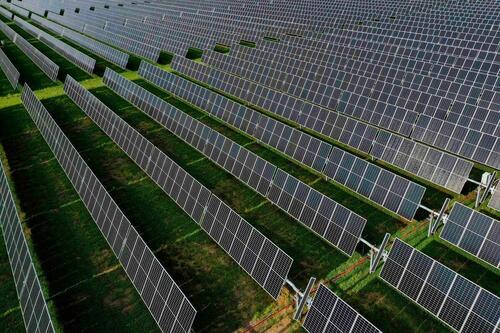
Solar Surpasses Coal in Texas ERCOT: Market Forces Drive Transition in Conservative Energy Heartland
EIA data confirms solar is poised to exceed coal generation in Texas's ERCOT grid in 2026 (or possibly 2025 per grid operator), driven by the state's deregulated market, cost economics, and demand surge—signaling organic transition in a conservative state less dependent on top-down policy.
According to the U.S. Energy Information Administration's May 2026 Short-Term Energy Outlook, utility-scale solar generation in the Electric Reliability Council of Texas (ERCOT) is forecast to reach 78 billion kWh in 2026, surpassing coal's projected 60 billion kWh for the first time on an annual basis. This marks a continuation of trends where solar's share of the ERCOT mix grew from 4% to 12% between 2021 and 2025 as coal fell from 19% to 13%, with roughly 40% of national solar capacity additions occurring in Texas this year. ERCOT itself has indicated solar already outproduced coal on an annual basis in 2025, suggesting the shift may be accelerating ahead of federal projections. What sets this apart in analyses is Texas's deregulated, energy-only market design, which relies on price signals rather than mandates, enabling rapid deployment of low-cost solar and battery storage amid exploding demand from population growth, manufacturing, and data centers. This organic, economics-driven progress in a Republican-led state rich in oil and gas resources challenges narratives framing renewable growth primarily as federal policy imposition. Natural gas remains dominant at around 44% of generation, with no new coal plants planned, but the pairing of solar with batteries is reshaping grid dynamics in ways that address intermittency through market incentives. Meanwhile, the Trump administration's 2025 efforts to curb subsidies, restrict foreign supply chains, and prioritize firm capacity have faced court challenges and shown limited impact on Texas's momentum, as red states accounted for a majority of recent solar additions nationally. A July 2025 Department of Energy report highlights rising outage risks from retiring 104 GW of firm capacity by 2030 without one-for-one replacement, underscoring tensions between intermittent renewables and reliability. Yet Texas's experience points to a deeper, underreported reality: deregulated markets and plunging solar costs can propel transition even amid federal pushback, potentially decoupling energy evolution from partisan frames and influencing broader U.S. trends where solar and wind are projected to rise to 21% of generation by 2027.
[LIMINAL]: Texas's deregulated grid proves solar's rise can be propelled by raw economics and abundant resources in red states, revealing a market-led energy shift that outpaces federal resistance and reframes the transition as pragmatic adaptation rather than imposed ideology.
Sources (4)
- [1]Electricity generation from solar could exceed coal in ERCOT for the first time in 2026(https://www.eia.gov/todayinenergy/detail.php?id=67685)
- [2]Solar to surpass coal in Texas power generation in 2026, EIA says(https://www.reuters.com/business/energy/solar-surpass-coal-texas-power-generation-2026-eia-says-2026-05-13/)
- [3]Solar to produce more power than coal in Texas, EIA says(https://www.eenews.net/articles/solar-to-produce-more-power-than-coal-in-texas-eia-says/)
- [4]Growth of Renewable Energy in US Defies Trump Attacks(https://earth.org/growth-of-renewable-energy-in-us-defies-trump-administrations-attacks/)