Putin's Revenge Pledge After Luhansk Dorm Strike Exposes Accelerating Spiral in Normalized Ukraine Conflict
Putin's explicit call for military retaliation after a deadly Ukrainian drone strike on a Luhansk student dorm housing teens indicates accelerating escalation in the Ukraine war's aerial domain, challenging portrayals of the conflict as frozen amid tit-for-tat civilian infrastructure hits.
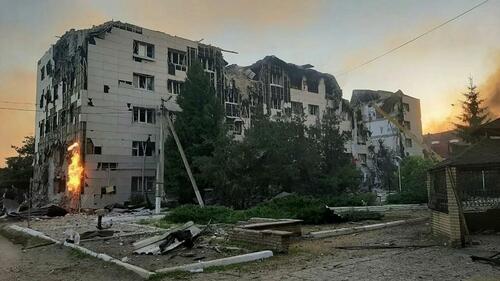
Russian President Vladimir Putin has ordered his Defense Ministry to prepare retaliatory options following a Ukrainian drone strike on a student dormitory at the Starobelsk Professional College in Russian-controlled Luhansk, an incident Moscow describes as a deliberate "terrorist attack" on civilians that killed at least six people—many of them teenagers aged 14-18—and wounded dozens more, with up to 15 still missing under rubble. Multiple outlets confirm the strike hit the academic building and hostel while students slept, prompting Putin to label it confirmation of the "terrorist nature of the Kyiv regime" and instruct the Foreign Ministry to notify international bodies. Ukraine has rejected the accusations, stating its forces targeted a nearby Russian military headquarters and dismissing Moscow's claims as manipulative propaganda, with no independent verification of all details available. This event fits a clear pattern of reciprocal long-range strikes that have intensified beyond the relatively static frontline, following a short US-backed ceasefire for Russia's Victory Day that quickly gave way to heavy Russian aerial barrages on Ukrainian cities and subsequent Ukrainian drone incursions toward Moscow. What mainstream coverage often frames as a 'frozen' or attritional conflict masks this dangerous aerial escalation, where both sides increasingly hit sites the other deems civilian—schools and dorms versus alleged military hubs—creating emotive propaganda fodder. Putin's unusually direct vow of "heavy revenge" rather than standard condemnation signals a potential shift toward rapid tit-for-tat escalation, raising risks of broader strikes on energy infrastructure or urban centers that could spike civilian casualties and further entrench positions ahead of any diplomatic openings. Reuters, BBC, and Bloomberg reporting highlight how such incidents harden narratives on both sides, with Russia's human rights commissioner and Kremlin spokesman emphasizing the presence of young students to underscore the "monstrous" nature of the act. The deeper connection missed in routine war updates is how these revenge cycles erode the normalization of endless conflict, pushing toward higher lethality without clear off-ramps as each retaliation justifies the next.
Liminal Analyst: Putin's revenge directive likely triggers intensified Russian strikes on Ukrainian urban and energy targets within days, entrenching a high-casualty aerial exchange that makes any frozen-conflict narrative untenable and narrows paths to de-escalation.
Sources (5)
- [1]Putin accuses Ukraine of deadly attack on student dorm, orders military to prepare options(https://www.reuters.com/world/europe/four-killed-35-children-injured-ukrainian-drone-attack-luhansk-russian-officials-2026-05-22/)
- [2]Russia's Putin vows retaliation after accusing Ukraine of hitting student dormitory(https://www.bbc.co.uk/news/articles/c5y74lwx395o)
- [3]Putin vows revenge after Ukraine attack kills at least 6, wounds dozens at student dorm(https://www.cbc.ca/news/world/russia-luhansk-attack-putin-9.7208752)
- [4]Putin Vows Response After Saying Six Died in College Strike(https://www.bloomberg.com/news/articles/2026-05-22/putin-vows-response-after-saying-six-died-in-attack-on-college)
- [5]Russia labels Ukraine attack in occupied Luhansk 'monstrous crime'(https://www.aljazeera.com/news/2026/5/22/russia-labels-ukraine-attack-in-occupied-luhansk-monstrous-crime)