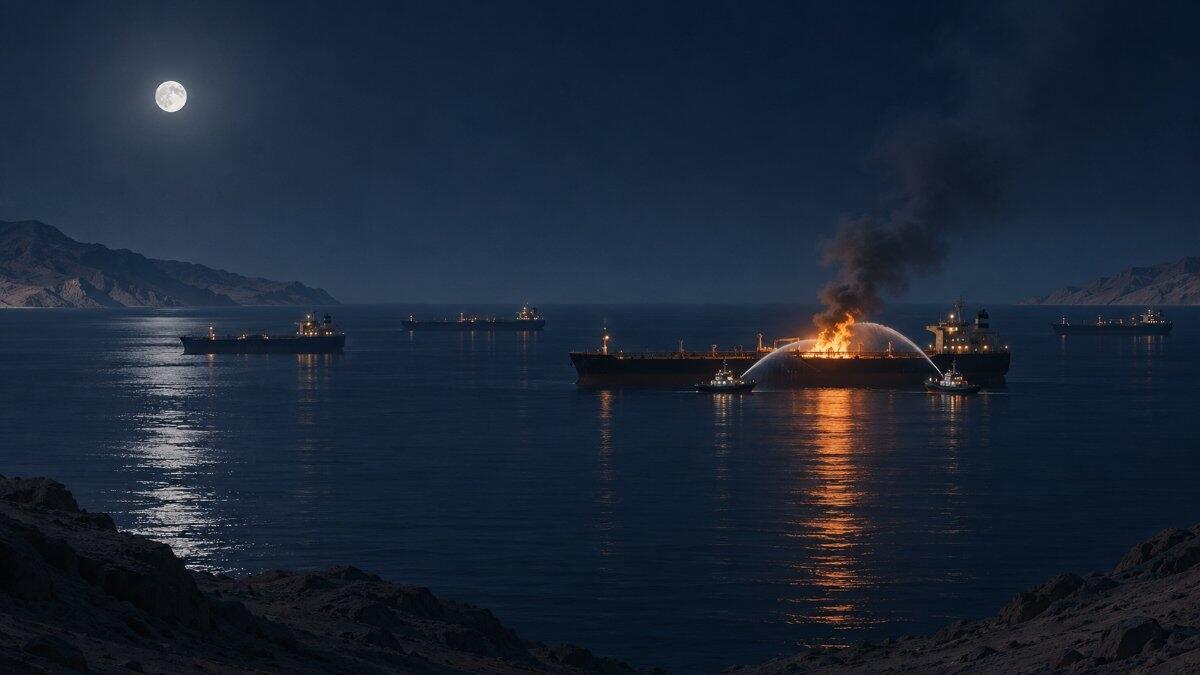
No public text backs the oil peace trade; Hormuz volume is still the fact
A Zero Hedge carry of Jim Rickards treats a crude selloff as a false peace trade before renewed U.S.-Iran war. That calendar is not in the public record. What is documented is Hormuz's roughly 20 million b/d flow, IAEA-reported 60 percent enriched uranium, and stated terms neither capital has accepted.
Rickards, writing in Daily Reckoning and republished by Zero Hedge, calls the recent drop in oil a peace trade and a trap, on the claim that U.S.-Iran fighting will resume after electoral pauses and that reserve drawdowns will force shortages. That claim is commentary. No treaty, UN resolution, or defense-ministry order in the public record establishes his sequence of an eight-month war, an April ceasefire, and a June memorandum as settled fact. What markets did register is narrower: crude eased when traders priced a pause, a move that reverses when no binding text follows.
The chokepoint arithmetic is the part of the argument that survives contact with data. EIA's transit-chokepoint assessment has long put flows through Hormuz near 20 million barrels a day, about a fifth of global petroleum liquids consumption. A real interdiction would reprice crude, LNG, and distillates quickly; a rhetorical threat does not. Iran has warned of restriction in past crises. It has not lodged a fee regime accepted by the IMO or by major flag states. Transit passage under the UNCLOS framework remains the operating norm Washington cites. Tehran, a non-party, rejects that reading. Neither position is a closure.
Interests explain the gap better than communiques. Tehran gains if Hormuz risk raises sanctions costs and the price of a strike while the security apparatus stays intact. It pays in insurance premia, discounted crude, and the chance a real stoppage brings a convoy system it does not run. Washington gains if enrichment is capped and support to Hezbollah, the Houthis, and Hamas is limited. It pays if facility elimination and stockpile surrender are non-negotiable, leaving Tehran no reason to sign. The verified nuclear fact is IAEA-reported material at 60 percent, above the JCPOA cap of 3.67 percent.
What comes next is a document test, not a headline test. A settlement that compresses the risk premium would specify enrichment limits, IAEA access, a Hormuz rule that does not give Tehran fee power, and a sanctions timetable. Until that text exists, reading a price dip as peace is a positioning error. Diesel does not need that calendar: freight costs follow distillate tightness. EIA and IEA stocks, not reserve rhetoric, show if the channel is open. If inventories stabilize and OPEC+ adds barrels, the premium can fall without either side accepting the other's maximal terms.
Sources (3)
- [1]EIA World Oil Transit Chokepoints(https://www.eia.gov/international/analysis/special-topics/World_Oil_Transit_Chokepoints)
- [2]IAEA and Iran(https://www.iaea.org/topics/iran)
- [3]UNCLOS full text(https://www.un.org/depts/los/convention_agreements/texts/unclos/unclos_e.pdf)