Chinese EV Expansion into Western 'Zombie' Factories Signals Industrial Displacement Beyond Mere Competition
Chinese EV companies like Leapmotor, Geely, and BYD are acquiring idle Western factories from Stellantis, Ford, and others in Europe and Brazil to bypass tariffs and expand globally, potentially reaching 35% world market share by 2030 per UBS. This reflects structural manufacturing reversal and supply chain realignment beyond standard competition.
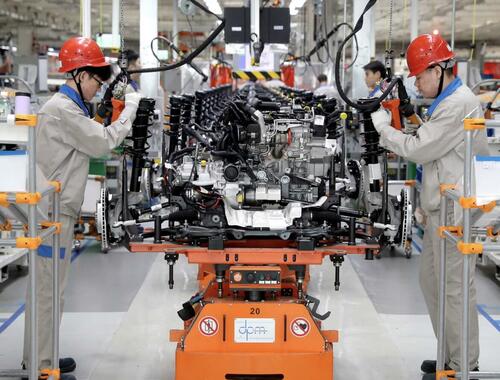
Recent partnerships between Chinese EV manufacturers and struggling Western automakers reveal a deeper structural shift in global manufacturing. Rather than simply competing in the marketplace, Chinese firms are strategically repurposing idle factories in Europe and Latin America, inheriting physical infrastructure while leveraging their dominance in low-cost battery supply chains. According to a Nikkei report, Stellantis has opened facilities in France and Spain to Dongfeng and Leapmotor, while Geely is set to restart an idle production line at Ford's Valencia plant in Spain. This marks the first time a major Western carmaker has offered European manufacturing lines to a Chinese brand.
UBS analysts project that Chinese brands could expand from 25% to 35% of the global auto market by 2030, driven by a roughly $2,000 per vehicle cost advantage in batteries that persists due to scale, R&D, and supply chain control. The report explicitly warns of "structural market share loss" for foreign automakers. Mainstream coverage often frames these moves as pragmatic responses to tariffs and local content rules—Leapmotor plans to source components within Europe at Stellantis plants to bypass EU tariffs of over 30%. Yet this obscures the industrial displacement: Western legacy firms like Volkswagen admit to excess capacity and are reducing production by millions of vehicles, effectively ceding manufacturing real estate.
Reuters and CNBC reporting confirm Geely's acquisition of Ford's Body 3 assembly hall in Spain for GEA platform vehicles, allowing hybrid, PHEV, and EV production while utilizing underused assets. Similar talks involve BYD exploring Stellantis and other legacy plants across Europe, despite setbacks like labor controversies at its renovated former Ford site in Brazil. These arrangements provide Chinese firms faster market access and political cover—local economies "get a cut" through jobs—while Western partners monetize dormant facilities.
The pattern points to supply-chain realignment: China's control over battery inputs creates dependencies that extend beyond sales into ownership of production footprints. Citigroup analysts have noted the irony of Chinese firms inheriting Europe's regulatory and labor complexities, yet the trend continues as building anew requires "tons of extra preparation." WSJ coverage highlights this as a test case for collaboration amid the rise of low-cost Chinese EVs. What others frame as mutual benefit masks a reversal where the West's automotive heritage infrastructure now serves as global launchpads for Beijing-aligned manufacturers, accelerating deindustrialization trends and locking in long-term technological and economic dependencies.
LIMINAL: This is not win-win competition but asymmetric industrial succession—Western firms downsizing core capacity while Chinese players inherit factories, absorb know-how, and lock in battery-dependent supply chains, hastening Europe's manufacturing hollowing and a multipolar realignment favoring Beijing's EV ecosystem by 2030.
Sources (5)
- [1]Chinese EV makers awaken Western rivals' zombie production lines(https://asia.nikkei.com/business/automobiles/chinese-ev-makers-awaken-western-rivals-zombie-production-lines)
- [2]Jeep Maker Stellantis to Help Build Chinese Cars in Europe(https://www.wsj.com/business/autos/stellantis-and-chinas-leapmotor-deepen-ties-to-drive-european-ev-expansion-99a47e70)
- [3]Chinese carmaker Geely buys Ford assembly facilities in Spain, local media reports(https://www.reuters.com/business/autos-transportation/chinese-carmaker-geely-buys-ford-assembly-facilities-spain-local-media-reports-2026-05-06/)
- [4]How is the electric vehicle world shifting?(https://www.ubs.com/global/en/investment-bank/insights-and-data/articles/electric-vehicle-world-shifting.html)
- [5]Stellantis' Leapmotor partnership points to a wider(https://www.cnbc.com/2026/05/13/autos-stellantis-leapmotor-europe-china-evs.html)