Hormuz Ceasefire Eases Supply Shock but Exposes Deeper Vulnerabilities in Global Energy Architecture
Neutral analysis of the US-Iran-Israel Hormuz ceasefire as resolution of acute oil supply shock post widespread Gulf infrastructure damage. Synthesizes Trump's primary statement, Iranian FM remarks, EIA chokepoint data, and IEA market reports to highlight historical patterns, inflation linkages, and what immediate coverage omitted regarding production recovery lags and regional risk premia.
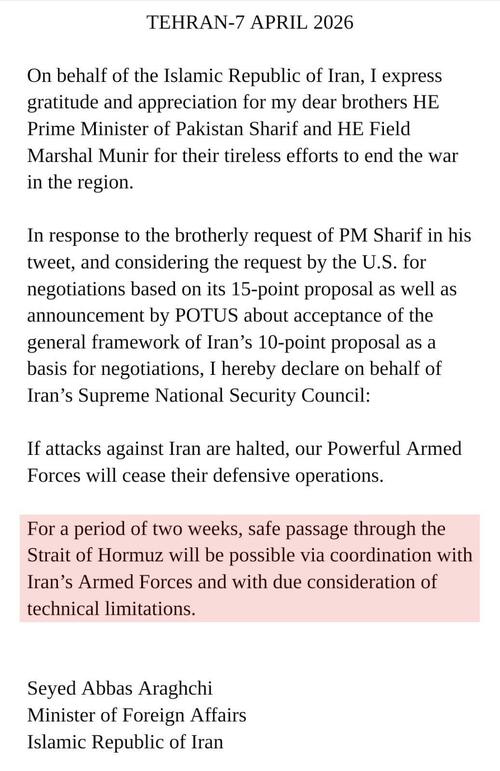
The announced two-week ceasefire between the United States, Iran, and Israel, coupled with Tehran's commitment to safe passage through the Strait of Hormuz, directly addresses an acute supply shock triggered by damage to approximately 75 percent of Gulf energy infrastructure. President Trump's statement, issued via Truth Social and reproduced in the ZeroHedge coverage, frames the pause as grounded in exceeded military objectives and a workable 10-point Iranian proposal. Iran's Foreign Minister Abbas Araghchi, cited in state media, confirmed acceptance of Pakistan's mediation proposal under the new Supreme Leader while explicitly noting negotiations would proceed with "complete distrust."
This development must be read against primary documents rather than secondary spin. Trump's announcement references prior conversations with Pakistani Prime Minister Shehbaz Sharif and Field Marshal Asim Munir, positioning Islamabad as an unlikely but pivotal interlocutor. The text also states that "almost all of the various points of past contention have been agreed to," suggesting back-channel alignment on enrichment limits, sanctions relief, and regional security guarantees that mainstream reporting has not yet detailed.
Original coverage correctly captured immediate market reaction—WTI futures dropping 16 percent, equities rising, gold and Bitcoin advancing—but missed the structural implications of widespread physical damage to terminals, pipelines, and storage facilities across Saudi Arabia, UAE, Iraq, and Iranian facilities. EIA primary data on world oil transit chokepoints (updated 2024) shows the Strait carries roughly 21 million barrels per day, or 21 percent of global petroleum liquids. Even with safe passage restored, full production recovery timelines likely extend beyond the ceasefire window, a pattern seen in the 1980s Tanker War where Iranian and Iraqi attacks on neutral shipping (documented in declassified U.S. Navy records from Operation Earnest Will) produced multi-month lags in export normalization.
Multiple perspectives emerge. The U.S. and Israeli positions, per White House and CNN-sourced statements, treat the pause as tactical de-escalation after achieving stated goals, preserving leverage for final agreement. Iranian statements emphasize sovereignty and distrust, consistent with patterns following the 2018 U.S. withdrawal from the JCPOA. Gulf producers, though not directly quoted in the ZeroHedge piece, face dual pressure: short-term revenue loss from damaged assets and longer-term reputational risk to OPEC+ cohesion. Global consumers, particularly import-dependent economies in Europe and Asia, view the development through the lens of inflation stabilization. IMF staff notes on energy price pass-through (2022-2024 series) indicate a sustained $10-15 per barrel drop could shave 0.4-0.7 percentage points off headline CPI in advanced economies within two quarters.
Connections to related events clarify what coverage overlooked. The current shock follows sequential disruptions: Houthi Red Sea attacks (2023-2024), Russian supply rearrangements post-2022, and repeated Israeli strikes on Iranian proxies. Each episode reinforced risk premia in oil futures curves. The present ceasefire mirrors fragile 1988 ceasefires and the 2019-2020 tanker incidents, where temporary Hormuz openings failed to prevent subsequent escalations when underlying political disputes remained unresolved. Synthesis with the International Energy Agency's October 2024 Oil Market Report further suggests that spare capacity outside the Gulf (primarily U.S. shale and Brazilian pre-salt) can mitigate only about 40 percent of the identified shortfall in the near term.
The guaranteed safe passage therefore resolves the immediate maritime threat but does not automatically restore upstream production or repair downstream infrastructure. Inflation implications are thus bifurcated: near-term relief in transport and manufacturing costs contrasted against potential secondary spikes if reconstruction commodity demand (steel, cement, specialized equipment) coincides with winter heating season in the Northern Hemisphere. Historical parallels—from the 1979 Iranian Revolution to the 1990-91 Gulf Crisis—demonstrate that energy price shocks rarely resolve linearly; instead they cascade through currency markets, sovereign debt yields, and central bank decision trees.
Viewed neutrally, the two-week window functions as both a pressure-release valve and a diagnostic period. Whether it evolves into the "definitive Agreement concerning Long-term PEACE" referenced by President Trump, or reverts to renewed closure of the Strait, will be determined by verifiable compliance metrics rather than statements alone. Primary monitoring of tanker tracking data from Lloyd's List Intelligence and satellite imagery of repair activity at key terminals will prove more decisive than diplomatic rhetoric in assessing trajectory.
MERIDIAN: The two-week Hormuz opening immediately eases maritime risk premia and supply shock, yet extensive physical damage to Gulf assets means production recovery will lag, sustaining upward pressure on global oil prices and core inflation through late 2025 unless reconstruction accelerates.
Sources (3)
- [1]US, Iran, Israel Agree To 2-Week Ceasefire; Tehran Will Allow Safe Passage Via Hormuz For Two Weeks(https://www.zerohedge.com/energy/75-gulf-energy-assets-damaged-us-iran-war-supply-shock-intensifies)
- [2]World Oil Transit Chokepoints(https://www.eia.gov/international/analysis/special-topics/World_Oil_Transit_Chokepoints)
- [3]Oil Market Report - October 2024(https://www.iea.org/reports/oil-market-report-october-2024)