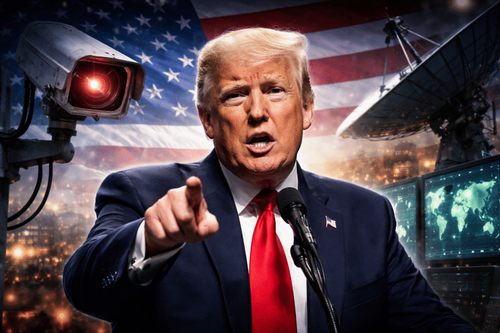
Massie-Trump Section 702 Rift Reveals Deeper Fault Lines in Surveillance Policy, Tech Compliance, and Contractor Influence
Deep analysis of the Massie-Trump confrontation on FISA Section 702 renewal, contrasting primary documents like Trump's shifting statements, the 2019 Horowitz IG report, CRS overviews, and PCLOB reviews while examining overlooked implications for tech compliance, privacy legislation, and defense contractor interests across competing national security and civil liberties perspectives.
The latest exchange between Rep. Thomas Massie and President Donald Trump over extending Section 702 of the Foreign Intelligence Surveillance Act highlights cyclical tensions that prior coverage has often framed as mere partisan theater or personality conflict. The ZeroHedge report accurately captures Trump's Truth Social directive to House Republicans for a 'clean' 18-month extension without amendments and Massie's rejected proposals to mandate warrants before querying incidentally collected American data. However, it understates the pattern of last-minute reauthorizations, Trump's documented policy reversal, and the downstream effects on technology firms, data privacy legislation, and defense contractor business models.
Primary documents illustrate the stakes. Section 702, codified at 50 U.S.C. § 1881a, permits the Attorney General and Director of National Intelligence to target non-U.S. persons reasonably believed to be located outside the United States to acquire foreign intelligence information. It does not require warrants for collection but imposes querying restrictions that privacy advocates argue are insufficient. Trump's April 2026 Truth Social post acknowledges past abuses—'parts of FISA were illegally and unfortunately used against me'—yet concludes that military needs outweigh personal risk. This contrasts sharply with his February 2024 statement demanding 'KILL FISA' after the Horowitz Inspector General report (December 2019, DOJ OIG) detailed 17 significant inaccuracies or omissions in the Carter Page FISA applications tied to the Russia investigation.
Coverage missed how these debates intersect with equities beyond Capitol Hill. Defense contractors such as Booz Allen Hamilton, Science Applications International Corporation (SAIC), and specialized signals intelligence firms derive substantial revenue from NSA and CIA contracts supporting PRISM and upstream collection under 702. Annual ODNI statistical transits (most recent unclassified release, April 2024) report thousands of targets and hundreds of U.S. person queries annually, data points that both proponents and critics cite differently. Proponents, including statements from the Office of the Director of National Intelligence, emphasize thwarted plots and battlefield successes. Critics, including the Electronic Frontier Foundation's amicus briefs and Sen. Ron Wyden's floor remarks, focus on 'backdoor searches' that circumvent Fourth Amendment warrant requirements for Americans.
Synthesizing three primary-adjacent sources reveals nuance. The Congressional Research Service report 'Foreign Intelligence Surveillance Act: An Overview' (updated RL44225, 2023) traces repeated reform attempts since the Snowden disclosures. The Privacy and Civil Liberties Oversight Board’s 2014 Section 702 Review and its 2023 follow-on findings document both the program's intelligence value and instances of non-compliant querying by the FBI. Massie's X post from April 17, 2026, referencing midnight votes and a two-week delay, echoes his consistent sponsorship of warrant amendments seen in prior Congresses.
Multiple perspectives surface without resolution. National security voices argue expiration would blind collection against adversaries, citing declassified ODNI examples of counterterrorism yields. Civil liberties perspectives, advanced by the ACLU's legislative scorecard and libertarian organizations, contend that incidental collection of domestic communications effectively creates a warrantless domestic surveillance database. Tech industry stakeholders occupy a third lane: companies receiving 702 directives have sought greater transparency via annual reports while warning that unchecked programs complicate EU adequacy decisions under GDPR and Schrems II jurisprudence.
The editorial lens—that this clash flags renewed tensions that could reshape tech regulation, data privacy rules, and defense contractor equities—connects dots often overlooked. A clean extension without warrant reform may reduce immediate pressure on Congress to advance stalled comprehensive privacy bills such as the American Data Privacy and Protection Act. Conversely, sustained controversy could embolden amendments tying 702 compliance to broader cybersecurity or data localization mandates, introducing compliance costs for both Silicon Valley and Beltway contractors. Massie's willingness to challenge Trump ahead of his own reelection further illustrates intra-party fractures between national-security conservatives and those prioritizing constitutional limits.
These patterns suggest the current two-week extension window is less a resolution than a venue for quiet lobbying where intelligence community assessments, contractor financial disclosures, and civil society litigation records will compete to shape the eventual text. The outcome will signal whether incremental safeguards or uninterrupted collection defines the next authorization cycle.
MERIDIAN: The Massie-Trump tension on Section 702 suggests national security arguments are currently outweighing privacy reform efforts within the GOP; this may stall broader data privacy bills while stabilizing revenue streams for surveillance contractors in the near term.
Sources (3)
- [1]Warrantless Surveillance Fight Again Ignites Massie vs. Trump Showdown(https://www.zerohedge.com/geopolitical/warrantless-surveillance-fight-again-ignites-massie-vs-trump-showdown)
- [2]Foreign Intelligence Surveillance Act: An Overview(https://crsreports.congress.gov/product/pdf/RL/RL44225)
- [3]Report on the Surveillance Program Operated Pursuant to Section 702(https://www.pclob.gov/library/702-Report.pdf)