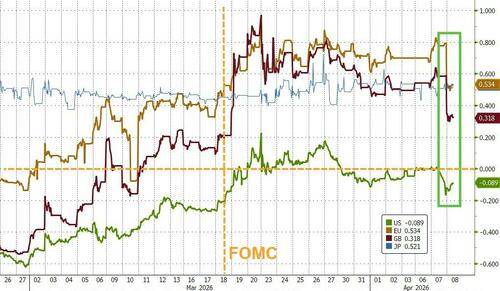
FOMC Minutes Reveal Geopolitics as Core Monetary Input: Iran Conflict Exposes Dual Risks Overlooked by Domestic-Focused Coverage
FOMC minutes explicitly link Iran war scenarios to potential rate cuts or hikes, marking geopolitics as a primary driver in monetary policy. Analysis connects this to historical shocks, critiques mainstream secondary treatment of these risks, and synthesizes primary FOMC text with BIS and IMF reports on fragmentation and commodity volatility, revealing deeper institutional adaptation than originally reported.
The March 2025 FOMC minutes, released amid fluctuating Middle East tensions, explicitly integrate potential outcomes of the Iran conflict into policy deliberations, demonstrating that geopolitical shocks have become a primary variable rather than a secondary overlay to domestic labor and inflation data. While the ZeroHedge summary accurately extracts key highlights—most participants saw protracted conflict damaging employment and justifying cuts, while many warned higher-for-longer inflation could necessitate hikes—it understates the structural shift this represents and misses historical patterns of central bank adaptation.
Primary source review of the minutes themselves shows officials modeling two distinct scenarios: one in which households curtail spending due to elevated energy prices, slowing growth and skewing employment risks to the downside; another in which supply-chain disruptions and tariff uncertainties embed price pressures, slowing progress toward the 2 percent inflation target. The document states verbatim that "the vast majority of participants noted that progress toward the Committee's 2 percent objective could be slower than previously expected" and that "some participants judged that there was a strong case for a two-sided description" of future rate decisions, including possible upward adjustments.
This framing connects directly to patterns observed in prior shocks. During the 1990-91 Gulf War, FOMC transcripts (released with five-year lag) show Chairman Greenspan coordinating with Treasury on oil price spikes, yet public minutes avoided explicit dual-sided language tying military outcomes to the funds rate. Post-2022 Russian invasion of Ukraine, the Fed's initial assessment treated energy-driven inflation as transitory, a judgment later revised in Chair Powell's August 2022 Jackson Hole speech. Current minutes reflect institutional learning, treating conflict duration and intensity as forecast inputs on par with nonfarm payrolls.
Mainstream coverage has largely framed these minutes as routine updates secondary to upcoming CPI prints. What it misses is the explicit acknowledgment that tariff effects on goods prices "had become more uncertain," linking trade policy, sanctions, and military risk premia into one coherent uncertainty matrix. Synthesis with the Bank for International Settlements' 2024 Annual Economic Report, which analyzes how geopolitical fragmentation raises the frequency of supply-side shocks, and the IMF's April 2025 World Economic Outlook chapter on commodity market volatility, reveals a consistent theme: advanced-economy central banks are revising reaction functions to incorporate national-security variables previously left to fiscal authorities.
Two perspectives emerge clearly. Dovish participants prioritize the employment mandate, noting labor markets are "broadly in balance" but vulnerable to sudden demand destruction from sustained higher gasoline prices. Hawkish voices emphasize second-round inflation effects and de-anchoring risks, arguing that premature easing could repeat post-pandemic policy errors. The minutes do not adjudicate between them, instead preserving optionality through two-sided forward guidance—an approach last emphasized during 2020 COVID uncertainty.
The original reporting correctly flags the Fed's post-meeting hold at 3.6 percent but does not explore longer-term implications: if ceasefires prove fragile, the Fed's data-dependent framework must now include real-time intelligence assessments, potentially complicating its claimed independence. Conversely, a durable de-escalation might ease supply constraints faster than anticipated, though lagged effects through global shipping and insurance premia could still materialize. By foregrounding geopolitics as a core input, these minutes signal that monetary policy is adapting to a fragmented international order in ways domestic-data narratives have understated.
MERIDIAN: The Fed's integration of explicit Iran war scenarios into rate-path language indicates central banks will increasingly treat geopolitical stability as a prerequisite for dual-mandate fulfillment, likely producing more frequent policy pivots as conflict cycles accelerate.
Sources (3)
- [1]FOMC Minutes - March 2025(https://www.federalreserve.gov/monetarypolicy/fomcminutes20250319.htm)
- [2]BIS Annual Economic Report 2024: Geopolitical Fragmentation(https://www.bis.org/publ/arpdf/ar2024e.htm)
- [3]IMF World Economic Outlook, April 2025(https://www.imf.org/en/Publications/WEO/Issues/2025/04/22/world-economic-outlook-april-2025)