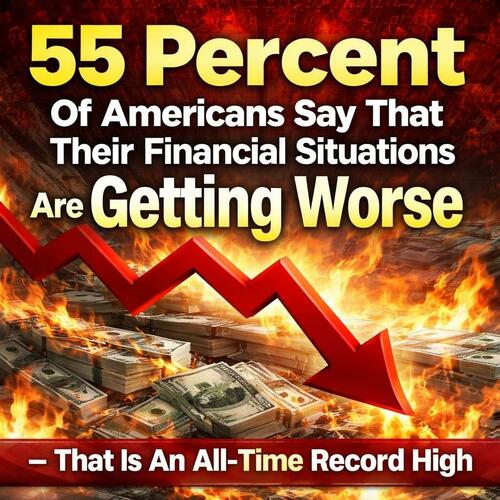
Record 55% of Americans Report Worsening Finances: Signals of Deepening Inequality and Latent Social Unrest
Gallup data showing a record 55% of Americans viewing their finances as worsening reveals structural wage suppression, wealth concentration, and middle-class erosion that mainstream outlets often minimize, raising risks of deeper social fragmentation beyond conventional economic reporting.
A Gallup survey conducted in April 2026 has revealed that a record 55% of Americans now say their personal financial situations are getting worse — the highest reading in over two decades and exceeding levels recorded during the 2008-2009 Great Recession. This marks the fifth consecutive year of rising pessimism, with majorities expressing anxiety over retirement savings (62%), major medical costs (60%), and maintaining their standard of living. While corporate earnings and select macroeconomic indicators continue to project optimism, this data exposes a widening chasm between headline statistics and lived reality for the majority. Mainstream coverage often frames current conditions through the lens of moderating inflation or stock market highs, yet multiple independent analyses reveal structural forces at play. TIME magazine identifies the crisis as fundamentally a wage and power imbalance rather than isolated price spikes: U.S. productivity has grown approximately 73% since 1979, but median wages rose only about 23%, with top 1% earnings surging 169%. This pattern of gains flowing disproportionately upward has left middle- and lower-income households with eroded purchasing power, particularly as essentials like housing (+34%), food, and energy have outpaced wage growth for most. An Allianz economic report underscores the "K-shaped" nature of the recovery, noting that the top 1% now control 31% of household wealth while the bottom 50% hold just 2.5%. Real disposable income for middle quintiles has stagnated or declined after taxes and transfers, even as non-housing debt burdens climb. The Urban Institute's Affordability Tracker finds nearly half of Americans cannot cover the true cost of living in their communities, with costs for housing, childcare, and healthcare rising far faster than earnings since 2017. Behavioral responses are telling: millions are canceling discretionary activities, postponing medical care, falling behind on rent, or taking on additional debt that leaves them one emergency away from collapse. A separate national survey cited in related reporting indicates roughly $6,000 in unexpected costs is enough to push many families over the edge. These trends connect to broader heterodox observations often missed in corporate media: sustained financial precarity decoupled from GDP or asset price narratives erodes social cohesion. When large segments of the population experience systematic decline in living standards despite national "wealth creation," trust in institutions frays. Historical patterns suggest such inequality gaps have preceded periods of heightened populism, political volatility, and, in extreme cases, social unrest. Official projections from the CBO acknowledge persistent deficits and uneven consumer spending pressures, yet rarely frame the human cost in terms of evaporating mobility or the quiet abandonment of the old middle-class compact. The Gallup findings, corroborated across outlets, suggest we are witnessing not temporary post-pandemic adjustment but a multi-decade entrenchment of economic stratification that mainstream optimism narratives downplay at society's peril.
LIMINAL: This decoupling of official economic optimism from mass financial despair is accelerating erosion of the social contract, likely manifesting in heightened political volatility, populist surges, and sporadic unrest as the middle collapses under sustained pressure.
Sources (5)
- [1]Affordability Still Dominates Americans' Financial Worries(https://news.gallup.com/poll/708905/affordability-dominates-americans-financial-worries.aspx)
- [2]Over half of Americans say their finances are worsening, Gallup poll finds(https://www.cbsnews.com/news/americans-finances-getting-worse-gallup-poll-2026/)
- [3]Americans feel worse off financially than at any point in 25 years, Gallup finds(https://www.axios.com/2026/04/28/trump-economy-gallup-finances)
- [4]America's Cost-of-Living Crisis Is Really a Pay Crisis(https://time.com/article/2026/04/10/america-cost-of-living-pay-crisis/)
- [5]High prices, thin buffers: America's affordability crisis persists(https://www.allianz.com/en/economic_research/insights/publications/specials_fmo/260211-US-affordability.html)