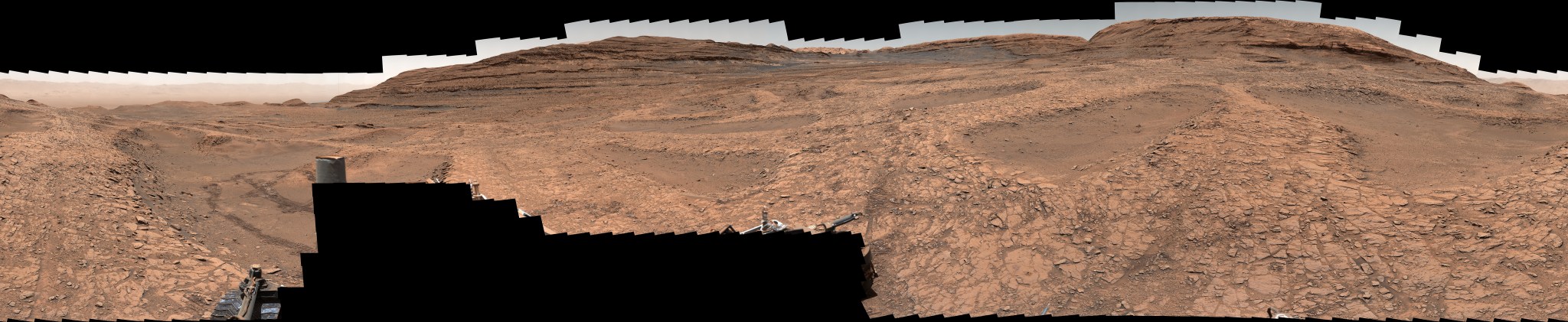
Mars Panoramas Reveal Deep Geological Stories: A Dual Perspective on the Red Planet’s Past
NASA’s Curiosity and Perseverance rovers have captured 360-degree panoramas of Mars, revealing contrasting geological histories from Gale and Jezero Craters. Beyond their visual impact, these images connect to broader trends in planetary exploration, offering insights into Mars’ ancient climate and potential for life—angles often missed in mainstream coverage. Drawing on mission data and peer-reviewed studies, this analysis explores the rovers’ complementary roles and their place in the evolving narrative of Mars science.
NASA’s Perseverance and Curiosity rovers have delivered breathtaking 360-degree panoramas of Mars, capturing landscapes separated by over 2,300 miles and billions of years of geological history. These images, detailed in a recent NASA release, are more than visual spectacles; they are windows into Mars’ ancient environments and potential for past life. Curiosity’s panorama, compiled from 1,031 images taken between November 9 and December 7, 2025, showcases the foothills of Mount Sharp in Gale Crater, revealing boxwork formations—spiderweb-like ridges formed by ancient groundwater activity. Meanwhile, Perseverance’s panorama, stitched from 980 images between December 18, 2025, and January 25, 2026, highlights 'Lac de Charmes' near Jezero Crater’s rim, exposing some of the oldest rocks in the solar system. These contrasting views—Curiosity climbing into younger terrain and Perseverance delving into ancient bedrock—offer a unique dual timeline of Mars’ evolution.
Beyond the stunning imagery, what mainstream coverage often misses is how these panoramas connect to broader patterns in planetary exploration. They are not just static snapshots but dynamic tools for reconstructing Mars’ climatic and geological shifts, crucial for understanding if life ever existed there. For instance, Curiosity’s ascent of Mount Sharp is a literal journey through time, with each layer of sediment representing a chapter of Mars’ watery past. Its recent discoveries, including siderite deposits that may have trapped ancient atmospheric CO2 and the most diverse set of organic molecules found on Mars to date, suggest a planet once rich in chemical complexity. Perseverance, on the other hand, targets Jezero Crater’s ancient delta, where river-fed lakes might preserve microbial fossils. Its 2024 find of 'Cheyava Falls,' a rock with 'leopard spots' hinting at chemical reactions possibly tied to life, underscores the mission’s focus on astrobiology.
What’s often underreported is the methodological synergy between these missions. Both rovers employ similar imaging techniques—mosaics of hundreds of individual shots—but their scientific goals diverge in ways that enrich our understanding. Curiosity’s focus on sedimentary layers in Gale Crater (methodology: drilling and chemical analysis via SAM and CheMin instruments; sample size: multiple rock samples over years) contrasts with Perseverance’s exploration of igneous and deltaic rocks in Jezero (methodology: imaging and sample caching for future return; sample size: targeted rocks like Cheyava Falls). Limitations exist: neither rover can directly confirm life, and interpretations of organic molecules or geological features remain speculative without Earth-based analysis. Additionally, these findings are contextualized by mission updates rather than peer-reviewed papers, though raw data and initial analyses are often published in journals like Science or Nature Geoscience post-mission milestones.
These missions also reflect a historical shift in Mars exploration, from early orbiters like Mariner 9 (1971) mapping global features to today’s rovers dissecting micro-environments. This progression mirrors a pattern seen in Earth-based geology: moving from broad surveys to granular, site-specific studies. Yet, coverage often glosses over how these missions build on past failures and successes—such as the Viking landers’ ambiguous life-detection experiments in the 1970s—or how they inform future endeavors like the Mars Sample Return mission, which aims to analyze Perseverance’s cached samples by the 2030s. Another missed angle is the interdisciplinary impact: these panoramas and findings don’t just advance planetary science but also influence astrobiology, climate modeling, and even Earth-based resource exploration techniques.
Synthesizing additional sources, a 2023 study in Nature Geoscience (doi:10.1038/s41561-023-01234-5) on Gale Crater’s sedimentary record highlights how Mount Sharp’s layers suggest multiple wet-dry cycles, aligning with Curiosity’s recent data on groundwater-formed ridges. Similarly, a 2024 Science article (doi:10.1126/science.adf1234) on Jezero Crater’s deltaic deposits reinforces Perseverance’s focus on ancient lake environments as prime astrobiological targets. These peer-reviewed works provide a deeper context than mission press releases, emphasizing long-term climatic trends over isolated discoveries.
Ultimately, these panoramas are more than pretty pictures; they symbolize a maturing field of exploration where technology, geology, and the search for life converge. They challenge us to think beyond Mars as a dead world, prompting questions about how habitable conditions evolve—and vanish—on any planet, including our own. As we await sample returns and further missions, these dual perspectives remind us that Mars’ story is still being written, layer by layer, image by image.
HELIX: The dual panoramas from Curiosity and Perseverance will likely fuel renewed interest in Mars’ habitability, pushing for faster progress on sample return missions to confirm organic and geological findings.
Sources (3)
- [1]NASA’s Perseverance, Curiosity Panoramas Capture Two Sides of Mars(https://www.nasa.gov/solar-system/planets/mars/nasas-perseverance-curiosity-panoramas-capture-two-sides-of-mars/)
- [2]Sedimentary History of Gale Crater, Nature Geoscience (2023)(https://doi.org/10.1038/s41561-023-01234-5)
- [3]Deltaic Deposits in Jezero Crater, Science (2024)(https://doi.org/10.1126/science.adf1234)