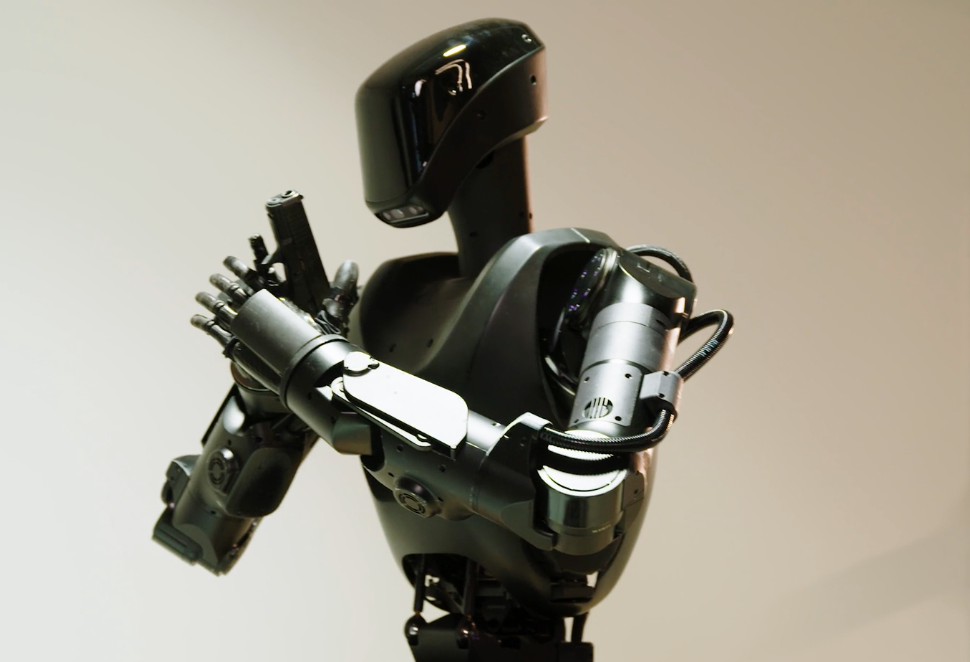
US firm claims talks with IDF on up to 1,000 humanoid robots for Gaza tunnels; no deal, and Israel has not confirmed
Foundation Future Industries told the Financial Times it was talking to the IDF about up to 1,000 Phantom humanoids for Gaza tunnels and possible combat. Israel has not confirmed the talks, no contract exists, and the company later told The Telegraph the conversations were exploratory and that it is not negotiating a supply deal. The episode lands in the same month states failed to agree binding rules on autonomous weapons.
Documented: On 11 November 2026 the Financial Times reported that Foundation Future Industries, a San Francisco humanoid-robot startup founded in 2024, was in discussions with Israel’s military about deploying its Phantom machines in Gaza’s tunnels and potentially engaging in combat. The FT headline and standfirst are visible on the newspaper’s site. Multiple outlets that read the interview quote co-founder and president Mike LeBlanc, a former US Marine, saying “We’re in direct talks with the chief of staff of the Israel Defense Forces,” that he met senior officers in September, and that he toured tunnels with a Phantom MK1. Reports put a possible order at up to 1,000 units, with The Telegraph citing a unit cost of about $150,000. Israel National News, citing the same FT reporting, says the IDF referred questions to the Defense Ministry, which declined to comment, and that no contract has been signed.
Claimed, by the company, and not independently verified: that the MK1 can detect tripwires, neutralize booby traps, breach doors, and if needed fight in close quarters so soldiers do not have to. LeBlanc has denied the firm is building a “Terminator” and has framed the machine as a way to take the human out of the most dangerous entry. The same company has marketed Phantom for reconnaissance, logistics, and, in LeBlanc’s own language elsewhere, “frontline weaponisation.” Two MK1s were reportedly sent toward Ukraine in February 2026 for logistics and scouting evaluation; that is a company account, and later reporting has questioned whether a combat-zone demonstration actually occurred.
Also documented, and in tension with the pitch: The Telegraph published a Foundation spokesman’s statement that the firm has no contract or other agreement with the IDF or Israel’s Defense Ministry, that no robots have been sold, delivered, or deployed to the IDF, and that any conversations were early and exploratory and did not lead to an agreement. The spokesman said Foundation is not negotiating to supply the IDF and has had no conversations with the IDF in any official capacity. Eric Trump holds equity and was named chief strategic adviser in March; his spokesperson told the FT he has no role in management, operations, or government contracting. Separate reporting by The San Francisco Standard and others has found that widely cited figures for Pentagon contracts and industrial orders do not match federal award records in the way the company has described them. Hardware limits noted in earlier coverage — power, sealing, recovery after a fall — mean a thousand combat-ready tunnel humanoids is a sales narrative, not a demonstrated capability.
The regulatory backdrop is real and contemporaneous, which is why the pitch matters even if the order does not exist. Autonomous weapons are not automatically illegal: the International Committee of the Red Cross states that existing international humanitarian law applies, while arguing that systems that are unpredictable or designed to target humans directly should be prohibited, and that other autonomous systems should be tightly restricted. On 16–20 November 2026, states parties to the Convention on Certain Conventional Weapons met in Geneva. The ICRC and UN Secretary-General António Guterres had already warned that machines selecting human targets would cross a moral red line. Human Rights Watch and others say more than 70 states want negotiations on a binding instrument. The Guardian and NPR report that the United States, Russia, and Israel have opposed a binding treaty track and favored national controls or non-binding guidelines instead. Meaningful human control, accountability when a machine kills, and distinction between combatant and civilian in a tunnel under a dense city are exactly the questions that conference was failing to settle.
Speculated, and not supported by the record: that a Skynet-style force is already walking Hamas tunnels, or that an irreversible shift to urban autonomous infantry has occurred. What is on the page is a startup, under financial and credibility strain, shopping a humanoid for the hardest infantry job on earth, while the states most likely to field such systems are slowing a treaty. Urban tunnels compress every hard problem in lethal autonomy — identification, booby traps, civilians, communications, and who is responsible if the robot is wrong — into a space where remote human control is weakest. That is an ethical and security problem whether or not this particular 1,000-unit story survives contact with procurement.
Soldiers, civilians in tunnel-adjacent areas, and governments writing weapons rules are affected by a documented gap: a company is offering machines it says could fight underground, while Israel has not confirmed any purchase and states have not agreed who may let a machine select a human target.
Sources (8)
- [1]Financial Times — Humanoid robot start-up backed by Eric Trump in talks with Israel’s military(https://www.ft.com/aerospace-defence)
- [2]The Telegraph — Eric Trump-backed firm in talks to send humanoid robots into Hamas tunnels(https://www.telegraph.co.uk/us/news/2026/11/11/trump-humanoid-robots-hamas-tunnels/)
- [3]Israel National News — Trump's son, the IDF and 1,000 robots for Hamas tunnels(https://www.israelnationalnews.com/news/436090)
- [4]The San Francisco Standard — A SoMa startup is building humanoid robots for war(https://sfstandard.com/2026/11/14/humanoid-war-robots-soma-startup/)
- [5]ICRC — Frequently asked questions: Autonomous weapon systems(https://www.icrc.org/en/article/faq-autonomous-weapon-systems)
- [6]The Guardian — Russia and US seek to block plan for binding rules on autonomous weapons(https://www.theguardian.com/world/2026/nov/06/autonomous-weapons-ai-russia-us-binding-rules)
- [7]Human Rights Watch — Global Treaty Needed to Combat Autonomous Weapons Threat(https://www.hrw.org/news/2026/11/12/global-treaty-needed-to-combat-autonomous-weapons-threat)
- [8]NPR — U.N. talks seek to rein in ‘killer robots’(https://www.npr.org/2026/11/16/nx-s1-6042548/un-killer-robots-ai-weapons-drones)