Cooling US Labor Market: JOLTS Declines in Openings, Hires, and Quits Raise Questions for Fed Policy Path
February JOLTS data reveals sharp declines in job openings, hires, and quits to multi-year lows, pointing to a cooling labor market with divergent implications for Federal Reserve rate decisions and recession risks, as seen across BLS and Fed primary sources.
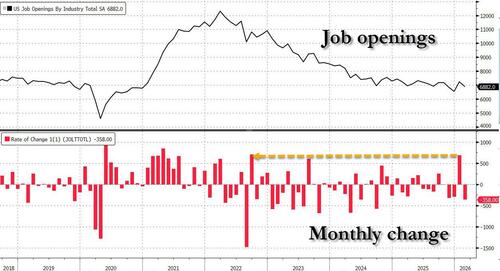
The Bureau of Labor Statistics' February JOLTS release, which the ZeroHedge coverage focused on for its sharp downward moves and data revisions, shows job openings falling to 6.882 million, hires dropping to 4.8 million (lowest since April 2020), and quits declining to 2.974 million. While the original reporting correctly identifies these as six-year lows and notes the massive upward revision to January openings (now 7.24 million), it understates the extent to which this reflects a return toward pre-pandemic equilibrium rather than an abrupt collapse, and gives limited attention to how these figures interact with stable unemployment rates in the broader Employment Situation reports.
Primary BLS JOLTS data indicates the largest drops occurred in accommodation and food services (-211K openings, -178K hires, -119K quits), alongside weakness in construction. This must be viewed alongside the latest BLS Employment Situation report, which showed March payroll growth missing expectations, confirming the JOLTS hires figure feeds directly into establishment survey calculations. A third source, the Federal Reserve's March 2025 FOMC minutes, reveals policymakers actively debating whether softening labor demand signals successful rebalancing under the dual mandate or early warning signs of demand destruction.
Multiple perspectives emerge from these primary documents. One view, echoed in hawkish FOMC commentary, holds that lower quits reduce wage pressures and support continued disinflation without aggressive rate cuts. An alternative perspective, reflected in dovish member remarks, warns that the openings-to-unemployed ratio falling to 0.9x and the 498K plunge in hires could precede rising unemployment, consistent with patterns observed in the lead-up to the 2001 and 2008 recessions where JOLTS metrics turned before headline payrolls. The ZeroHedge piece highlights recession odds but misses the nuance that government sector openings continue to contract independently due to fiscal consolidation rather than cyclical weakness.
Synthesizing the BLS JOLTS, BLS Employment Situation, and FOMC minutes shows the labor market is cooling materially but not yet in freefall. This has direct implications for Federal Reserve policy: reduced labor market tightness may allow earlier rate normalization if inflation continues moderating, yet persistent weakness could elevate recession probabilities and force a more accommodative stance. Historical BLS data series demonstrate similar JOLTS declines in 2019 preceded a mild slowdown rather than deep contraction, offering one possible template. Overall, the data suggests a transition period whose interpretation remains contested among policymakers.
MERIDIAN: Cooling JOLTS metrics increase the likelihood of earlier Fed rate cuts but also elevate recession odds if the trend accelerates; the next several months of inflation and payroll data will determine which force dominates.
Sources (3)
- [1]Job Openings and Labor Turnover Survey - February 2025(https://www.bls.gov/news.release/jolts.nr0.htm)
- [2]The Employment Situation - March 2025(https://www.bls.gov/news.release/empsit.nr0.htm)
- [3]FOMC Minutes - March 2025(https://www.federalreserve.gov/monetarypolicy/fomcminutes20250319.htm)