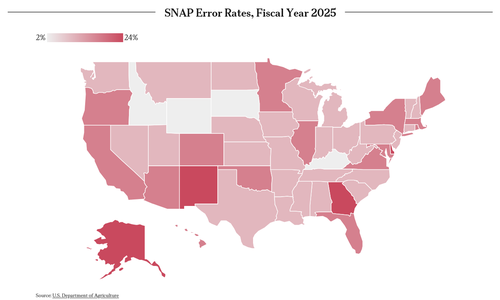
Forty-One States Exceed 6% SNAP Error Rate in 2025, Facing Partial Benefit Cost Liability from October 2027
The shift imposes direct state liability for SNAP errors above 6 percent from 2027, with 41 jurisdictions already noncompliant. This reverses decades of federal financing dominance and compels states to internalize verification costs previously borne by federal taxpayers. Large states face the steepest exposure absent rapid administrative changes.
The legislation shifts financial exposure to states that administer SNAP applications and payments while the federal government has historically covered nearly all benefit costs. Beginning October 2026, states will also absorb 75 percent of administrative expenses, up from the 50 percent share maintained since 1964. USDA data show total improper payments reached $10 billion in 2025, with overpayments comprising 87 percent of the total and an overall error rate of 10.6 percent.
Nine states met the threshold below 6 percent: Idaho, Iowa, Kentucky, Nebraska, South Dakota, Utah, Vermont, Wisconsin, and Wyoming. California, New York, and Florida each risk liabilities exceeding $1 billion if rates remain unchanged; Texas faces approximately $750 million. Four states are evaluating full program withdrawal. States recording 13.34 percent or higher errors in 2025 receive a two-year delay via the Alaska Carveout provision.
The structure addresses a documented financing mismatch identified in federal oversight records, where states process eligibility determinations without bearing direct fiscal consequences for inaccuracies. Primary causes include incomplete verification of income, household composition, and residency, as detailed in Government Accountability Office reviews. Enrollment has already declined by more than 5 million recipients amid implementation of stricter verification protocols.
States must now deploy enhanced data cross-checks and real-time reporting systems ahead of the 2027 deadline to avoid penalties. Failure to reduce rates will directly increase state budget outlays for a program serving low-income households, altering the prior division of federal and state responsibilities.
USDA: No more than 25 states will remain above the 6 percent error threshold by the end of fiscal 2027 after implementing new verification systems.
Sources (2)
- [1]USDA SNAP Quality Control Error Rate Report FY2025(https://www.fns.usda.gov/snap/quality-control)
- [2]GAO Report on Improper Payments in Federal Programs(https://www.gao.gov/products/gao-25-xxx)