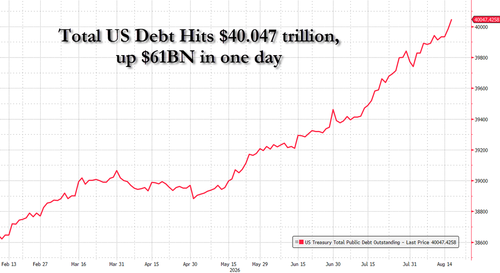
US Debt Crosses $40 Trillion Milestone Amid Rising Yields and Fiscal Concerns
The U.S. debt surpassing $40 trillion highlights accelerating fiscal pressures from deficits and rising interest costs, with credible reports confirming the milestone and warning of broader stability risks.
As of mid-August 2026, the U.S. national debt has surpassed or is on the verge of exceeding $40 trillion, a threshold crossed months ahead of earlier projections, according to Treasury Department data and reporting from multiple outlets. This rapid escalation—doubling from roughly $20 trillion in 2017—stems from persistent deficits driven by spending on defense, social programs, healthcare, and especially mounting interest costs, which have outpaced revenue.[1][2]
Yields on Treasuries have climbed, with recent auctions for 30-year bonds marking the costliest in 25 years and 10-year notes at highs since 2007, exacerbating the debt-servicing burden. Interest payments for fiscal year 2026 have already reached $1.37 trillion, up 20% year-over-year, fueling a self-reinforcing cycle where higher borrowing costs necessitate more issuance.[3]
Analysts note this trajectory raises risks to global financial stability through potential crowding out of private investment, elevated inflation pressures, and vulnerability to market disruptions. Bank of America strategists warn investors against long-duration bonds due to fiscal risks, while projections from the Congressional Budget Office and others indicate little near-term improvement in the deficit-to-GDP ratio absent major policy shifts. Connections to broader dynamics include how invalidated tariffs have reduced revenue, accelerating the timeline, and the political reluctance across parties to enact tax increases or entitlement reforms.[4]
The milestone underscores systemic challenges in U.S. fiscal policy, with implications extending to international bond markets and economic growth forecasts.
[Economist at Deutsche Bank]: Crossing $40 trillion signals no immediate tipping point but amplifies yield pressures that could constrain future policy options and global risk appetite.
Sources (4)
- [1]U.S. debt is set to hit $40 trillion, months earlier than expected, as bond yields rise(https://www.washingtonpost.com/business/2026/08/18/us-debt-set-hit-40-trillion-months-earlier-than-expected/)
- [2]National debt tops $40 trillion after doubling in less than a decade, Treasury data shows(https://www.cbsnews.com/news/national-debt-tops-40-trillion-doubles/)
- [3]US Debt Tops Historic $40 Trillion Mark(https://www.bloomberg.com/news/newsletters/2026-08-19/us-debt-exceeds-historic-40-trillion-mark-evening-briefing-americas)
- [4]The national debt just hit $40 trillion. Here's how it can hurt Americans.(https://www.marketwatch.com/story/the-national-debt-is-about-to-hit-40-trillion-heres-how-it-can-hurt-americans-b4f252b9)