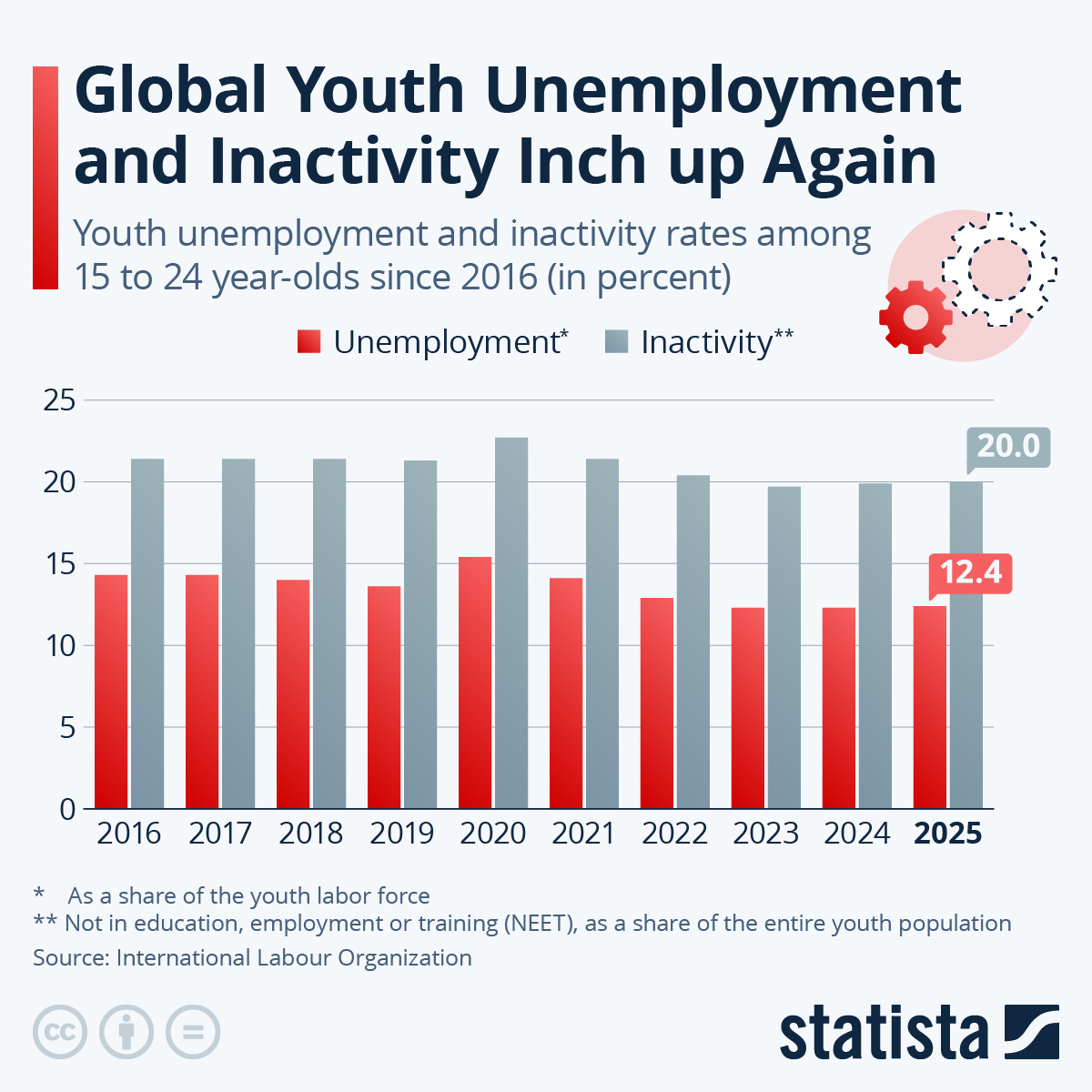
Global Youth Unemployment Edges Higher in 2025 as Post-Pandemic Gains Stall Amid Economic Fragility and Technological Shifts
ILO data confirms rising global youth unemployment (12.4%, 67M) and NEET rates (20%, 257M) in 2025, reversing post-COVID gains due to economic headwinds, with disproportionate impacts on women and higher-income regions; highlights urgent need for policy focus on job quality and inclusion.
According to the International Labour Organization's (ILO) Global Employment Trends for Youth 2026 report, the global youth unemployment rate for those aged 15-24 rose to 12.4% in 2025, affecting 67 million young people—an increase from the post-COVID low of 12.3% in 2023.[1][2] This marks an abrupt halt to recovery, driven by subdued GDP growth, high inflation, geopolitical tensions, and weak job creation. The share of youth not in employment, education, or training (NEET) also climbed slightly to 20%, impacting 257 million individuals.[3]
Regional disparities are stark: rates surged in higher-income economies like Northern America (from 8.3% to 9.8%) and remained elevated at 15% in Northern, Southern, and Western Europe, while the Arab States (26.2%) and Northern Africa (22.6%) continue to face the highest burdens, with over one-third of youth in NEET status in those areas.[1] Sub-Saharan Africa shows lower unemployment (around 8.5%) but high NEET rates due to demographic pressures and limited decent work opportunities.
Beyond quantity, job quality has deteriorated, with rising underemployment and skills mismatches. Gender gaps persist: young women comprise over two-thirds of NEETs (NEET rate 27.4% vs. 13.1% for men), often due to unpaid care responsibilities.[2] Technological change, including AI, is reshaping entry-level jobs, with 6.1% of youth occupations highly exposed.[1]
These trends underscore broader policy shortcomings in fostering inclusive growth, education-to-work transitions, and social protections. Long-term, they risk scarring lifetime earnings, increasing inequality, and straining social systems—particularly as youth populations grow in developing regions. UN analyses echo concerns over stalled progress and the need for targeted interventions like expanded training and formalization of informal work.[4]
[Economic Analyst]: Persistent youth disengagement could amplify social instability and reduce long-term productivity growth unless policies prioritize skills alignment, formal job creation, and gender-equitable care supports.
Sources (4)
- [1]Youth unemployment rises as young people face a harder road to decent work(https://www.ilo.org/resource/news/youth-unemployment-rises-young-people-face-harder-road-decent-work)
- [2]Global Employment Trends for Youth 2026: Back to the future (full report)(https://www.ilo.org/sites/default/files/2026-08/9789220437612_PDFA_Web_ENG.pdf)
- [3]Chart: Global Youth Unemployment and Inactivity Inch up Again | Statista(https://www.statista.com/chart/36550/youth-unemployment-and-inactivity-rates-among-15-to-24-year-olds/)
- [4]After post-pandemic improvement, youth unemployment is rising again | UN News(https://news.un.org/en/story/2026/08/1168120)