Kpler and EIA Data Show Persistent Hormuz Constraints Despite Wright Claim of 9 Million Barrels Daily
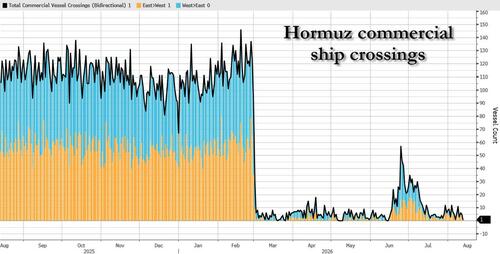
Tanker tracking from Kpler and the EIA's August STEO directly contradict Secretary Wright's assertion of normalized 9 mb/d Hormuz flows and 15 mb/d total regional exports. The mismatch highlights incentives for both Washington and Gulf producers to signal stability amid constrained physical movements and stalled negotiations. Daily vessel counts remain the decisive metric for assessing actual supply risk.
Wright attributed the reported volumes to US military coordination with Gulf allies and additional pipeline exports. Kpler data cited by Reuters and CNN instead documented a sharp decline in tanker movements, with Monday traffic falling below the recent ten-day average of eleven vessels. The EIA simultaneously revised upward its estimate of shut-in Middle East crude, assuming severe transit limits would persist through August. These figures cannot be reconciled with the Secretary's totals.
The discrepancy occurs against a backdrop of fading prospects for a US-Iran accommodation. Iranian export capacity remains constrained by sanctions and limited access to shadow-fleet tonnage willing to risk Hormuz passage. Gulf producers have not activated spare pipeline capacity at the scale required to offset any Hormuz shortfall. Both sides therefore face incentives to project stability while actual physical flows stay suppressed.
Primary records show the EIA explicitly tying its production forecast to ongoing transit constraints, while Kpler's independent tracking provides granular daily counts that contradict the Administration's aggregate claim. No official methodology has been released to explain the 9 million barrel figure.
Absent a verifiable uptick in observed transits or a documented surge in pipeline loadings, the gap between stated and measured volumes is likely to widen. Market participants will continue to price in persistent supply risk rather than normalized flows.
Kpler: Average daily transits at the Strait of Hormuz remain below eight vessels per day through 31 August 2026
Sources (3)
- [1]EIA Short-Term Energy Outlook August 2026(https://www.eia.gov/outlooks/steo/)
- [2]Reuters Kpler Vessel Tracking Report(https://www.reuters.com/business/energy/)
- [3]Kpler Commodity Research Statement via CNN(https://www.cnn.com/2026/08/11/energy/)