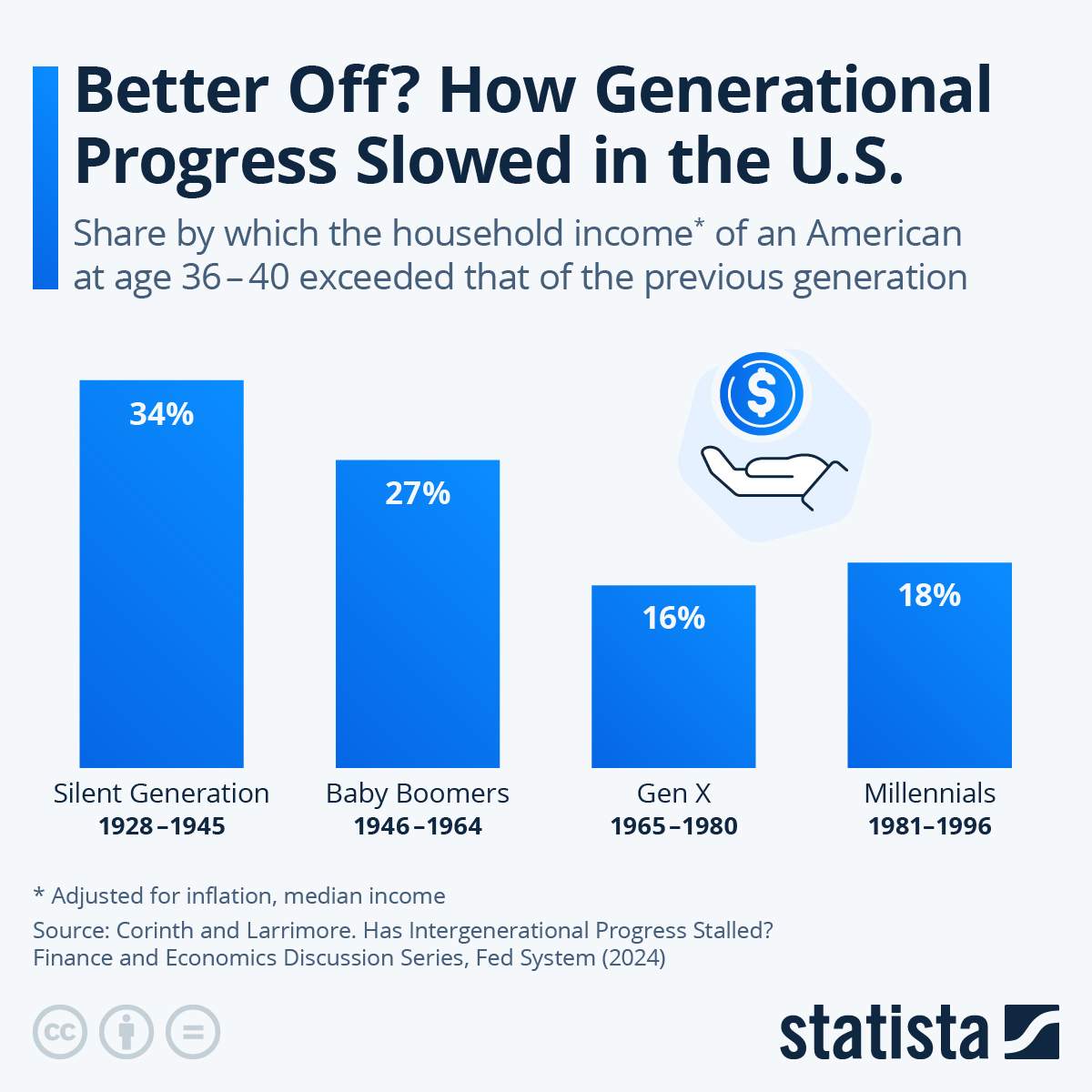
US Generational Income Gains Slow to 18 Percent for Millennials Over Gen X
Federal Reserve analysis shows decelerating cohort income gains since the Baby Boom era alongside reduced absolute mobility documented by Chetty et al. The data reveal a multi-decade structural pattern in which labor-hour increases ceased while housing and education costs absorbed rising shares of household resources.
The 2024 Federal Reserve discussion paper tracks inflation-adjusted median household income at ages 36-40 across cohorts beginning with the Greatest Generation. Cumulative gains reached 133 percent for Millennials relative to that baseline, yet the marginal increment between successive cohorts has declined steadily since the post-war period. Hours worked rose 14 percent for the Silent Generation and another 14 percent for Boomers before stabilizing, indicating that later gains derive less from labor input and more from asset and credential effects.
Raj Chetty's 2017 Opportunity Insights study documented the complementary mobility decline: only 50 percent of the 1984 birth cohort out-earned their parents by age 30, versus more than 90 percent for the 1940 cohort. Census Bureau income distribution tables corroborate that middle-quintile wage growth flattened after 2000 while housing and education costs absorbed larger shares of household budgets.
The pattern reflects sustained shifts in labor-market returns to education, homeownership timing, and intergenerational transfers rather than cyclical conditions. Primary records show no reversal in these structural parameters through 2022.
Federal Reserve staff projections indicate further compression for Generation Z cohorts entering prime earning years after 2025 unless asset price trajectories or credential premia change materially.
Federal Reserve: Median real household income gains for Generation Z at ages 36-40 will register below 12 percent relative to Millennials by 2032.
Sources (3)
- [1]Primary Source(https://www.federalreserve.gov/econres/feds/discussion-papers-2024.htm)
- [2]Supporting Source(https://opportunityinsights.org/paper/the-fading-american-dream/)
- [3]Supporting Source(https://www.census.gov/library/publications/2023/demo/p60-279.html)