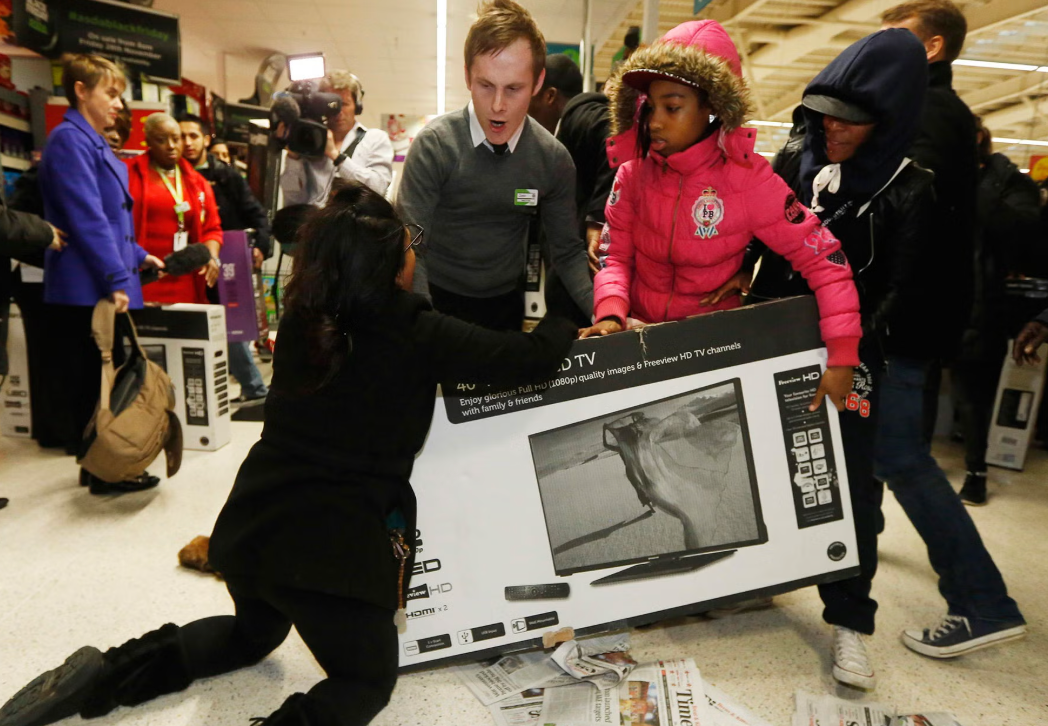
Fewer people plan to shop Thanksgiving weekend as holiday spending splits by income
NRF expects 182.7 million Thanksgiving-weekend shoppers, slightly fewer than last year, even as holiday sales are forecast to grow. Card data and multiple surveys show higher-income households holding or increasing spend while lower-income households pull back—the split a crowded Black Friday makes hard to ignore.
Documented: The National Retail Federation and Prosper Insights & Analytics estimate that 182.7 million people plan to shop from Thanksgiving through Cyber Monday, down from 186.9 million a year earlier. The survey of 7,956 adults, conducted Oct. 30–Nov. 9, also finds that 60% of consumers had already started holiday shopping by early November, up from 56% before the pandemic. Black Friday remains the peak day, with 69% of weekend shoppers (about 126 million) planning to buy that day; Cyber Monday is second at 36% (about 66.1 million). NRF’s separate sales forecast still calls for November–December retail sales to rise 4.2% from the prior year, to about $1.013 trillion.
Documented, not the same as a uniform consumer: That headline turnout and sales growth sit on top of a documented income split in how people actually spend. Credit- and debit-card data analyzed by Consumer Edge and reported by The Washington Post showed that, over Black Friday through Cyber Monday in 2025, households earning more than $150,000 spent about 3% more than a year earlier, while households under $40,000 spent about 2% less. Wells Fargo economist Shannon Grein described the bifurcation as becoming more acute. Gallup’s 2025 holiday survey found the same directional split in plans: households under $50,000 expected to spend $651 on gifts, down more than $100 from the prior year, while households at $100,000 or more expected $1,479, up from $1,403. NRF’s own research staff have written that discretionary spending growth has been concentrated among higher spenders even when total retail sales look solid—strong results at the top can mask weakness lower down.
Claimed: A ZeroHedge write-up of the same weekend attributes a sharper planned split to a Goldman Sachs consumer survey of roughly 1,000 people: half of households earning $100,000 or more planning to spend more (up from 44%), and 48% of households under $50,000 planning to spend less (up from 46%). Those exact Goldman figures were not independently corroborated in public reporting reviewed here and should be treated as a sell-side claim, not as an official statistic.
What is not speculation is the mechanism the weekend makes visible. A mass shopping event can still draw near-record crowds—people hunting deals, using cards, and increasingly AI tools to compare prices—while the dollars behind those trips move in opposite directions by income. NRF notes that 82% of consumers in its latest weekend survey are taking steps to manage holiday costs, including cheaper gifts or cuts elsewhere. Higher earners, by contrast, have been supported in recent years by asset gains that lower-income households do not share. The result is a K-shaped pattern that is easy to miss in aggregate forecasts: more shoppers in the parking lot and on Amazon does not mean more households can afford the same basket.
Speculated only at the margin: Whether this season’s final receipts will look more like 2025’s card data or like the more mixed 2026 survey snapshots is not yet settled. NRF economists have also cautioned that the shape of the “K” depends on the time window and on discretionary versus staple categories. What is already on the record is narrower: weekend traffic is slightly lower and earlier, total holiday sales are still forecast to grow, and measured spending and spending plans have repeatedly diverged by income.
Holiday shopping is one of the few moments when income gaps show up in a purchase almost everyone makes. Documented card and survey data show higher earners carrying more of the season’s growth while lower-income households cut gift budgets or hunt harder for discounts.
Sources (5)
- [1]183 Million Consumers Expected to Shop During Thanksgiving Weekend(https://nrf.com/media-center/press-releases/183-million-consumers-expected-to-shop-during-thanksgiving-weekend)
- [2]Whether you shopped on Black Friday may depend on how much you make(https://www.washingtonpost.com/business/2025/12/09/holiday-shopping-economy-black-friday/)
- [3]Black Friday Cyber Monday Retail Trends 2025: A Tale of Two Consumers(https://www.consumeredge.com/resources/insights/holiday-performance-begins-with-a-tale-of-two-consumers/)
- [4]U.S. Holiday Shoppers Plan to Spend Briskly(https://news.gallup.com/poll/697061/holiday-shoppers-plan-spend-briskly.aspx)
- [5]Is retail spending really K-shaped?(https://nrf.com/blog/is-retail-spending-really-k-shaped)