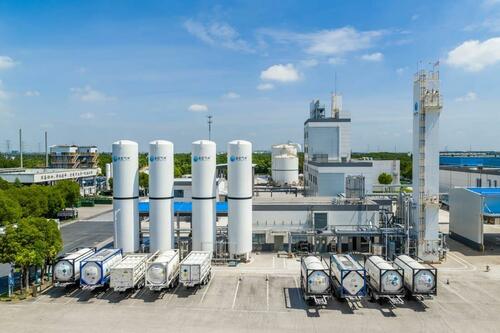
China's Helium Export Ban Compounds Qatar Supply Shock, Threatening Global Semiconductor and Medical Supply Chains
China's abrupt helium export ban, verified by Reuters, SCMP, AP, and others, intensifies a global shortage stemming from Qatar's Ras Laffan damage in the US-Iran conflict, directly impacting semiconductors, healthcare, and other sectors through reduced supply and higher prices.
China's Ministry of Commerce and General Administration of Customs announced on July 10, 2026, a temporary prohibition on exports of helium under customs code 2804290010, effective immediately, with no exemptions, expiration date, or detailed rationale provided beyond reference to the Foreign Trade Law. This move, corroborated across multiple outlets, occurs amid escalating geopolitical tensions in the Middle East, specifically disruptions from the US-Iran conflict that have severely impacted Qatar's helium production.
QatarEnergy's Ras Laffan Industrial City, a critical hub accounting for roughly one-third of global helium supply as a byproduct of LNG processing, suffered missile attacks in March 2026. These strikes damaged facilities, leading to a declaration of force majeure, a 17% reduction in Qatar's LNG export capacity, and an estimated 14% drop in its helium output. Repairs are projected to take 3-5 years, removing significant volumes from the market and triggering price doublings in spot markets.
Helium's unique properties—extreme cryogenic requirements and rapid evaporation during transport—make it irreplaceable for semiconductor manufacturing (cooling during chip fabrication), MRI machines, fiber optics, aerospace, and scientific research. With China importing over 80-85% of its needs despite limited domestic production (~1.6% of world supply), the export ban prioritizes domestic conservation amid the shortage. This compounds vulnerabilities in a concentrated market where Qatar's outage alone has already prompted force majeure declarations by major suppliers and raised risks for industries reliant on stable helium flows, including potential delays in AI chip production and medical imaging.
The timing underscores how geopolitical events translate into physical supply constraints for a resource with broad industrial and medical applications, amplifying price volatility and forcing downstream sectors to seek alternatives or rationing.
Analyst: Prolonged helium shortages will accelerate diversification of supply sources and substitution R&D, but near-term bottlenecks in advanced chipmaking and medical diagnostics are likely through 2027-2028.
Sources (6)
- [1]China issues temporary helium export ban as Iran war strains global supplies(https://www.scmp.com/economy/china-economy/article/3360114/china-announces-temporary-ban-helium-exports)
- [2]China temporarily bans helium exports as US-Iran tensions flare again(https://www.reuters.com/world/asia-pacific/china-announces-temporary-export-ban-helium-2026-07-10/)
- [3]China blocks exports of helium, key for chipmaking, as Iran war squeezes supply(https://abcnews.com/Technology/wireStory/china-blocks-exports-helium-key-chipmaking-iran-war-134650800)
- [4]Iran attacks wipe out 17% of Qatar's LNG capacity for up to 5 years(https://www.reuters.com/business/energy/iran-attack-damage-wipes-out-17-qatars-lng-capacity-three-five-years-qatarenergy-2026-03-19/)
- [5]Iran war threatens global helium supply(https://cen.acs.org/business/specialty-chemicals/Iran-war-threatens-global-helium/104/web/2026/03)
- [6]Iran War Chokes Off Helium Supply Critical for AI(https://www.wsj.com/world/iran-war-chokes-off-helium-supply-critical-for-ai-bf020a3f)