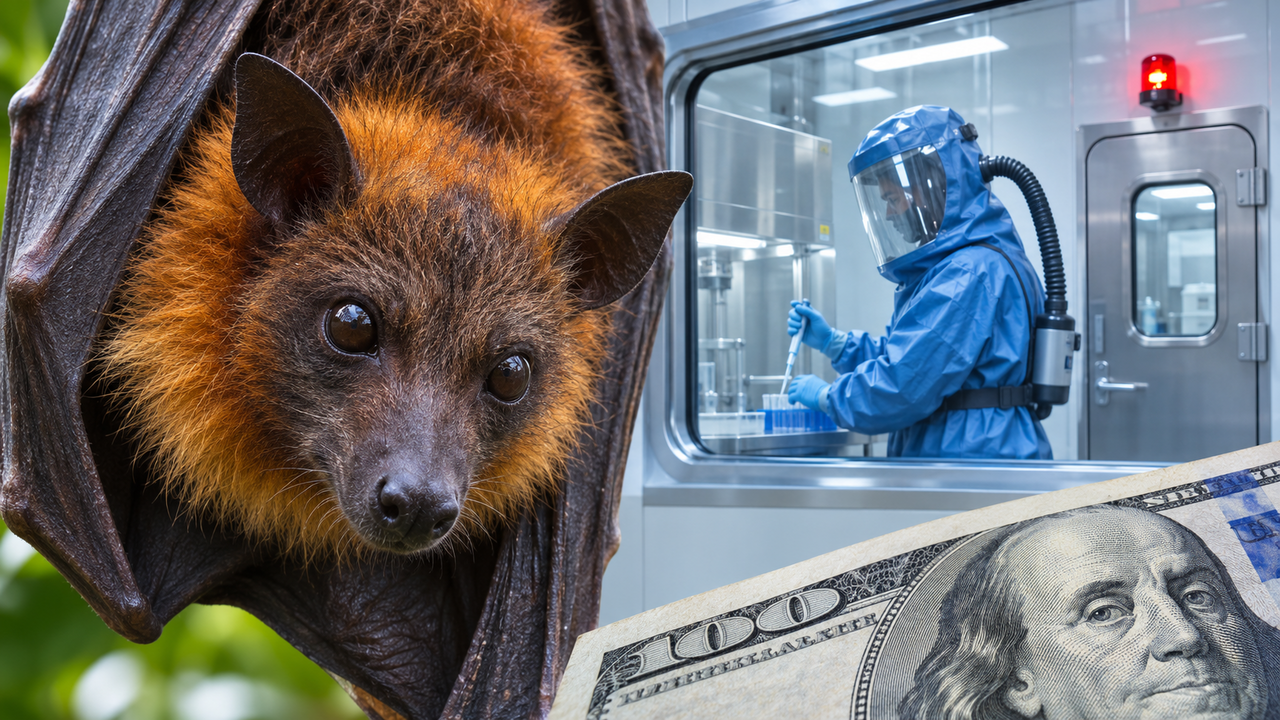
NIH-funded Hendra study at Australian high-containment lab was suspended after bats were euthanized and reporting lagged
Federal records obtained by PETA and reviewed by Fox News Digital say an NIH-funded Hendra study at CSIRO’s Australian Centre for Disease Preparedness was suspended in 2023 after staffing and containment problems forced the killing of nine flying foxes, and that NIH’s animal-welfare office was not told for more than ten months. The grant itself, for experimental bat infection with a naturally lethal henipavirus, is in public award records. NIH had not commented when Fox published.
Documented: The National Institute of Allergy and Infectious Diseases awarded grant R21AI169481, titled “Shining a Light on Bat Cellular Immunity Following Virus Infection,” to Australia’s Commonwealth Scientific and Industrial Research Organisation (CSIRO). Public grant records list the work as performed in Australia, with the Australian Centre for Disease Preparedness and Monash University described in the abstract as the sites suited to infect animals with Hendra virus under high containment. The abstract states the aim was experimental infection of black flying foxes to map innate and adaptive immune responses, and comparison with ferrets, in which Hendra is fatal. HigherGov lists an initial obligation near $144,000 and later total federal obligations of $296,288, with the performance end date extended to April 30, 2026.
Documented, via federal records obtained by PETA under FOIA and reviewed by Fox News Digital: the facility’s Animal Ethics Committee suspended the project after operational problems. Those records, as summarized by Fox and in a PETA letter excerpted in a Fox-hosted filing, cite too few staff trained for animal work at the required biocontainment level, inadequate contingency planning, unclear procedures, and prolonged confinement of flying foxes without adequate enrichment. After one flying fox tested positive for Hendra, all eight bats housed with it were killed because that room could not be raised to BSL-4. A ninth bat, already housed at BSL-4, later tested positive and was also killed. PETA’s account to NIH describes the May 22, 2023 notice from the principal investigator as concerning naturally occurring Hendra infections; the ethics committee suspended the project on June 8, 2023. The NIH Office of Laboratory Animal Welfare did not receive even a preliminary report of the suspension until April 29, 2024, more than ten months later. Fox News Digital reported that it asked NIH for comment and had not received one at publication.
What that does and does not establish: Hendra is a documented bat-borne henipavirus. CDC states that flying foxes carry it, that horses are the usual bridge to people, that human cases are rare (seven reported, all in Australia), and that more than half of known human infections have been fatal. The grant was explicitly for experimental infection of reservoir bats, not for engineering a novel human pathogen. Nothing in the records reviewed by Fox describes a release outside the facility, human exposure, or a gain-of-function construct. The failure that is documented is internal: containment could not be upgraded in time, animals were euthanized, and the U.S. animal-welfare office learned of the suspension late.
Claimed, and only partly independently checkable from public reporting: PETA’s review of 124 federal files found that of 70 annual reports from foreign labs doing NIH-backed animal work in the 2023–2025 reporting window, 67 reported zero violations. Fox reports that NIH “enhanced oversight” of foreign sites has consisted of virtual visits announced months ahead, with document reviews and camera tours controlled by the host lab’s staff—no unannounced walk-throughs, random rooms, real-time record checks, or confidential staff interviews. A 2025 virtual review of Newcastle University, which does NIH-funded primate brain and stroke work, ordered the lab to reassess protective equipment, tuberculosis screening, and emergency procedures for possible human exposure to herpes B. Separate administrative gaps described in the same records include a $13 million University of Sydney tuberculosis-adjuvant contract whose animal work was performed at Australia’s Centenary Institute without the required NIH Foreign Animal Welfare Assurance, unnoticed until a 2025 inquiry about a mouse death, and NIH statements that it could find no assurance records for other foreign recipients, including Australian firm Kinoxis Therapeutics. Those points rest on PETA’s reading of agency files as relayed by Fox; NIH has not publicly confirmed or rebutted them in the reporting available.
Context that is documented elsewhere: this sits inside an already public fight over overseas NIH animal grants. In July 2023 NIH ended funding to Colombia’s Caucaseco Scientific Research Center and an affiliated malaria center after they had received about $17 million, following animal-welfare findings PETA publicized. Bipartisan sponsors have pushed the Cease Animal Research Grants Overseas (CARGO) Act to bar NIH funding of animal experiments abroad. PETA used the Australian and related files to ask NIH Director Jay Bhattacharya to freeze such funding. Whether the Australian suspension shows a systemic biosafety failure, a one-site staffing failure around a natural infection in a reservoir species, or both, is an inference. The paper trail that exists shows a halted study, euthanized bats, and a long delay before OLAW was told.
U.S. taxpayers funded a high-containment study of a virus that has killed people after spillover from Australian flying foxes, and the records say the lab could not raise containment in time and was slow to tell NIH’s animal-welfare office. That is a documented oversight gap for anyone who relies on NIH to know, quickly, when foreign labs it pays run into trouble with dangerous pathogens.
Sources (5)
- [1]EXCLUSIVE: NIH funded foreign labs with troubling safety lapses, including deadly bat virus experiment(https://www.foxnews.com/world/exclusive-nih-funded-foreign-labs-troubling-safety-lapses-deadly-bat-virus-experiment)
- [2]Grant R21AI169481, CSIRO — Shining a Light on Bat Cellular Immunity Following Virus Infection(https://www.highergov.com/grant/R21AI169481/)
- [3]About Hendra Disease, CDC(https://www.cdc.gov/hendra-virus/about/index.html)
- [4]PETA letter excerpt hosted by Fox News (foreign funding, CSIRO suspension timeline)(https://static.foxnews.com/foxnews.com/content/uploads/2026/11/2026-11-23-peta-request-nih-foreign-funding-no-ea.pdf)
- [5]PETA on congressional push to end NIH funding of foreign animal experiments(https://www.peta.org/media/news-releases/peta-applauds-congressional-letter-calling-on-nih-to-end-funding-for-animal-experimentation-in-foreign-labs/)