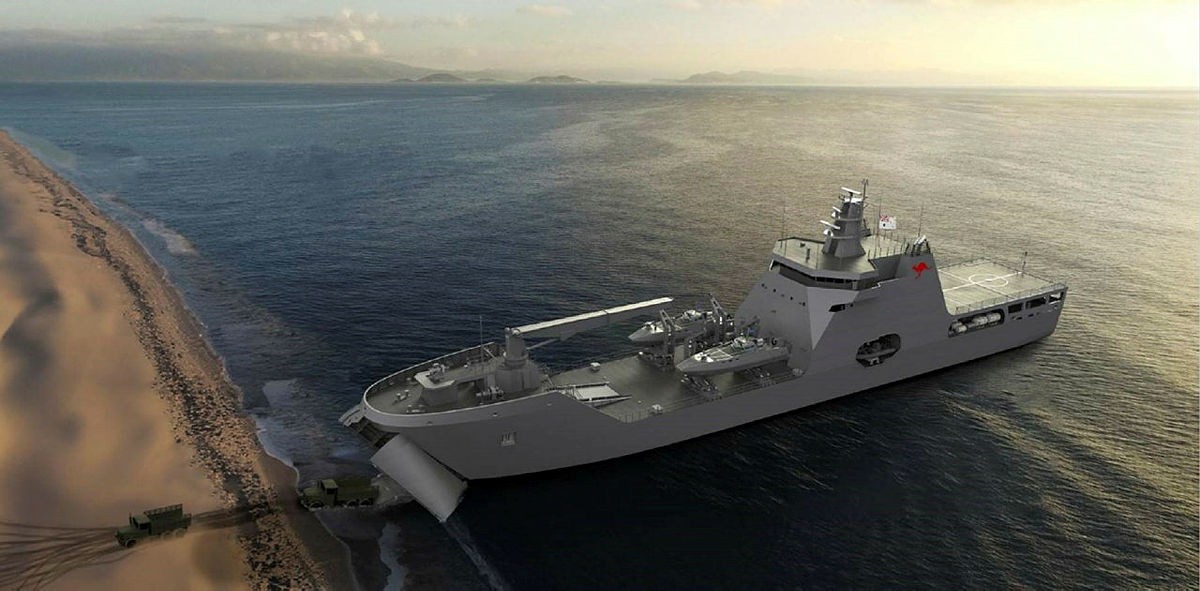
USMC Medium Landing Ship: Harbinger of Distributed Maritime Operations in the Indo-Pacific Peer Contest
The USMC's new LSM reflects a profound shift to distributed, agile operations under EABO and DMO doctrines to counter Chinese A2/AD. Beyond the Defense News report, this program exposes Navy readiness shortfalls, aligns with wargaming insights on dispersion, and highlights tensions with costly 'Golden Fleet' concepts—ultimately aiming to turn Pacific geography into a strategic advantage.
The U.S. Marine Corps' release of conceptual footage for its new Medium Landing Ship (LSM), based on Damen Shipyards' LST-100 design, marks far more than an incremental procurement decision. While the Defense News coverage accurately details the vessel's 100-meter length, 3,400-nautical-mile range, 800-ton beaching capacity, UAS flight deck, and role in intratheater logistics, it underplays the program's deeper doctrinal significance. This platform is the physical manifestation of the USMC's decade-long evolution toward Expeditionary Advanced Base Operations (EABO) and Distributed Maritime Operations (DMO), core components of Washington's strategy to impose calibrated deterrence across the Western Pacific against a peer adversary with formidable anti-access/area-denial (A2/AD) capabilities.
The original reporting correctly notes the LSM is 'not a traditional amphibious warfare ship designed for large-scale assault' but frames it too passively as a mere 'complementary asset.' What it misses is how this vessel directly operationalizes the findings of the USMC's Force Design 2030 and subsequent Force Design Annual Updates. These documents, informed by classified wargames run by the Center for Strategic and Budgetary Assessments (CSBA), demonstrated that legacy concentrated amphibious ready groups are highly vulnerable to Chinese DF-21D and DF-26 'carrier killer' missiles and PLA Navy submarine wolfpacks. The LSM instead enables 'stand-in forces'—small, dispersed Marine units equipped with long-range precision fires (HIMARS, NMESIS, Typhon systems) that can rapidly emplace, strike, and relocate across the first and second island chains.
Synthesizing this with a 2024 RAND Corporation study on 'Littoral Operations in Contested Environments' and a March 2025 CSIS report on 'Denial by Dispersion: Maritime Strategy for the Indo-Pacific,' the LSM addresses a critical gap the original story glosses over: the Navy's amphibious fleet readiness collapse. With 2025 GAO data showing only 42% of big-deck amphibs fully mission-capable due to chronic maintenance backlogs at Norfolk and San Diego shipyards, the service cannot sustain traditional massed landings. The McClung-class LSMs, by contrast, operate independently or in small packets, leveraging commercial-derived hulls for lower cost and faster production—precisely the 'affordable attritable' profile repeatedly advocated in classified Pacific Deterrence Initiative planning.
The story's mention of the 'Golden Fleet' and Trump-class battleships is particularly revealing. While the LSM is notionally tied to this high-profile initiative, deeper analysis exposes a strategic tension. CSIS analysts have correctly flagged that resurrecting battleship-scale surface combatants creates irresistible, expensive targets for Chinese saturation attacks. The LSM concept inverts this logic: smaller signatures, tactical dispersion, and the ability to beach and unload in austere locations turn geography (the Philippine Sea's thousands of atolls and islands) into a force multiplier. This mirrors MacArthur's WWII island-hopping but updated for the precision-missile era.
Crucially, the design's emphasis on unmanned aerial systems integration hints at convergence with the Pentagon's Replicator drone initiative. LSMs will likely serve as forward staging bases for attritable UAVs and USVs, extending Marine sensor and effector reach without requiring permanent infrastructure that China could pre-target. However, the coverage fails to address vulnerabilities: limited self-defense against hypersonic threats or maritime swarms, dependence on resilient logistics networks, and the industrial base's ability to scale production before 2030.
In the broader geopolitical context, this program signals Washington's acceptance that outright sea control against the PLA Navy may prove illusory in the opening phases of conflict. Instead, the U.S. is prioritizing sea denial from dispersed, temporary island outposts—precisely the 'porcupine strategy' refined through joint exercises with the Philippines, Japan, and Australia. The LSM is the connective tissue between the larger amphibious fleet operating from safer distances and the forward-deployed Marine littoral regiments already standing up in Okinawa and Guam. Its success or failure will likely determine whether U.S. deterrence in the Taiwan Strait remains credible through the 2030s.
SENTINEL: The LSM program will drive accelerated fielding of Marine littoral regiments across the first island chain by 2029, strengthening integrated deterrence with allies, but success hinges on solving escort shortages and hardening against PLA reconnaissance-strike networks that could preemptively target beaching operations.
Sources (3)
- [1]Primary Source(https://www.defensenews.com/news/your-military/2026/04/17/us-marine-corps-releases-video-showcasing-new-medium-landing-ship-design/)
- [2]CSIS: Deterrence by Dispersion in the Indo-Pacific(https://www.csis.org/analysis/deterrence-dispersion-indo-pacific)
- [3]RAND: Littoral Operations in Contested Environments(https://www.rand.org/pubs/research_reports/RRA1234-1.html)