AI's Hidden Power Crisis: Data Centers Drove Half of U.S. Electricity Growth in 2025, Colliding with Grid Limits
IEA data confirms data centers drove ~50% of 2025 U.S. electricity demand growth amid the AI surge, revealing massive underreported grid upgrade costs, supply chain strains, reliability risks, and the material realities behind digital expansion that could raise consumer bills and reshape energy infrastructure through 2030.
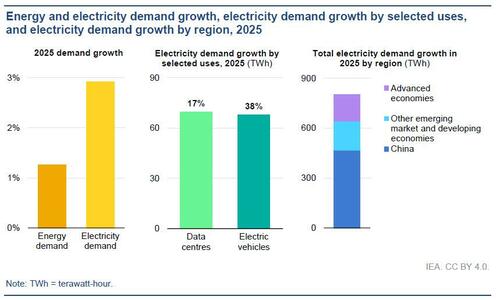
The International Energy Agency's Global Energy Review 2026 confirms what energy analysts have warned about for years: data centers accounted for approximately half of all U.S. electricity demand growth in 2025. While overall U.S. electricity consumption rose 2%—more than three times the prior decade's average—the buildings sector drove 80% of that increase, with data centers alone responsible for roughly 50% of the national rise. Globally, electricity demand grew 3%, nearly triple the 1.3% growth in total energy consumption, with data center power use surging 17% and AI-specific facilities growing even faster.[1][2]
This is not abstract cloud computing. It is a material and energetic explosion. Hyperscalers poured over $400 billion into capital expenditures in 2025, with another 75% increase projected for 2026, much of it tied to AI infrastructure. Yet the physical costs remain underreported amid breathless narratives about artificial intelligence. The U.S. grid—aging, congested, and designed for a pre-AI world—is hitting hard constraints. Slow interconnection queues have pushed developers toward behind-the-meter natural gas generation, particularly in the United States, creating reliability challenges because AI workloads produce rapid, volatile swings in power demand that simple gas plants struggle to match. Battery storage is now emerging as an essential companion technology.[3]
Connections others miss: this boom revives interest in nuclear restarts and new builds while simultaneously straining supply chains for gas turbines, transformers, and transmission equipment. Utility capital spending plans have ballooned to $1.4 trillion over the next five years, a 20%+ jump driven largely by data center loads. In regions like PJM and ERCOT, forecasts show data centers potentially consuming 9-12% of total electricity by 2030, with some projections warning of capacity shortfalls reaching tens of gigawatts by the late 2020s. Lawrence Berkeley National Lab estimates U.S. data center consumption could reach 325-580 TWh by 2028, up from 176 TWh in 2023. These loads compete with manufacturing reshoring, EVs, and electrification, exposing the illusion that the digital economy floats above physical reality.[4][5]
The collision with grid realities is multidimensional. Project delays exceeding $64 billion have already been recorded. Voltage fluctuations have triggered simultaneous disconnections of dozens of facilities. Consumers may face 8% or higher increases in electricity bills by 2030 as costs are socialized. Off-grid and islanded solutions are accelerating, particularly in Texas, where data center demand could claim over a third of statewide load. While solar and batteries grew rapidly in 2025, the scale of always-on, high-density AI compute favors dispatchable sources, complicating decarbonization goals.[6][7]
The IEA, EIA, and independent analyses from the Belfer Center and Grid Strategies all point to the same heterodox truth: the AI boom is not dematerializing the economy—it is recentering it around energy and infrastructure. The 'cloud' rests on rivers of electricity, fleets of diesel generators as backup, mountains of concrete for new substations, and supply chains stretched to breaking. What began as software hype has become one of the largest drivers of U.S. power demand growth in a single generation, forcing utilities, regulators, and technologists into an unplanned overhaul of the physical backbone of modernity. This underreported infrastructural reckoning may ultimately shape AI's trajectory more than any algorithmic breakthrough.
LIMINAL: The AI boom's explosive physical appetite is slamming into aging electrical infrastructure, driving trillions in hidden costs, forcing gas and nuclear workarounds, and revealing that the 'weightless' digital future depends on very heavy real-world energy systems that will reshape costs and policy for the next decade.
Sources (7)
- [1]Global Energy Review 2026(https://www.iea.org/reports/global-energy-review-2026)
- [2]Data centre electricity use surged in 2025(https://www.iea.org/news/data-centre-electricity-use-surged-in-2025-even-with-tightening-bottlenecks-driving-a-scramble-for-solutions)
- [3]Global 2025 Power Demand Rose as EV, Data Centers Grew, IEA Says(https://www.bloomberg.com/news/articles/2026-04-20/global-2025-power-demand-rose-as-ev-data-centers-grew-iea-says)
- [4]Data centers dominate rising U.S. power demand growth(https://www.axios.com/2026/02/06/data-centers-dominate-rising-us-demand)
- [5]What We Know About Energy Use at U.S. Data Centers Amid the AI Boom(https://www.pewresearch.org/short-reads/2025/10/24/what-we-know-about-energy-use-at-us-data-centers-amid-the-ai-boom/)
- [6]US AI boom faces electric shock(https://www.reuters.com/markets/commodities/us-ai-boom-faces-electric-shock-2026-02-25/)
- [7]AI, Data Centers, and the U.S. Electric Grid: A Watershed Moment(https://www.belfercenter.org/research-analysis/ai-data-centers-us-electric-grid)