BEA revises Q3 2026 GDP up to 4.3% as software and business investment lead the upgrade
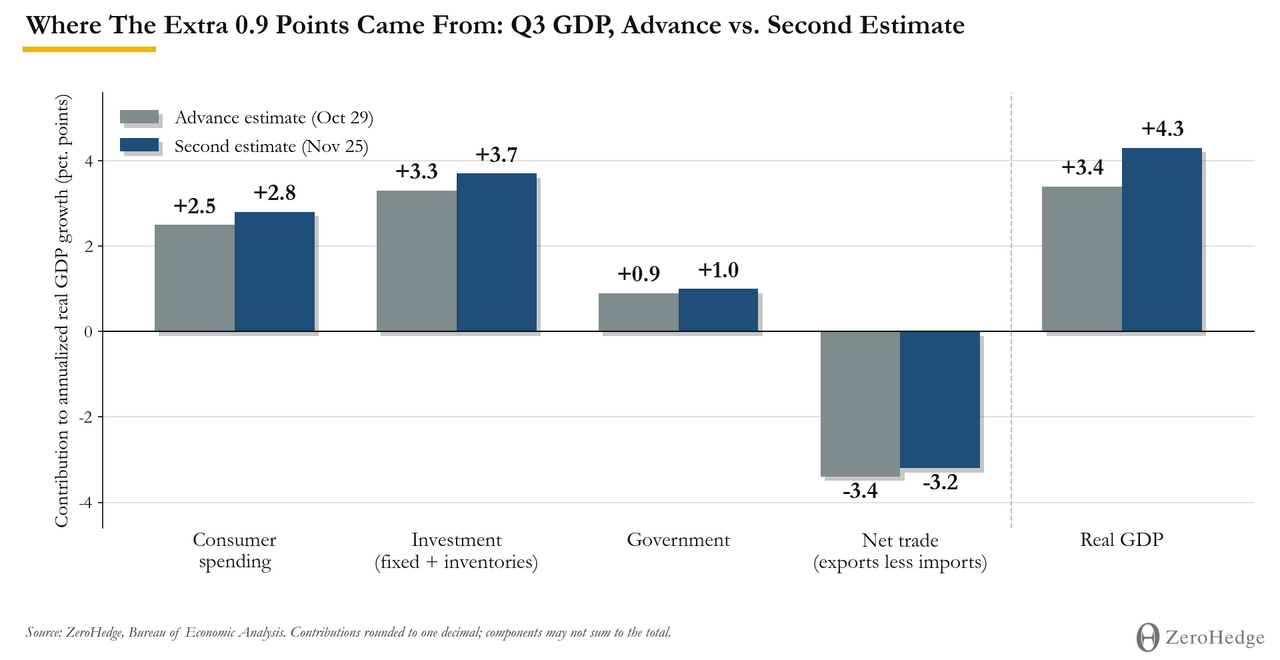
BEA’s second estimate put Q3 2026 real GDP at 4.3%, up 0.9 point, led by investment — especially software — and consumer spending. Economists tie much of the business-investment surge to AI capex, while a software price-index revision also lifted real growth on paper.
Documented: The Bureau of Economic Analysis, in its second estimate released November 25, 2026, reported that real GDP rose at a 4.3% annualized rate in the third quarter of 2026, up 0.9 percentage point from the 3.4% advance estimate. Growth in the second quarter was 2.2%. BEA said the quarter’s increase reflected investment, consumer spending, and government spending, partly offset by a drop in exports, while imports rose (a subtraction in GDP). The revision itself was led by investment and consumer spending. On investment, BEA said the upgrade was led by intellectual property products, notably software, based primarily on revisions to the Bureau of Labor Statistics producer price index for system and application software publishing. Consumer spending was revised up on goods, partly offset by a downward revision to services.
Also documented in the same release: real final sales to private domestic purchasers — consumer spending plus private fixed investment — rose 5.8%, revised up 0.9 point from 4.9%. Current-dollar GDP was revised to 6.2% from 5.6%, a smaller upgrade than the real figure. The price index for gross domestic purchases was revised down 0.3 point to 2.7%. The PCE price index (2.1%) and core PCE (2.5%) were unchanged from the advance estimate. Real gross domestic income rose 4.4%, and the average of GDP and GDI also rose 4.4%. Corporate profits from current production increased $206.0 billion, slower than the $384.0 billion increase in the second quarter.
Documented by contemporaneous reporting, not by a single BEA line item labeled “AI”: Reuters described the quarter as powered by robust consumer spending and business investment in artificial intelligence, with consumer spending revised to a 4.2% rate from 3.8% and equipment spending at a 21.8% rate (from 20.9%). TD Economics reported nonresidential business investment at 16.1% (from 12.7%), with equipment at 21.8%, intellectual property products at 13.6% (from 8.4%), and structures at 9.5% (from 5.4%), while residential investment fell 3.4%. TD said AI-related capital expenditure remained a key driver — data-center construction and related power infrastructure — but also said gains were not only an AI story, citing industrial and construction equipment and oil and gas infrastructure. MarketWatch treated the roughly 22% equipment pace as a proxy for AI-related investment and noted that a wider trade deficit was the main drag, with part of the import increase tied to the AI buildout. Reuters added that business investment had posted three straight quarters of double-digit growth, and that economists warned the pace could slow if investors scrutinize AI valuations. It also reported that households were saving less.
Claimed, not established by the official release: that AI accounts for a specific share of GDP growth (including a figure near two-thirds), that fixed investment posted its fastest quarter since the 2020 reopening in a way that can be read off a single BEA sentence, or that the print falsifies a “soft landing” narrative. Those are interpretations layered on the accounts. What the accounts do show is narrower and still consequential. A large part of the statistical surprise is real spending on equipment, software, and structures. A smaller, explicitly documented part is a price-index revision: a lower software PPI raises measured real software investment even if nominal outlays are unchanged. Housing remained a drag in the economist tallies. Trade subtracted. Income-side GDP (GDI) moved in the same direction as GDP this quarter, which reduces the chance that the expenditure print is a one-sided fluke, but profits growth cooled versus the prior quarter.
Speculated: that the investment surge will persist, that it is masking a broader stall that will show up once capex slows, or that cheaper measured software is mostly an accounting convenience. BEA does not forecast. The documented mechanism is only that software prices entered the revision, and that equipment and structures were also revised higher in outside readings of the same release. Concentration is the structural fact available now: domestic private demand looks strong in the aggregate (final sales to private domestic purchasers at 5.8%), while the investment leg is unusually tilted toward information-processing capital and the residential leg is not participating.
The official growth number households and markets are being shown is being lifted by business spending on software, equipment, and structures, while housing is still contracting and a software price revision mechanically raised real GDP. That mix changes how strong the quarter looks once AI-related capex is separated from broader demand.
Sources (4)
- [1]GDP (Second Estimate) and Corporate Profits, 3rd Quarter 2026 — U.S. Bureau of Economic Analysis(https://www.bea.gov/news/2026/gdp-second-estimate-and-corporate-profits-3rd-quarter-2026)
- [2]US third-quarter GDP growth revised sharply higher — Reuters(https://www.reuters.com/business/finance/us-third-quarter-gdp-growth-revised-sharply-higher-2026-11-25/)
- [3]Real GDP (Q3-2026, second estimate) — TD Economics(https://economics.td.com/us-real-gdp)
- [4]Third-quarter GDP already looked great. Now it looks even better. — MarketWatch via Morningstar(https://www.morningstar.com/news/marketwatch/20261125110/third-quarter-gdp-already-looked-great-now-it-looks-even-better)