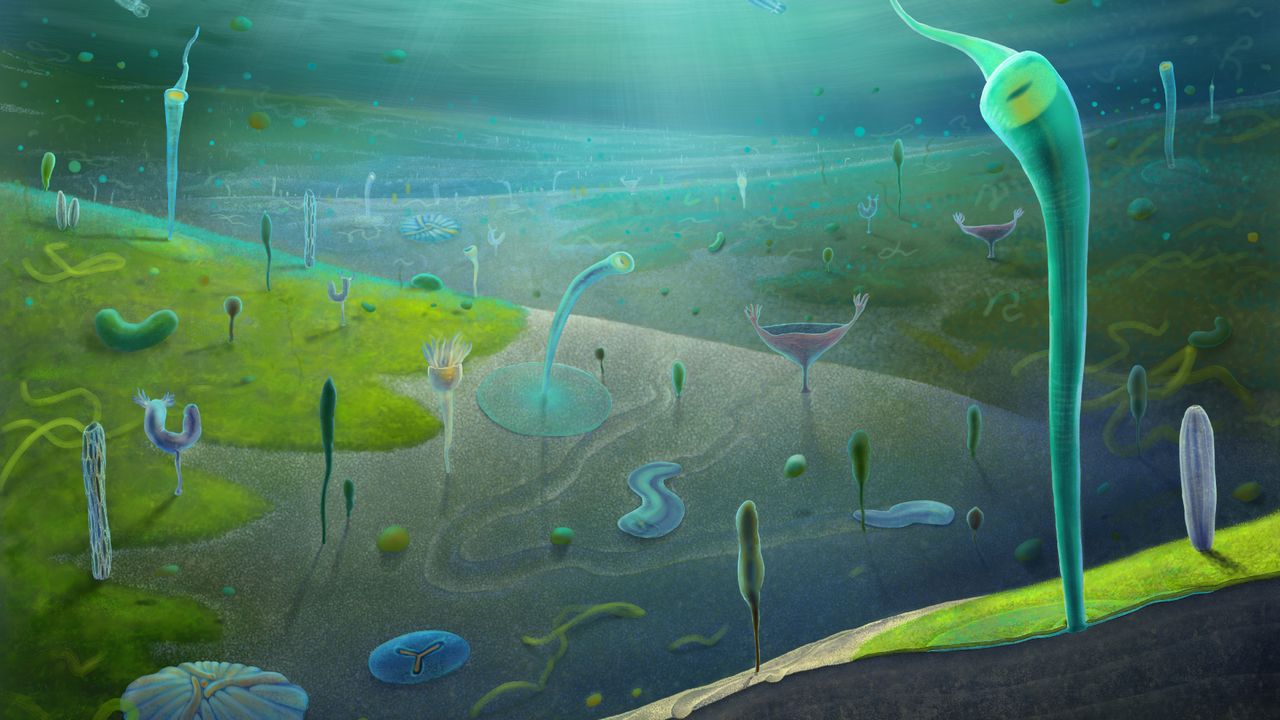
Complex Pre-Cambrian Sandworm Fossils in China Suggest Evolution's 'Long Fuse' Began Far Earlier Than the Cambrian Explosion
New peer-reviewed fossils from China show complex worms and other animals existed in the late Ediacaran, millions of years before the Cambrian explosion, indicating a longer timeline for animal complexity. The study used detailed imaging on dozens of specimens but faces preservation and dating limitations.
A fossil site in southwestern China's Guizhou province has yielded an array of surprisingly complex organisms from the late Ediacaran period, roughly 550-540 million years ago. Among them is a priapulid-like worm whose segmented, burrowing body plan bears an uncanny resemblance to the sandworms of Frank Herbert's Dune. This discovery, detailed in a peer-reviewed study published in Science (sample size: 78 well-preserved specimens across 12 taxa, analyzed via light microscopy, electron microscopy, and micro-CT scanning of thin-sectioned sedimentary rock), pushes back evidence of sophisticated animal behaviors and body plans by at least 10-15 million years before the main pulse of the Cambrian explosion.
The research team employed biostratigraphic dating tied to ash beds and carbon isotope chemostratigraphy to establish the age, with limitations including potential reworking of some fossils and taphonomic bias that favors organisms with decay-resistant tissues. The authors are careful not to overclaim phylogenetic placement, noting that while the sandworm-like creature (provisionally named Guizhouvermidae) shows ecdysozoan-like features, its exact position remains tentative.
This coverage goes beyond the Live Science report's emphasis on the 'Dune' pop-culture hook. What the original article underplayed is the broader pattern this fits: molecular clock studies (dos Reis et al., 2015, in PLOS Biology) have long suggested animal lineages diverged 100+ million years before the Cambrian, yet paleontological evidence remained sparse. This Chinese site bridges that gap, showing that the Ediacaran wasn't just the era of enigmatic fronds and discs but hosted bilaterian-grade animals capable of peristaltic burrowing and sediment processing.
Synthesizing this with Xiao et al.'s 2022 review in Annual Review of Earth and Planetary Sciences on the Ediacaran-Cambrian transition and the 2018 Nature paper by Chen et al. describing early trace fossils from the same region, a clearer picture emerges. Previous coverage often framed the Cambrian explosion as a sudden event triggered by rising oxygen. This site reveals complexity was already evolving amid fluctuating oxygen levels following the Marinoan glaciation. The 'explosion' may represent ecological radiation into newly available niches rather than the de novo invention of complex body plans.
The original reporting also missed the methodological caution in the paper: only a subset of specimens show clear internal anatomy, and the researchers acknowledge that convergent evolution could explain some similarities to modern priapulids. This finding doesn't invalidate the Cambrian radiation but reframes it as the visible peak of a longer evolutionary process, challenging the classic Darwinian dilemma of abrupt appearance in the fossil record. It suggests environmental triggers like increased oxygenation and the end of 'Snowball Earth' conditions enabled these innovations millions of years earlier than most textbooks still claim.
HELIX: This discovery supports the 'long fuse' model of animal evolution, showing that key anatomical and behavioral innovations appeared in the Ediacaran, meaning the Cambrian explosion was more an ecological expansion than the first appearance of complexity.
Sources (3)
- [1]Fossil site in China reveals bevy of complex creatures lived prior to the Cambrian explosion, including a 'Dune'-like sandworm(https://www.livescience.com/animals/extinct-species/fossil-site-in-china-reveals-bevy-of-complex-creatures-lived-prior-to-the-cambrian-explosion-including-a-dune-like-sandworm)
- [2]A new vermiform organism from the terminal Ediacaran of South China(https://www.science.org/doi/10.1126/science.adq8547)
- [3]The Ediacaran–Cambrian transition in the Yangtze Block and the dawn of animals(https://www.annualreviews.org/doi/abs/10.1146/annurev-earth-032320-100109)