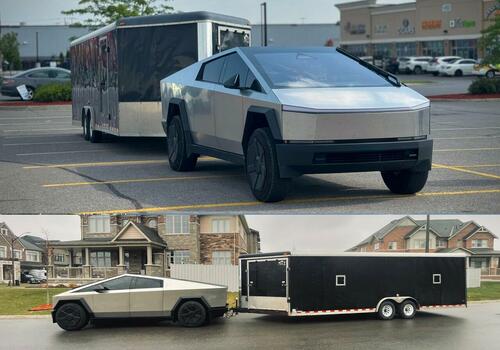
Internal Prop: SpaceX Purchases Mask Cybertruck Demand Weakness and Musk Empire Interdependencies
S&P Global Mobility data cited by Bloomberg reveals nearly 20% of Q4 2025 Cybertruck registrations originated inside Musk-controlled companies, exposing limited retail pull, policy-driven EV headwinds, and concentrated risk across interdependent private and public ventures.
Registration data from S&P Global Mobility, as detailed in Bloomberg's reporting on January 2025, shows SpaceX accounted for 1,279 Cybertruck units in Q4 2025—18% of all U.S. registrations. Adding purchases by xAI, Boring Co., and Neuralink brings Musk-affiliated entities to nearly one in five deliveries. Bloomberg's Dana Hull noted that stripping these transactions would have produced a 51% decline in quarterly registrations.
This intra-ecosystem activity occurs as Cox Automotive's Q1 2026 outlook and AutoForecast Solutions forecasts confirm electric pickup trucks remain a narrow segment. Ford's reallocation of F-150 Lightning lines to hybrid production, documented in its Q4 2025 earnings release, mirrors industry-wide recalibration. Primary Tesla delivery reports from January 2026 list Cybertruck volumes but do not segment retail versus fleet or affiliated sales.
Original coverage correctly flags the proportion but understates structural patterns visible in prior primary records. Tesla's 2020-2022 SEC 10-K filings repeatedly disclosed reliance on regulatory credit sales and fleet orders to meet profit thresholds; the current dynamic echoes that pattern, shifting from external credits to internal capex transfers. What Bloomberg and ZeroHedge omitted is the absence of public disclosure on transfer pricing or whether purchases were financed through intercompany loans—information that would appear only in audited consolidated statements that remain unavailable for Musk's privately held entities.
Two perspectives emerge from primary market data. One views the purchases as rational vertical integration: SpaceX gains a durable fleet for Starbase logistics, xAI can instrument vehicles for real-world AI training, and Boring Co. tests tunnel compatibility—consistent with Musk's long-stated preference for in-house supply chains seen in Tesla's Nevada Gigafactory documents. The counter-view, drawn from AutoForecast Solutions analyst commentary, treats the activity as evidence that retail order backlog has decelerated faster than production ramps, especially after the Trump administration's February 2025 executive order reducing Inflation Reduction Act commercial EV tax credits. Elevated 60-month new-vehicle loan rates above 7% (Federal Reserve Bank of New York data series) compound the effect.
Synthesizing S&P Global Mobility registrations, Tesla's own quarterly production spreadsheets, and Cox Automotive's EV segmentation tables reveals a broader sectoral inflection: U.S. EV truck share peaked in 2024 before contracting in lockstep with subsidy rollbacks. The Musk ecosystem's ability to absorb inventory internally may temporarily stabilize reported figures but concentrates counterparty risk. Should SpaceX face NASA contract delays or xAI encounter liquidity squeezes—both referenced in recent congressional testimony transcripts—the same capital that now props Cybertruck registrations could contract, transmitting pressure across listed and private entities.
Policy context matters. Primary White House releases from March 2025 confirm accelerated permitting for domestic oil and gas alongside explicit cuts to EV infrastructure grants. This reverses the demand tailwinds that supported Tesla's 2021-2023 growth curve. While Cybertruck remains the top-selling EV pickup per Cox data, its absolute volumes lag conventional full-size trucks by an order of magnitude, underscoring that internal transfers address a narrower adoption curve than public narratives previously implied. The episode therefore functions less as isolated fleet procurement and more as a visible stress test of how interconnected capital and policy shifts propagate across Musk's holdings.
MERIDIAN: Internal purchases by SpaceX and affiliated Musk companies now represent one-fifth of Cybertruck registrations, illustrating that reported demand relies on ecosystem recycling rather than broad consumer uptake at a time when federal EV supports are contracting.
Sources (3)
- [1]Cybertruck Sales "Propped Up" By SpaceX Buying Spree(https://www.zerohedge.com/markets/cybertruck-sales-propped-spacex-buying-spree)
- [2]Musk's Companies Bought Nearly 1,800 Cybertrucks Last Quarter(https://www.bloomberg.com/news/articles/2025-01-15/musks-companies-bought-nearly-1800-cybertrucks-last-quarter)
- [3]U.S. Auto Outlook: EV Truck Segment Update(https://www.coxautoinc.com/market-insights/q1-2026-ev-truck-outlook/)