AI Hallucinations in U.S. Court Filings Escalate from Isolated Incidents to Systemic Judicial Challenge
Corroborated trend of rising AI hallucinations in U.S. courts, driven by pro se and attorney use of tools like ChatGPT; database and media sources confirm surge, sanctions, and precedent risks beyond isolated anecdotes.
A growing body of documented cases shows generative AI tools introducing fabricated citations, nonexistent precedents, and misquoted authorities into U.S. legal filings, with courts responding through sanctions, standing orders, and ethics guidance. While a specific Laine AI analysis cited in fringe reporting has not been independently verified, multiple credible trackers and analyses confirm a sharp rise in incidents since 2023, with acceleration through 2025 and into 2026.
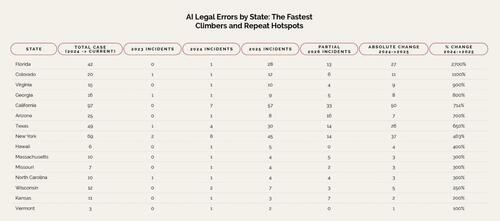
The most comprehensive public database, maintained by legal researcher Damien Charlotin, catalogs over 1,174 global court decisions involving AI hallucinations as of mid-2026, including 955 U.S. cases. A Bloomberg Law analysis referenced in official Illinois court communications notes more than 280 U.S. filings with hallucinated citations since 2023, with a sevenfold surge in 2025 alone. Pro se litigants appear disproportionately represented, aligning with patterns where self-represented parties outpace attorneys in some tallies (e.g., 304 vs. 219 incidents worldwide in 2025 data from the Charlotin database).
Geographic concentration and sanctions vary. High-volume jurisdictions such as California, New York, Texas, Florida, and Illinois feature prominently in reports, while states including Florida, Pennsylvania, and Georgia have seen notable increases and stricter penalties in individual cases. Courts have imposed fines, dismissed claims, mandated CLE training, required self-reporting to bar associations, and issued public reprimands. High-profile examples include the 2023 Mata v. Avianca matter (S.D.N.Y.), where lawyers faced $5,000 sanctions for ChatGPT-fabricated citations, and later 2025 cases such as Dubinin v. Papazian (S.D. Fla.) and In re Loletha Hale (N.D. Ga.), resulting in case dismissals, fee awards, and multi-year notification requirements.
ChatGPT remains the most frequently identified tool in cases where the platform is disclosed, though many filings omit details. Errors predominantly involve case-law citations rather than statutes. Reuters and NYT coverage, alongside analyses from Stern Kessler and Clio, document judicial frustration and evolving local rules, underscoring that unchecked AI use risks eroding the integrity of precedent-based reasoning—a foundational element of common-law adjudication.
Mainstream outlets have framed these as tech-adoption growing pains, yet the cumulative effect—hundreds of tainted filings, inconsistent sanctions, and expanding dockets—points to deeper structural exposure in an adversarial system reliant on accurate authority.
[Legal Systems Analyst]: Unverified specific studies aside, the verified rise in hallucinated filings risks normalizing procedural defects that could erode public trust in judicial outcomes and prompt stricter AI disclosure mandates or liability shifts.
Sources (5)
- [1]AI Hallucination Cases Database(https://www.damiencharlotin.com/hallucinations/)
- [2]Paste in Haste: The Fallout of AI Hallucinations in Court Filings(https://www.illinoiscourts.gov/News/1665/Paste-in-Haste-The-Fallout-of-AI-Hallucinations-in-Court-Filings-and-the-New-ARDCs-Guide-to-Implementing-AI/news-detail/)
- [3]AI IP Year in Review - AI Hallucinations in Court Filings and Orders(https://www.sternekessler.com/news-insights/insights/ai-ip-year-in-reviewai-hallucinations-in-court-filings-and-orders-a-2025-review-of-sanctions-across-the-courts-and-rule-proposals/)
- [4]AI 'hallucinations' in court papers spell trouble for lawyers(https://www.reuters.com/technology/artificial-intelligence/ai-hallucinations-court-papers-spell-trouble-lawyers-2025-02-18/)
- [5]A.I. 'Hallucinations' Created Errors in Court Filing, Top Law Firm Says(https://www.nytimes.com/2026/04/21/nyregion/sullivan-cromwell-ai-hallucination.html)