Chinese Cars at the Gate: Tariffs, Proximity, and the Limits of Technological Decoupling
U.S. efforts to ban or tariff Chinese vehicles are undermined by their rapid expansion in Mexico, where affordable BYD, Geely, and other models are sold near the border and purchased by Americans. This exposes ironies in economic security policy, national security risks from connected cars, technological dependency on Chinese supply chains, and the challenges of geopolitical decoupling in a globalized auto industry.
The U.S. push to restrict Chinese-made vehicles, particularly EVs, through steep tariffs and national security measures faces an ironic reality: these cars are already within easy reach of American consumers. Just south of the border in Mexican cities like Ciudad Juárez, dealerships for BYD, Geely, and Great Wall Motor sell feature-packed electric and hybrid models starting as low as $17,000–$20,000—often half the price of comparable U.S. new cars. Americans near the border cross over to test drive, purchase, and register them, with some vehicles appearing on U.S. roads through personal imports and cross-border use, according to a detailed Wall Street Journal investigation.[1][2]
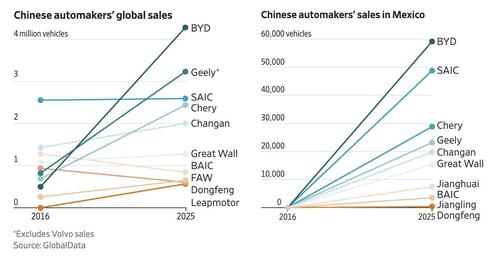
This market penetration in Mexico, where Chinese brands now command roughly 25% of sales, underscores deeper vulnerabilities in U.S. economic security strategy. While Washington has imposed 100% tariffs on Chinese EVs and pushed Mexico to raise its own tariffs to 50% in 2026 under pressure, Chinese automakers are adapting by bidding on existing Mexican plants (including a Nissan-Mercedes facility) and expanding dealership networks. Mexico initially welcomed this investment for its EV growth but has cooled on new Chinese factories post-Trump election signals, illustrating how trade wars ripple through North American supply chains under the USMCA framework.[3][4]
Beyond economics, national security concerns loom large. Connected vehicles from Chinese firms could transmit location data, camera feeds, and telemetry back to Beijing, potentially mapping U.S. infrastructure, military sites, or personal movements—parallels repeatedly drawn by lawmakers to risks from Huawei and TikTok. Democratic representatives, including Rep. Debbie Dingell, have urged prohibitions on Chinese-owned vehicles from Mexico or Canada entering the U.S., citing threats to manufacturing, jobs, and data sovereignty. A CFR analysis highlights how these imports test U.S. strategy, as tariffs alone fail to address circumvention via third-country assembly.[5][6]
The situation reveals connections often missed in mainstream trade coverage: America's technological dependency on China for EV batteries, rare earth minerals, and advanced manufacturing has created a structural irony. Decades of offshoring left domestic automakers struggling with high prices and slower innovation, while Chinese firms leverage scale, subsidies, and speed-to-market. U.S. consumers priced out of new vehicles (median prices exceeding $40,000) naturally gravitate toward affordable alternatives visible at the border, accelerating cultural acceptance of Chinese tech even as policy erects barriers. This mirrors broader geopolitical patterns—solar panels, semiconductors, and drones—where attempts at decoupling expose how globalized supply chains resist containment. Tariffs may protect legacy industries short-term but risk slowing America's own EV transition and ceding Latin American markets entirely. As Chinese global sales surge (BYD alone exceeding 4 million vehicles annually), the "ban" narrative increasingly looks like a rear-guard action against inevitable diffusion of affordable, high-tech mobility. The real exposure is not just cars at the gate, but a dependency that trade wars cannot fully reverse without massive domestic reinvestment.
[Liminal Analyst]: US tariff walls and security reviews at the Mexican border reveal how market proximity and pricing superiority can bypass decoupling efforts, accelerating American exposure to Chinese EV tech and highlighting irreplaceable dependencies in critical supply chains that rivalries cannot easily untangle.
Sources (5)
- [1]The U.S. Wants to Ban China’s High-Tech Cars, but They’re Already Here in El Paso(https://www.wsj.com/business/autos/chinese-cars-byd-geely-u-s-mexico-be0dea28)
- [2]Mexico, Canada's Chinese EV Imports Test U.S. Auto Strategy(https://www.cfr.org/articles/what-canadian-and-mexican-ev-imports-from-china-mean-for-the-united-states)
- [3]Prospect of low-priced Chinese EVs reaching US from Mexico poses threat to automakers(https://www.ap.org/news-highlights/spotlights/2024/prospect-of-low-priced-chinese-evs-reaching-us-from-mexico-poses-threat-to-automakers/)
- [4]Biden's Chinese EV tariffs don't address national security concerns(https://www.cbsnews.com/news/bidens-chinese-ev-tariffs-dont-address-lingering-national-security-concerns/)
- [5]House Lawmakers Urge Trump to Prohibit China's Automakers From Building Cars in the U.S.(https://www.wsj.com/business/autos/house-lawmakers-urge-trump-to-prohibit-chinas-automakers-from-building-cars-in-the-u-s-a4b2fb8f)