Berkshire Hathaway's $397 Billion Cash Pile: A Signal of Market Caution Amid Economic Uncertainty
Berkshire Hathaway’s record $397 billion cash reserve after significant stock sales in Q1 signals market caution under new CEO Greg Abel. Amid economic uncertainty and declining consumer confidence, this move may reflect anticipation of a correction and could influence broader investor sentiment, contrasting with market euphoria over tech sectors.
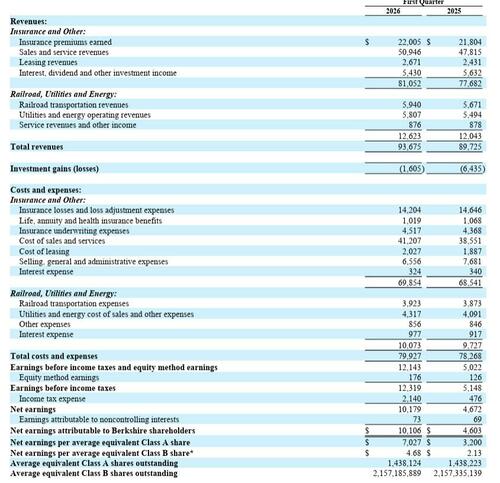
Berkshire Hathaway, under the new leadership of Greg Abel, has amassed a record-breaking $397 billion in cash reserves following aggressive stock sales in Q1, marking the largest divestment since mid-2024. This move, detailed in the company’s latest earnings report, reflects a cautious stance amid economic uncertainty, as several of Berkshire’s consumer-oriented businesses like Clayton Homes and Fruit of the Loom reported revenue declines due to weakened consumer confidence. While operating profit rose 18% to $11.35 billion, driven by strong underwriting results in its insurance sector (up 29% to $1.7 billion), challenges persist, particularly with Geico’s 35% drop in pretax underwriting earnings due to increased claims and marketing costs. Beyond these figures, Berkshire’s strategy under Abel appears to signal a broader wariness about overvalued markets and looming economic risks, a perspective rooted in the conglomerate’s value-oriented investment philosophy originally shaped by Warren Buffett.
What the original coverage missed is the deeper implication of Berkshire’s cash hoarding and stock sales as a potential bellwether for market sentiment. Historically, Berkshire has increased cash reserves during periods of perceived overvaluation, as seen before the 2008 financial crisis when Buffett held significant liquidity to capitalize on distressed assets. Today’s $397 billion war chest—equivalent to roughly 5% of the U.S. M2 money supply—could indicate Abel’s anticipation of a market correction or recessionary pressures, especially as consumer spending weakens and inflation persists. This also contrasts with the broader market’s AI-driven euphoria, which Berkshire has notably sidestepped, underscoring a disconnect between its hard-asset focus and tech-heavy indices like the S&P 500.
Contextually, this move aligns with patterns of institutional caution observed in other major investors. For instance, recent Federal Reserve minutes from March 2025 indicate growing concern among policymakers about persistent inflation and softening labor markets, which could exacerbate the economic uncertainty Berkshire’s portfolio reflects. Additionally, the International Monetary Fund’s April 2025 World Economic Outlook warns of global growth slowdowns due to geopolitical tensions and tightening monetary policies, factors that may be influencing Abel’s conservative positioning. These external pressures, combined with internal challenges like Geico’s underperformance compared to competitors such as Progressive, suggest Berkshire is bracing for turbulence while maintaining flexibility for opportunistic acquisitions.
What’s also underexplored is the potential ripple effect on investor sentiment. Berkshire’s actions often serve as a signal to the market, and this cash accumulation could prompt other institutional investors to adopt defensive strategies, potentially accelerating a shift away from risk assets. However, critics might argue that Berkshire’s cash-heavy approach risks missing out on growth opportunities in a market still buoyed by sectors like technology, where valuations remain high but innovation drives returns. This tension between caution and opportunity underscores a pivotal moment for Abel as he navigates Buffett’s legacy in a rapidly evolving economic landscape.
Synthesizing these insights with primary sources, Berkshire’s Q1 earnings report confirms the cash pile and divestitures, while the Federal Reserve’s minutes provide a macroeconomic backdrop of uncertainty. The IMF report adds a global dimension, highlighting risks that could justify Berkshire’s stance. Together, these sources frame a narrative of strategic caution that goes beyond mere financial conservatism, positioning Berkshire as a potential harbinger of broader market shifts.
MERIDIAN: Berkshire’s massive cash reserve may foreshadow a market downturn as Abel positions for flexibility. If economic indicators worsen, expect Berkshire to leverage this liquidity for distressed asset acquisitions.
Sources (3)
- [1]Berkshire Hathaway Q1 2025 Earnings Report(https://www.berkshirehathaway.com/reports.html)
- [2]Federal Reserve Minutes, March 2025(https://www.federalreserve.gov/monetarypolicy/fomcminutes202503.htm)
- [3]IMF World Economic Outlook, April 2025(https://www.imf.org/en/Publications/WEO/Issues/2025/04)